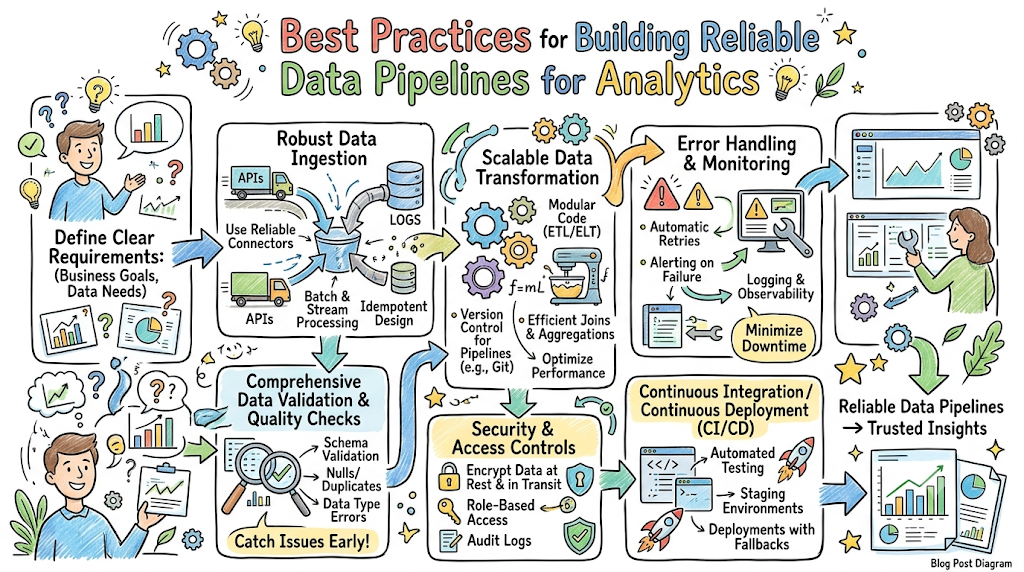
The data engineering team blames a modified upstream API schema, while the analytics team scrambles to fix a broken SQL script. DataOps provides a practical framework designed to resolve this exact friction. In simple terms, DataOps applies agile development, continuous integration, and automated statistical process controls to the domain of data operations. It creates a collaborative environment where data engineers, data analysts, and data scientists can work together harmoniously. By automating testing, deployment, and data quality tracking, DataOps removes the traditional bottlenecks that slow down reporting and business intelligence initiatives. In this comprehensive guide, you will learn the core architecture of DataOps, the operational principles that make it successful, and how it transforms daily workflows. We will explore the tools that power modern pipelines, common implementation mistakes to avoid, and a clear path toward building a career in this growing discipline. If you are ready to master these operational workflows and elevate your team’s analytical capability, explore the specialized learning pathways available at DataOpsSchool to start your practical transformation journey.
The Evolution of Data Engineering and Analytics
Traditional Separation Between Data Teams
Historically, data departments operated in distinct silos with minimal direct communication. Data engineers sat deep within the IT infrastructure, focused primarily on server maintenance, database storage, and rigid nightly batch extraction jobs.
Analysts worked on the business side, focusing on spreadsheets, local reporting tools, and business intelligence suites. This traditional separation created a transactional relationship between the two teams.
Analysts submitted a support ticket requesting a new column or a new data source, and engineers processed the request weeks later based on IT queues. Because neither team fully understood the daily operational context of the other, errors frequently passed through pipelines undetected.
The Growing Need for Faster Data Delivery
As businesses transitioned into digital-first operational models, the demand for trusted insights changed from monthly reports to near real-time operational feedback loops. Marketing managers need to know how an active campaign performs this morning, not next Tuesday.
Supply chain operators need automated alerts when inventory levels fluctuate unexpectedly. This growing need for speed put massive pressure on traditional data collection structures.
When data delivery lags behind business decision-making, the value of the analytics drops significantly. Organizations quickly realized that moving data quickly means nothing if the underlying pipeline constantly breaks under the weight of changing source schemas.
The Emergence of DataOps
To address these compounding operational delays, forward-thinking organizations looked toward the software development world for inspiration. Just as DevOps broke down the barriers between software engineers and IT operations teams, DataOps emerged to bridge the gap between data engineers and business analytics functions.
DataOps is not just a collection of software applications; it is an operational model that treats data pipelines as production-ready software products. It combines automated testing, continuous deployment, and proactive quality monitoring to ensure a continuous flow of validated info from source to dashboard.
Understanding DataOps as a Connecting Framework
The Core Architecture of DataOps
The operational structure of DataOps relies on five foundational pillars working together to create a reliable production environment.
- Pipelines: The core movement pathways that ingest data from source environments, apply necessary structural transformations, and load the results into cloud data warehouses.
- Automation: The elimination of manual file movements, manual server configurations, and ad-hoc script execution through scheduled, code-driven workflows.
- Observability: Continuous, end-to-end visibility into the health, performance, volume, and freshness of data throughout the entire data lifecycle.
- Governance: The structured policies that manage data security, user access controls, regulatory compliance, and data lineage documentation automatically.
- Collaboration: Integrated communication channels and shared code repositories that allow data engineers and analytics teams to build together.
Daily Workflows Enabled by DataOps
In an enterprise environment utilizing DataOps, a typical day looks vastly different from a traditional data setting. When an application developer changes a database column name in the primary e-commerce system, an automated validation test triggers instantly within the data ingestion pipeline.
Instead of breaking a critical revenue dashboard, the DataOps framework flags the schema divergence, routes an alert to the engineering team, and pauses the affected transformation segment while keeping the rest of the system operational.
Analysts continue working with verified data, fully aware of the pending upstream adjustment through integrated status notifications.
Data Engineering vs. Analytics vs. DataOps
Understanding how these roles interact helps clarify the structure of a modern data department. Data engineers focus primarily on infrastructure architecture, raw data ingestion, storage optimization, and system uptime.
Analytics professionals focus on business logic interpretation, metric definitions, dashboard design, and trend discovery.
DataOps professionals focus on the connective tissue. They design the deployment pipelines, build automated testing suites, maintain observability platforms, and optimize the operational workflows that allow engineers and analysts to deliver business value safely and reliably.
The Collaborative Data Culture Mindset
Shifting toward a DataOps model requires breaking down long-standing cultural silos across departments. It encourages a shared-responsibility model where data quality becomes everyone’s priority rather than just an engineering burden.
When analysts understand pipeline constraints and engineers understand downstream business goals, teamwork improves naturally. This cultural alignment changes the data team from a reactive cost center into a proactive business asset.
The 7 Core Principles of DataOps
1. Continuous Data Integration
Continuous data integration focuses on the automated movement, transformation, and validation of information as it flows into your ecosystem. Instead of relying on massive, high-risk batch updates at the end of the week, information moves through smaller, frequent automation cycles.
This approach minimizes processing spikes and ensures that downstream environments remain constantly updated with minimal human intervention.
2. Data Quality and Validation
You cannot build trustworthy analytics outputs on top of unverified data. DataOps embeds automated validation checks directly into every stage of the pipeline lifecycle.
These tests check for missing values, unexpected null fields, out-of-bounds metrics, and schema mutations before the information ever reaches a production reporting system. If a data quality test fails, the system handles the failure predictably according to predefined operational rules.
3. Automation Across the Data Lifecycle
Manual steps introduce human error and create operational bottlenecks. DataOps prioritizes code-driven automation across everything from infrastructure provisioning and code deployments to error alerting and report generation.
By reducing manual intervention, organizations ensure that every pipeline step runs exactly the same way every single time, regardless of which team member triggers the workflow.
4. Observability and Monitoring
Proactive visibility separates mature data operations from chaotic environments. DataOps implementations leverage continuous monitoring to track the operational health of pipelines, data warehouses, and semantic models.
Team members receive immediate alerts regarding latency spikes, volumetric anomalies, or failing transformation code, allowing them to fix underlying problems before business stakeholders notice an issue on a dashboard.
5. Collaboration Between Teams
DataOps builds clear communication bridges directly into the technical workflow. Engineers and analysts share unified code repositories, utilize standardized documentation practices, and collaborate within common communication channels.
This cross-functional approach ensures that business requirements match up perfectly with technical pipeline architectures from the very start of a development project.
6. Governance and Compliance
Modern data management requires strict adherence to privacy laws, security standards, and corporate accountability rules. A sound DataOps framework builds governance directly into the automated delivery process.
Access permissions, data masking rules, and end-to-end lineage tracking update automatically whenever code moves to production, ensuring continuous compliance without slowing down development speeds.
7. Continuous Improvement
DataOps embraces an iterative approach to operational optimization. Teams regularly review system performance logs, track pipeline failure frequencies, and analyze team velocity metrics.
By identifying specific bottlenecks during every production release, data organizations can systematically refine their workflows, optimize query performance, and lower cloud compute costs over time.
Key DataOps Concepts Every Beginner Must Know
DataOps vs. Data Engineering vs. Analytics — Explained Simply
To keep these concepts clear, let us look at how they break down in practice:
- Data Engineering: Focuses on building the physical roads, bridges, and infrastructure needed to transport raw information from source databases to data lakes.
- Analytics: Focuses on driving the cars across those bridges to gather insights, build visualizations, and answer specific business questions for leadership.
- DataOps: Focuses on installing the traffic lights, automated speed cameras, road maintenance schedules, and safety barriers to keep everything running smoothly.
ETL and ELT Pipelines
Modern data movement architectures generally follow one of two paths: Extract-Transform-Load (ETL) or Extract-Load-Transform (ELT). Traditional ETL extracts data from sources, transforms it on a dedicated processing server, and then loads it into a target system.
Modern cloud architectures prefer ELT, where raw information moves directly into a powerful cloud data warehouse first, allowing transformation work to happen directly within the target environment using scalable cloud compute resources.
Data Quality and Reliability
In simple terms, data quality measures how well a dataset satisfies the practical needs of the business. Reliability ensures that this quality remains consistent day after day.
DataOps maintains this trust by applying statistical process controls to tracking metrics, validating that incoming information conforms to expected structural shapes before it reaches business intelligence dashboards.
Data Observability and Monitoring
While monitoring tells you when a specific job fails, data observability helps you understand why it failed by analyzing system inputs, internal states, and environmental outputs.
Observability tracks data freshness, volume anomalies, schema mutations, lineage tracking, and system performance metrics to provide a complete picture of ecosystem health.
Analytics Enablement
Analytics enablement means removing the operational friction that prevents analysts from doing their best work.
By providing clean, pre-validated, and well-documented data models, DataOps allows analytics teams to spend their time discovering deep insights and building predictive dashboards rather than cleaning dirty data files manually.
The Four Pillars of Successful DataOps
Building a sustainable operation requires equal attention to four fundamental pillars:
┌────────────────────────────────────────────────────────┐
│                      DATAOPS                           │
├─────────────┬───────────────┬──────────────┬───────────┤
│ AUTOMATION  │ COLLABORATION │   QUALITY    │ OBSERV-   │
│             │               │              │ ABILITY   │
└─────────────┴───────────────┴──────────────┴───────────┘
- Automation: Orchestrating workflows to run without human intervention.
- Collaboration: Aligning engineers and analysts through shared processes.
- Quality: Ensuring accurate numbers through continuous automated testing.
- Observability: Maintaining absolute visibility into pipeline operations.
Traditional Data Workflows vs. DataOps — What’s the Real Difference?
The Philosophy Difference
Traditional data operations focus primarily on project-based delivery milestones, where teams build complex systems in isolation and pass them over the wall to another department.
DataOps shifts this philosophy toward continuous, product-centric product delivery. Data is treated as an active, evolving software product that requires ongoing lifecycle support, automated validation, and regular incremental updates based on direct user feedback.
Roles & Responsibilities Compared
To understand how work shifts under this framework, let us look at how individual responsibilities align:
- Data Engineer: Moves away from manual database maintenance; focuses on infrastructure-as-code, pipeline development, and core ingestion scalability.
- Data Analyst: Moves away from data cleaning and verification tasks; focuses on semantic modeling, business logic definition, and deep explanatory analysis.
- DataOps Specialist: Focuses on workflow orchestration design, continuous integration pipeline maintenance, observability system configuration, and automated testing deployments.
Can DataOps Coexist with Existing Data Teams?
A common misconception is that implementing DataOps requires firing your current staff and rebuilding your department from scratch. In reality, DataOps integrates into your existing organizational structure.
It upgrades the methodologies your current teams use by introducing automation tools, Git-based version control workflows, and structured communication loops that help your current data engineers and analysts work more efficiently together.
Which Organizations Benefit Most from DataOps?
While small startups with a single data analyst can manage with ad-hoc scripts, organizations facing specific scale indicators need DataOps immediately.
If your company manages multiple disparate cloud data platforms, maintains hundreds of business dashboards, experiences frequent reporting inaccuracies, or spends more time fixing broken data pipelines than building new features, implementing a DataOps strategy becomes critical to your survival.
Real-World Use Cases of DataOps
Accelerating Business Intelligence Projects
Imagine building reliable dashboards without waiting weeks for data fixes. A multinational retail company struggled with a multi-week delay whenever marketing requested updates to their seasonal performance reports.
By implementing an automated DataOps workflow using dbt and version-controlled repositories, analysts began writing their own transformation models safely. Automated testing validated the code changes instantly, cutting the deployment cycle for new reporting metrics from twenty days down to fifteen minutes.
Improving Data Pipeline Reliability
A financial services firm faced constant challenges with volatile upstream transactional data that regularly crashed their night-shift data warehouse ingestion runs.
By installing an automated monitoring framework with proactive volume anomaly alerts, the engineering team started catching unexpected schema alterations the moment they hit the cloud storage bucket. The system isolated the problematic files automatically, allowing the main ingestion runs to complete successfully and keeping executive dashboards fully accurate for morning market openings.
Supporting Data-Driven Decision Making
When an enterprise healthcare company migrated its operational systems, leadership needed absolute certainty that patient analytics reports remained perfectly accurate across platforms.
The implementation of continuous data validation checks ensured that every records migration batch matched up perfectly against source schemas down to the individual record row count. This high level of structural verification gave executives total confidence to make critical resource allocation choices based on the resulting analytical trends.
Scaling Cloud Data Platforms
This becomes critical when data teams scale across departments. A logistics corporation expanding its operations across multiple continents needed to scale its modern cloud data infrastructure without hiring an army of infrastructure engineers.
By adopting infrastructure-as-code principles within a DataOps framework, they automated the deployment of localized warehouse environments, unified access governance rules, and standardized data quality checks across five separate regional business units simultaneously.
DataOps for Startups and Growing Businesses
Growing businesses must remain lean while scaling their analytics capabilities quickly. A fast-growing software startup used a simplified DataOps framework to manage their initial product tracking metrics.
By setting up basic automated testing on their core event ingestion pipelines from day one, they avoided accumulating massive technical debt, allowing their small team to scale reporting capabilities efficiently as user transaction volumes grew exponentially.
Common Mistakes Organizations Make When Adopting DataOps
Mistake 1 — Treating DataOps as Just Another Tool
Purchasing an enterprise software license does not instantly fix a broken operational model. Many organizations purchase expensive pipeline orchestration platforms expecting their data quality issues to vanish overnight, only to discover that their staff continues to write unverified code in silos.
DataOps succeeds only when you prioritize cultural alignment, process redesign, and specialized team training alongside tool selection.
Mistake 2 — Ignoring Data Quality Early
Building complex automation networks without embedding validation steps at the point of ingestion creates an efficient highway for delivering garbage information directly to your executives.
When you ignore quality tracking early in your implementation journey, you end up discovering errors only after they have corrupted downstream analytical models, forcing your team to waste valuable hours performing manual database rollbacks and historical data cleanups.
Mistake 3 — Failing to Align Engineering and Analytics Teams
If your engineering department implements a DataOps framework without involving your analytics practitioners, you simply create a highly optimized silo.
Engineers will continue to deliver technical structures that may not map accurately to real-world business requirements. True operational optimization requires both groups to build the deployment pipeline, test parameters, and data documentation models collaboratively.
Mistake 4 — Overlooking Monitoring and Observability
Operating a modern data network without automated observability solutions is like flying an airplane without an instrument panel. You have no idea something is wrong until you crash into an operational obstacle.
Failing to invest in proactive freshness tracking and volumetric anomaly detection leaves your data team in a permanently reactive state, constantly dependent on angry Slack messages from stakeholders to discover broken systems.
Mistake 5 — Avoiding Automation Investments
Relying on manual file uploads, ad-hoc terminal scripts, and tribal knowledge because “it is faster than writing automation code” severely limits your organizational scalability.
While manual work might save an hour today, it introduces long-term operational fragility. Every manual process step represents a hidden point of failure that will eventually break when key team members take a vacation or leave the company.
Mistake 6 — Neglecting Governance and Compliance
In the rush to deliver analytics updates quickly, teams sometimes bypass security parameters, hardcode access passwords into development scripts, or neglect data lineage documentation.
This operational carelessness creates massive regulatory liabilities and exposes your company to severe data security breaches. Effective DataOps architectures embed compliance checkpoints directly into the deployment process, ensuring speed never comes at the expense of safety.
Essential Tools & Technologies Supporting DataOps
Pipeline Orchestration Platforms
Modern workflow orchestration requires moving beyond basic cron jobs toward flexible, code-driven management tools. Apache Airflow stands out as an industry standard, allowing engineering teams to author, schedule, and monitor complex data pipelines as directed acyclic graphs (DAGs) written completely in Python.
This programmatic approach allows teams to build dynamic pipeline logic, handle complex dependency flows, and manage error recovery scenarios predictably at scale.
Data Transformation Technologies
Once raw data sits inside a cloud environment, dbt (data build tool) provides a clean framework for the transformation layer. It allows anyone who knows basic SQL to write modular, production-grade transformation models, manage code version control, and auto-generate interactive lineage documentation.
By treating SQL transformation scripts as software code, dbt allows analytics teams to run automated testing sequences directly against their data models before deploying updates to production tables.
Data Warehousing Platforms
Modern analytical workloads require highly scalable, cloud-native storage foundations like Snowflake and Databricks. Snowflake offers completely independent scaling of compute and storage resources, allowing multiple business units to query the same underlying datasets simultaneously without degrading performance.
Databricks combines lakehouse architectures with unified engine capabilities, allowing teams to run advanced machine learning scripts and standard business intelligence transformations within a single data environment.
Data Quality and Observability Solutions
Maintaining absolute trust across your data ecosystem requires dedicated verification tools like Great Expectations and Monte Carlo. Great Expectations provides an open-source framework for asserting what your data should look like through automated unit tests, checking file profiles during active ingestion runs.
Monte Carlo provides end-to-end data observability by using machine learning models to automatically map system lineage and alert teams to data volume anomalies or unexpected schema changes without manual configuration.
Analytics and Visualization Platforms
The final stage of the data delivery cycle relies on business intelligence suites like Tableau and Power BI to translate numbers into clear business strategies.
Tableau offers deep exploratory visualization features that allow business analysts to build complex dashboards across varied enterprise data sources. Power BI integrates with cloud ecosystems to provide rapid reporting capabilities, interactive data filtering, and automated report distribution directly to corporate end users.
Becoming a DataOps Professional
Essential Skills Every DataOps Practitioner Needs
Building a career in this operational discipline requires a balanced blend of technical capabilities and soft skills.
- SQL Mastery: The foundational language needed to query data structures, optimize analytical models, and understand complex relational databases.
- Python Programming: Crucial for writing orchestration scripts, building automated testing frameworks, and interacting with modern cloud platform APIs.
- Infrastructure Understanding: Familiarity with cloud data warehouse configurations, containerization tools like Docker, and basic version control using Git.
- Observability Practices: Knowing how to configure alert structures, interpret system logs, and analyze pipeline performance patterns.
- Communication Skills: The ability to translate complex technical engineering limitations into actionable business terms for analysts and business stakeholders.
Step-by-Step Learning Path
If you are starting from scratch, begin by mastering standard data analytics workflows and solidifying your SQL fundamentals. Next, progress into core data engineering concepts, focusing on how cloud data warehouses store information and how modern ELT pipelines move data.
From there, introduce version control via Git and learn to write automated data quality tests. Finally, master orchestration tools like Apache Airflow and cloud governance principles to pull your entire operational skillset together.
┌─────────────────┐      ┌─────────────────┐      ┌─────────────────┐
│   STEP 1: SQL   │ ────>│ STEP 2: CLOUD & │ ────>│ STEP 3: GIT &   │
│  & ANALYTICS    │      │  ELT PIPELINES  │      │ AUTOMATED TESTS │
└─────────────────┘      └─────────────────┘      └─────────────────┘
                                                           │
                                                           ▼
┌─────────────────┐      ┌─────────────────┐      ┌─────────────────┐
│ CAREER SUCCESS! │ <────│ STEP 5: GOVERN- │ <────│ STEP 4: AIRFLOW │
│                 │      │ ANCE & SCALE    │      │ & ORCHESTRATION │
└─────────────────┘      └─────────────────┘      └─────────────────┘
Certifications and Learning Programs Worth Exploring
Validating your skills in the job market requires structured study and recognized credentials. Focus on cloud architecture certifications from major providers like AWS, Google Cloud, or Microsoft Azure.
Specialized certifications in data transformation platforms like dbt or infrastructure systems like Snowflake also carry substantial weight with enterprise hiring managers looking for proven operational talent.
Educational Resources with DataOpsSchool
To truly accelerate your practical learning journey, you need hands-on experience building real-world deployment pipelines and automated testing architectures.
Explore the targeted educational resources, interactive project labs, and structured career development blueprints provided by DataOpsSchool to gain the practical enterprise skills demanded by modern technical organizations.
The Future of DataOps
AI-Driven Data Operations
As enterprise environments grow more complex, artificial intelligence will play an increasing role in managing operational workloads.
Future systems will leverage intelligent automation to self-heal broken pipelines, predict compute cost spikes before they occur, automatically generate data quality tests based on observed historical patterns, and adjust warehouse resource allocations in real time without human engineering intervention.
Real-Time Analytics Ecosystems
The business world is moving quickly away from traditional overnight batch windows toward a demand for instantaneous operational feedback.
DataOps frameworks will evolve to handle continuous streaming data inputs via platforms like Apache Kafka as a standard operational pattern, ensuring that data validation, transformation work, and governance masking rules apply instantly to information flights within fractions of a second.
Cloud-Native Data Platforms
The continuous evolution of cloud-native data architectures will further abstract away underlying hardware management tasks.
Data professional teams will spend zero time worrying about database servers, disk space, or network configurations, allowing them to focus entirely on optimizing data pipelines, refining shared semantic layers, and improving collaboration metrics across business departments.
Skills That Will Matter Most in Future Data Careers
As simple coding tasks become increasingly automated, the most valuable data professionals will be those who master system observability, end-to-end data governance, and strategic business alignment.
The ability to design resilient operational systems, maintain strict data compliance across international borders, and bridge the communication gap between technical engineers and executive leaders will define career success.
FAQ Section
- How does an investment in DataOps directly impact corporate revenue and bottom-line growth?
DataOps directly drives enterprise valuation by removing the operational downtime that delays go-to-market strategies. When data engineering and analytics operate on a unified framework, product launch timelines compress from months to days, and marketing campaigns scale based on intra-day performance metrics. By automating pipeline resilience, your high-value data talent shifts away from manual troubleshooting and focuses entirely on high-margin predictive modeling and business growth opportunities.
- What structural team changes must an executive champion when transitioning to a DataOps model?
Transitioning to DataOps requires shifting from functional silos to cross-functional, product-centric squads. Instead of keeping data engineers, analytics professionals, and governance officers in isolated departments, combine them into unified data product teams. These squads own the data lifecycle end-to-end for specific business domains—such as customer acquisition or supply chain logistics. This cross-functional alignment eliminates operational friction and speeds up delivery.
- How does DataOps mitigate corporate risk and safeguard sensitive enterprise information?
Traditional data pipelines often treat governance as an afterthought, exposing organizations to massive regulatory liabilities and security breaches. DataOps solves this by embedding compliance directly into the automated continuous delivery pipeline. Data masking, access control configurations, and comprehensive data lineage tracking are managed via code-driven automation. This ensures that every software release automatically satisfies global compliance architectures, such as GDPR and HIPAA, without slowing down development speeds.
- What baseline infrastructure metrics indicate that an organization is ready for DataOps?
An organization needs a formal DataOps operational model when it crosses specific scale and stability thresholds. Key indicators include: data teams spending greater than 40% of their operational hours fixing broken pipelines, business leaders reporting conflicting metrics from different dashboards, or data deployment cycles exceeding two weeks. If your enterprise manages multiple disparate cloud data platforms or ingestion sources, implementing DataOps becomes critical to maintaining infrastructure efficiency.
- Can an enterprise implement DataOps without replacing its legacy data storage systems?
Yes. DataOps is an operational methodology and architectural framework, not a rip-and-replace software suite. It is designed to sit on top of your existing infrastructure—whether you run on-premise relational databases, modern cloud data warehouses, or hybrid environments. By introducing version control, automated orchestration platforms, and proactive observability layers to your current tech stack, you significantly extend the lifespan and performance of your legacy investments.
- How should a Chief Technology Officer calculate the true ROI of a DataOps implementation?
The financial return on DataOps is calculated across three operational pillars: infrastructure cost reduction, engineering velocity, and data quality metrics. Quantifiably, this translates to lower cloud compute bills achieved through optimized transformation queries, a drastic reduction in mean time to detection (MTTD) for data pipeline errors, and a surge in data product delivery speed. The ultimate, qualitative ROI is the establishment of total data trust across executive decision-makers.
- What are the hidden pitfalls to avoid during the first 90 days of DataOps adoption?
The most common executive mistake is treating DataOps as a tool acquisition project rather than a cultural evolution. Purchasing expensive pipeline monitoring or orchestration software without restructuring team communication and workflow ownership results in automated chaos. Avoid trying to automate your entire data ecosystem at once; instead, select a single, high-impact data pipeline, optimize its quality and deployment speed, and use that success as an internal blueprint for enterprise-wide adoption.
- How does the integration of DataOps impact the data mesh and data contract strategies?
DataOps serves as the core technical engine that makes modern decentralization strategies—like data mesh—operationally viable. A data mesh requires individual business domains to publish their own data products; DataOps provides the standardized, automated tooling templates that allow them to do so safely. Furthermore, DataOps automates the verification of data contracts between engineering producers and analytical consumers, ensuring that upstream schema changes never break downstream systems.
- What specific career pathways open up for an IT department adopting DataOps principles?
Implementing a DataOps framework creates high-value, highly specialized technical career tracks within your organization. Traditional data engineers can transition into DataOps Architects, focusing on infrastructure-as-code and orchestration scalability. Analytics professionals can elevate into Analytics Engineers, owning the centralized semantic models and automated validation suites. These roles command premium market compensation and dramatically improve internal staff retention rates.
- How will the rise of generative AI and automated coding affect the future of DataOps?
Generative AI will act as a major accelerator for DataOps practitioners, rather than a replacement. Automated models will take over routine tasks like writing baseline SQL transformations, generating test documentation, and provisioning cloud resources. Consequently, the human DataOps professional shifts toward a highly strategic role—focusing on advanced systemic observability design, cross-departmental governance workflows, and aligning data architecture with long-term corporate objectives.
Final Summary
Bridging the operational gap between data engineering and analytics functions is no longer an optional luxury for companies that want to remain competitive.
Without a structured operational model like DataOps, organizations remain trapped in a costly cycle of broken pipelines, untrusted analytics dashboards, and frustrated, siloed data professionals. By prioritizing continuous data integration, automated testing, and proactive observability, you transform your data environment into a reliable corporate asset.
Implementing these practices requires a deliberate commitment to cultural alignment, process automation, and ongoing skill development.
Whether you are an engineering manager looking to stabilize your platform uptime, an analyst tired of fixing messy source files, or an executive driving a digital transformation strategy, mastering these workflows is your key to long-term operational success.
