Introduction
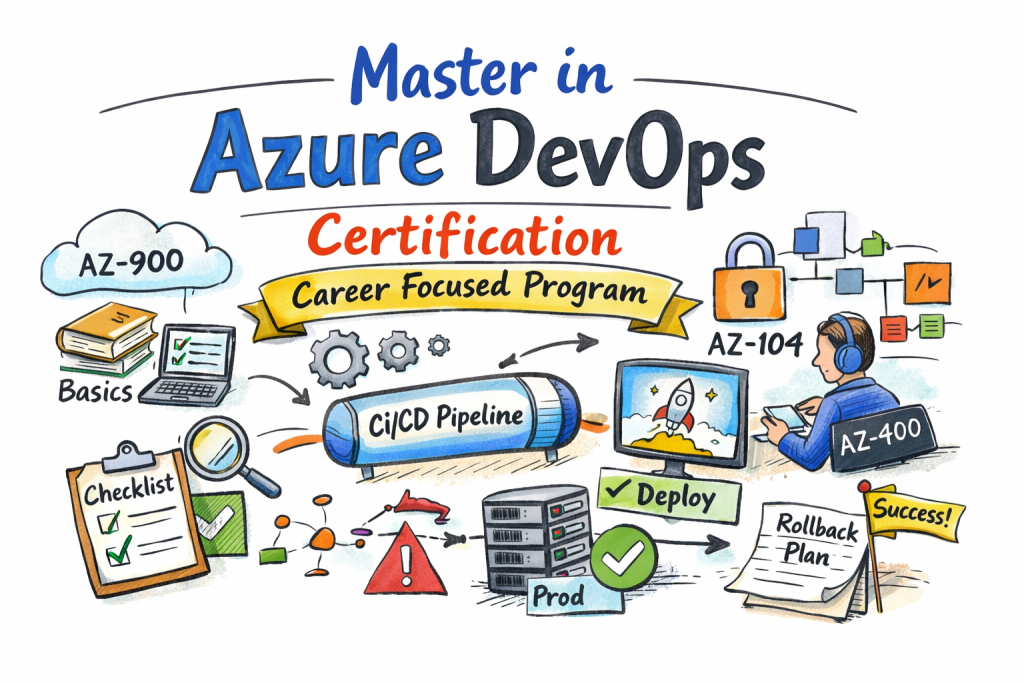
Software delivery looks simple, but in real teams it often becomes messy—builds fail late, releases depend on manual steps, small changes break production, and nobody has clear visibility on what shipped or how to roll back fast. Azure DevOps helps solve this by bringing structure to planning, code, build, test, release, and tracking in one connected flow, so delivery becomes repeatable and safer. The Master in Azure DevOps program is built for working engineers and managers and follows a practical sequence: learn Azure cloud basics first (AZ-900), then learn how to run and manage Azure environments (AZ-104), and finally learn how to build strong CI/CD pipelines and DevOps practices on Azure (AZ-400). This guide focuses on real job skills—what the program includes, who it suits, what you will learn, the projects you should build, how to prepare with clear timelines, the common mistakes to avoid, and what to do next after completion.
Why Master in Azure DevOps matters
Why engineers care
Engineers want fewer release surprises. This program helps you build delivery systems that:
- Run builds the same way every time
- Test automatically and early
- Create clean release steps
- Protect production with approvals
- Make rollback and recovery easier
When your pipelines are strong, you spend less time fixing urgent issues and more time building real features.
Why managers care
Managers want predictable delivery and lower risk. This program helps teams improve:
- Release speed with control
- Delivery visibility (what changed, who approved, what shipped)
- Standard process across teams
- Better quality and fewer urgent fixes
- Better planning and smoother execution
What the Master in Azure DevOps program includes
From the official program page, here is what is clearly stated:
- Course duration: approx 60 hours
- Lab assignments: 100+
- Training formats: online, classroom, corporate
- The program covers three major certifications: AZ-900, AZ-104, AZ-400
- It also includes a topic area on integrating open-source tools with Azure
- The page also mentions support for doubts during training, projects, and interview preparation kits (as described).
The certifications covered in this program
You asked for a table listing every certification with Track, Level, Who it’s for, Prerequisites, Skills covered, Recommended order, and Link.
| Certification | Track | Level | Who it’s for | Prerequisites | Skills covered | Recommended order |
|---|---|---|---|---|---|---|
| Azure Fundamentals (AZ-900) | Azure Basics | Foundation | Beginners, developers, managers who need cloud clarity | None | Cloud concepts, cloud models, Azure core services, basic governance | 1 |
| Azure Administrator (AZ-104) | Azure Operations | Associate | Cloud engineers, admins, platform teams, DevOps engineers who manage Azure | AZ-900 recommended | Identity and governance, compute, storage, networking, monitoring basics | 2 |
| Azure DevOps (AZ-400) | DevOps on Azure | Expert | DevOps engineers, release owners, platform engineers | AZ-104 recommended | DevOps process implementation, pipelines, release flow, tool integration concepts | 3 |
This 3-certification structure is explicitly listed on the official page.
How to follow this program without getting confused
Many people jump straight to “pipelines” and feel lost. A simple sequence works better:
Step 1: Learn the cloud language (AZ-900)
You learn what cloud is, how Azure is structured, and what services exist.
Step 2: Learn how Azure is operated (AZ-104)
You learn identity, access, storage, network, and monitoring basics.
Step 3: Learn DevOps implementation (AZ-400)
You learn how to build and run delivery workflows: CI, CD, approvals, and safe release habits.
This order helps you learn faster and also helps in real jobs.
Master in Azure DevOps mini-sections (as requested)
What it is
Master in Azure DevOps is a structured learning path that covers Azure basics (AZ-900), Azure operations (AZ-104), and Azure DevOps implementation (AZ-400). It aims to help you design and implement DevOps processes on Azure with practical learning and projects.
Who should take it
- Software engineers who want to own CI/CD and releases
- DevOps engineers who want Azure-first delivery skills
- Cloud engineers who want to move into DevOps and platform roles
- SRE and platform engineers building standard pipelines for teams
- QA/automation engineers who want to shift testing into pipelines
- Engineering managers who want clear release control and visibility
Skills you’ll gain (bullets)
- Clear understanding of cloud concepts and Azure structure (regions, subscriptions, resource groups)
- Practical view of Azure core services: compute, storage, networking, databases (high level in AZ-900, deeper in AZ-104)
- Identity and governance thinking: roles, access scopes, control mindset (AZ-104 section)
- DevOps workflow knowledge: planning + code + build + test + release + feedback loop (AZ-400 goal)
- Working approach to integrating open-source tools with Azure DevOps (program topic area)
- Strong habits: standard pipelines, simple runbooks, safe deployments, clear ownership
Real-world projects you should be able to do after it (bullets)
- Build a CI pipeline that compiles code, runs unit tests, and publishes artifacts
- Create a multi-stage release flow (dev → staging → production) with approvals
- Set branch and PR checks so risky code does not merge easily
- Create reusable pipeline templates so teams follow one standard way
- Add basic “post-deploy checks” so issues show up quickly after release
- Prepare a rollback plan (what to do when the release goes wrong)
- Build a small “release runbook” that explains the steps and checks
Preparation plan (7–14 days / 30 days / 60 days)
7–14 days plan (fast start)
Goal: get clarity and build one working pipeline.
- Day 1–3: Learn Azure structure (region, subscription, resource group, management basics)
- Day 4–6: Learn basic cloud service types and Azure core services (AZ-900 topics list)
- Day 7–10: Learn Azure DevOps basics (repo + pipeline concept) and create a simple CI pipeline
- Day 11–14: Add one more improvement: unit tests, basic artifact publishing, and clean PR workflow
What success looks like:
- One pipeline that runs cleanly
- You can explain each step in simple words
30 days plan (job-ready foundation)
Goal: build real confidence with 2–3 pipelines and one mini project.
- Week 1: Finish AZ-900 core ideas and make simple notes you can revise fast
- Week 2: Start AZ-104 basics: identity and access, governance concepts, and monitoring basics
- Week 3: Build a CI pipeline with tests + artifact versioning (simple versioning is enough)
- Week 4: Build a CD flow to dev and staging:
- Add approvals for staging
- Add config and secrets handling approach (do not hard-code)
- Add a “release checklist” (simple bullet list)
What success looks like:
- You can deploy to two environments using a repeatable flow
- You have a basic checklist for releases
60 days plan (strong mastery)
Goal: build one strong capstone project that looks like real work.
- Month 1: Complete the base learning and small pipelines
- Month 2: Build the capstone:
- Multi-stage CD (dev → staging → prod)
- Environment approvals and permissions thinking
- Pipeline templates so you can reuse steps
- Post-deploy checks (smoke checks + basic monitoring signals)
- Failure drills: make a pipeline fail and practice recovery
What success looks like:
- One end-to-end project you can show and explain
- You can answer “What happens if this fails?” with a clear plan
Common mistakes (bullets)
- Jumping to pipelines without understanding Azure basics first
- Copy-pasting pipeline YAML without knowing what it does
- Keeping secrets in plain text or sharing credentials in code
- No approvals or controls for production releases
- No standard templates, so every team does it differently
- No rollback plan, so failures become panic situations
- No post-deploy checks, so problems are found too late
Best next certification after this
After completing the Master in Azure DevOps path, choose your next step based on your career direction:
- Same track (deeper platform delivery and release governance)
- Cross track (DevSecOps, SRE, DataOps, FinOps)
- Leadership track (delivery governance and engineering management)
What you learn inside each certification (expanded, simple)
Azure Fundamentals (AZ-900)
What it is (2–3 lines)
AZ-900 builds your base understanding of cloud and Azure. It helps you understand what Azure services are, how Azure is structured, and how cloud choices affect cost and reliability.
Who should take it
- Beginners entering cloud or DevOps
- Developers who deploy to Azure
- Managers who want cloud clarity
- Anyone who wants a clean start
Skills you’ll gain (bullets)
The official page lists many AZ-900 topics. Here is what they mean in simple words:
- Cloud concepts: what cloud is, why companies use it, and common benefits
- Service models: IaaS, PaaS, SaaS, and when each makes sense
- Cloud types: public, private, hybrid, and trade-offs
- Azure structure: regions, region pairs, availability zones, resource groups, subscriptions
- Core services overview: VMs, App Services, AKS/containers, storage types, basic databases
- Management tools awareness: portal, CLI, PowerShell, Azure Monitor (high level)
- SLA basics: what SLA means and what impacts availability
Real-world projects you should be able to do after it (bullets)
- Explain your app using Azure building blocks (compute + storage + network)
- Plan a simple dev/test/prod environment setup (high level)
- Explain availability in a simple way (zone vs region ideas)
- Identify “wrong fit” decisions (for example: using a heavy VM for a simple app)
Preparation plan
- 7–14 days: learn the basics daily and write simple notes you can revise quickly
- 30 days: practice explaining cloud ideas in your own words (helps interviews)
- 60 days: create a simple “Azure basics cheat sheet” for your own use
Common mistakes
- Learning terms without understanding the “why”
- Ignoring identity basics (it becomes important later)
- Not understanding how Azure resources are organized
Best next certification after this
AZ-104 (Azure Administrator) is the best next step in this program flow.
Azure Administrator (AZ-104)
What it is (2–3 lines)
AZ-104 teaches you how to operate Azure in a real environment. It focuses on identity, governance, compute, storage, networking, and monitoring basics that you need before you run production systems.
Who should take it
- Cloud engineers and admins
- Platform engineers
- DevOps engineers working close to infrastructure
- Anyone who supports production workloads on Azure
Skills you’ll gain (bullets)
The official page lists detailed admin topics. In simple words, you learn how to:
- Manage users and groups and basic directory objects
- Use role-based access control (RBAC) and access scopes
- Understand which resources need which permissions
- Think about governance so environments are controlled, not messy
- Connect operations with monitoring and readiness thinking
Real-world projects you should be able to do after it (bullets)
- Build a clean environment layout with clear access boundaries
- Create a basic access model: who can deploy, who can approve, who can change infra
- Define a monitoring checklist (what should be watched after deployment)
- Run a simple incident drill: what you check first, and how you recover
Preparation plan
- 7–14 days: identity + access basics first, then small daily hands-on practice
- 30 days: build one operational scenario end-to-end and document it
- 60 days: write a simple “operations runbook” for common failures and checks
Common mistakes
- Treating networking and access as “someone else’s job”
- Running production-like work without checklists
- Doing monitoring at the end instead of from the start
Best next certification after this
AZ-400 (Azure DevOps) is the natural next step in this program flow.
Azure DevOps (AZ-400)
What it is
AZ-400 is where you learn DevOps implementation. You learn how to design and run delivery workflows so teams can ship changes safely and repeatedly.
Who should take it
- DevOps engineers who own pipelines and releases
- Platform engineers building shared pipeline templates
- Senior developers responsible for delivery
- Cloud engineers moving into DevOps responsibilities
Skills you’ll gain (bullets)
In simple words, you learn how to:
- Build strong CI pipelines: build, test, package, publish artifacts
- Build safe CD pipelines: controlled deployment across environments
- Use approvals and gates so production is protected
- Use better branch/PR habits so risky changes reduce
- Improve release clarity using simple runbooks and checks
- Understand integration ideas with open-source tools (program topic)
Real-world projects you should be able to do after it (bullets)
- Multi-stage pipeline with approvals (dev → staging → prod)
- Shared templates (one standard pipeline approach used by many teams)
- Post-deploy checks (smoke tests + monitoring checks)
- Rollback plan (clear steps when deployment fails)
- Release notes habit (what changed, what to watch, who approved)
Preparation plan
Below is a simple English, step-by-step plan in 3 timelines (7–14 days, 30 days, 60 days). It is practical and project-focused, so you can show real work at the end.
7–14 Days plan (Fast start)
Goal
Get clarity on Azure basics and build one working CI pipeline.
What you should do
Day 1–2: Setup and basics
- Create your learning folder (notes + screenshots + YAML files)
- Learn Azure structure: subscription, resource group, region, basic identity
- Understand what “CI” and “CD” mean in daily work
Day 3–5: Azure DevOps basics
- Learn the basics of:
- Repos (Git)
- Boards (work items)
- Pipelines (build and release idea)
- Artifacts (packages)
- Pick one small sample app (any simple app is fine)
Day 6–10: Build your first CI pipeline
- Create a pipeline that does:
- Checkout code
- Build the app
- Run unit tests
- Publish build output as an artifact
- Run it 5–10 times until it works the same every time
Day 11–14: Make it clean
- Add naming and simple structure:
- Clear pipeline stages
- Variables for build config
- Add PR checks concept:
- “Build + tests must pass before merge”
- Write a 1-page note:
- What your pipeline does
- What can fail
- What you check first when it fails
Output you must have by Day 14
- 1 CI pipeline YAML
- 1 small project repo
- 1 short document explaining the pipeline
30 Days plan (Job-ready foundation)
Goal
Build CI + CD to at least two environments and learn strong Azure operations basics.
Week 1: Azure basics (AZ-900 focus)
- Learn cloud basics and Azure services overview
- Make short notes:
- Azure structure
- Common services (compute, storage, network)
- Basic governance ideas
Deliverable
- A simple “Azure basics” note (2–3 pages max)
Week 2: Operations basics (AZ-104 focus)
- Learn in simple steps:
- Identity and access (roles and permissions)
- Network basics (why deployments fail)
- Monitoring basics (what signals matter)
Deliverable
- One “operations checklist”:
- Access checks
- Network checks
- Monitoring checks
Week 3: Improve CI pipeline
- Add quality habits:
- Better unit test steps
- Versioned artifacts (simple version is ok)
- Build logs that are easy to read
- Make pipeline faster (basic cleanup only)
Deliverable
- CI pipeline that is stable and clean
Week 4: Build CD to dev + staging
- Create a release pipeline that does:
- Deploy to dev
- Deploy to staging
- Add safety:
- Manual approval before staging
- Environment variables and secret handling (do not hardcode)
- Add a post-deploy check:
- “App is up” basic smoke test
Deliverable
- Multi-stage pipeline: CI + CD (dev + staging)
- One release checklist (simple bullets)
Output you must have by Day 30
- 1 working CI pipeline
- 1 working CD pipeline (dev + staging)
- 1 small project with release checklist and basic checks
60 Days plan (Strong mastery)
Goal
Build a complete end-to-end project that looks like real company work.
Week 1–2: Production-ready CD flow
- Extend CD to include production:
- dev → staging → production
- Add strong controls:
- Approval before production
- Clear environment permissions
Deliverable
- Full multi-environment CD flow
Week 3: Standardization (templates)
- Create reusable pipeline templates:
- Common build steps
- Common test steps
- Common deploy steps
- Use the same template in two pipelines (even if small)
Deliverable
- Template-based pipelines (shows maturity)
Week 4: Failure handling and rollback
- Practice failure:
- Break a deployment on purpose
- Fix it safely
- Create rollback steps:
- What you do if production fails
- Write a simple “release runbook”
Deliverable
- Rollback plan + runbook
Week 5: Monitoring and post-deploy checks
- Add post-deploy checks:
- Smoke tests
- Basic health endpoints checks (if available)
- Define what you watch after release:
- errors, latency, availability (simple list)
Deliverable
- Post-deploy checklist + monitoring checklist
Week 6: Interview-ready package
- Prepare your story:
- Problem → what you built → results you saw
- Create a clean README:
- Architecture
- Pipeline flow
- How to run and deploy
- Collect proof:
- YAML files
- Pipeline screenshots
- Runbook and checklists
Output you must have by Day 60
- One capstone project with:
- CI pipeline
- CD pipeline (dev/staging/prod)
- Approvals and controls
- Templates
- Post-deploy checks
- Rollback plan + runbook
- Clean documentation
Common mistakes
Learning mistakes
- Skipping AZ-900 basics and jumping directly to pipelines
- Studying only theory and not doing hands-on labs daily
- Trying to learn AZ-900, AZ-104, and AZ-400 together in the same week
- Memorizing terms instead of understanding real usage in a project
Pipeline mistakes (CI/CD)
- Copy-pasting YAML without understanding what each step does
- Building a pipeline that works “only once” and not making it repeatable
- Not using artifacts properly (rebuilding again and again for each environment)
- Mixing build and deploy logic without clean stages (hard to debug later)
- No pipeline templates or standards (every project becomes different)
Security and access mistakes
- Hardcoding passwords, keys, or tokens in code or pipeline files
- Giving too much access to everyone (no role-based access control thinking)
- Not separating environments (dev/staging/prod share the same permissions)
- Ignoring secrets management and audit mindset
Release and governance mistakes
- Deploying to production without approvals or checks
- No rollback plan (so failures become panic)
- No release checklist (people forget steps under pressure)
- No change notes or simple release documentation
Operations and reliability mistakes
- Not adding monitoring readiness and post-deploy checks
- Not doing “failure practice” (never testing what happens when deployment fails)
- Ignoring logs and metrics until something breaks
- Not tracking basic signals after release (errors, latency, availability)
Interview and career mistakes
- Not building one complete end-to-end project (CI + CD + approvals + checks)
- Not documenting your project (so you cannot explain it clearly)
- Not preparing simple stories: problem → what you built → how it helped
- Showing only certificates and no proof of real implementation
Best next certification after this
Pick based on your role: deeper platform (same track), security (DevSecOps), reliability (SRE), data delivery (DataOps), cost governance (FinOps), or leadership direction.
Option 1: Same track (go deeper in Azure DevOps / Azure cloud)
Best next if you want to stay Azure-focused
Microsoft Certified: Azure Solutions Architect (AZ-305)
- Best for people who want to design bigger Azure systems, not only pipelines
- Helps you think about architecture, scalability, reliability, and cost
- Good for: Platform Engineer, Cloud Engineer, Senior DevOps Engineer
Best next if you want advanced Azure security skills
Microsoft Certified: Azure Security Engineer (AZ-500)
- Best if your job involves securing cloud environments and controlling access
- Strong for: Security Engineer, DevSecOps Engineer, Cloud Security roles
Option 2: Cross-track (broaden your career)
Best next if you want security + DevOps
DevSecOps direction certification
- Focus: secure pipelines, security checks in CI/CD, secrets, compliance thinking
- Good for: DevOps Engineer, Security Engineer, Platform Engineer
Best next if you want reliability and production ownership
SRE direction certification
- Focus: monitoring, incident response, SLO basics, release safety, outage reduction
- Good for: SRE, Platform Engineer, Production support owners
Best next if you want data pipeline delivery discipline
DataOps direction certification
- Focus: reliable data pipelines, testing for data changes, controlled releases
- Good for: Data Engineer, Analytics engineers, Data platform teams
Best next if you want cloud cost governance
FinOps direction certification
- Focus: cloud cost control, tagging, budgets, accountability, spend visibility
- Good for: FinOps practitioner, Engineering manager, Platform owner
Option 3: Leadership (move toward manager / lead roles)
Best next if you want to lead delivery outcomes
DevOps Manager / Delivery Leadership direction certification
- Focus: governance, risk control, metrics (lead time, failure rate), team processes
- Good for: Engineering Manager, Delivery lead, DevOps lead
Choose your path (6 learning paths)
This section helps you pick the best direction after the core program.
DevOps path
Focus: speed with control.
- Standard pipeline templates
- Release approvals and environment protection
- Fast feedback with good tests
- Simple runbooks and stable delivery habits
Best for: DevOps Engineer, Platform Engineer, Release Owner.
DevSecOps path
Focus: security built into delivery.
- Secure secrets and access discipline
- Security checks inside pipelines
- Strong approval and audit mindset
- Risk-based release habits
Best for: Security Engineer, DevOps Engineer with security focus.
SRE path
Focus: reliability and safe production operations.
- Monitoring readiness before and after release
- Release risk reduction
- Incident response habits and learning
- Improving stability step by step
Best for: SRE, production-heavy platform teams.
AIOps/MLOps path
Focus: smarter operations and modern automation.
- Better alert quality and less noise
- Faster detection and response
- Automation-ready workflows
- Reliability thinking applied to ML/AI systems (when needed)
Best for: teams working on modern operations and ML platforms.
DataOps path
Focus: DevOps discipline for data pipelines.
- Testing and validation for data changes
- Controlled data releases
- Better versioning and governance
- Reliable delivery for analytics and data products
Best for: Data Engineers, data platform teams.
FinOps path
Focus: cost governance with engineering discipline.
- Cost visibility and accountability
- Guardrails and tagging discipline
- Trade-offs: cost vs performance vs reliability
- Better cloud spending habits for teams
Best for: FinOps practitioners, platform owners, engineering managers.
Role → Recommended certifications mapping
| Role | What you need most | Recommended certifications | What “good” looks like after learning |
|---|---|---|---|
| DevOps Engineer | CI/CD + automation | AZ-900 → AZ-104 → AZ-400 | One complete CI/CD project with approvals and checks |
| SRE | release safety + reliability | AZ-900 → AZ-104 → AZ-400 + SRE path | Release runbooks + monitoring readiness + rollback plan |
| Platform Engineer | standards and templates | AZ-900 → AZ-104 → AZ-400 | Shared pipeline templates adopted by teams |
| Cloud Engineer | stable ops + delivery bridge | AZ-900 → AZ-104 → AZ-400 | Can operate Azure and automate releases |
| Security Engineer | secure delivery controls | AZ-900 → AZ-104 → AZ-400 + DevSecOps path | Secure secrets + access discipline + pipeline gates mindset |
| Data Engineer | data delivery discipline | AZ-900 + AZ-104 + DataOps path | Controlled data pipelines and repeatable releases |
| FinOps Practitioner | cost control mindset | AZ-900 + FinOps path | Guardrails and cost-aware standards |
| Engineering Manager | predictability + governance | AZ-900 (fast) + AZ-400 awareness | Better approvals, planning, and release visibility |
Next certifications to take (3 options)
Option 1: Same track (go deeper)
Choose this if you want to become the “delivery platform” expert.
- Deeper enterprise pipeline governance
- Reusable templates across teams
- Better release measurement and improvement habits
- Strong platform enablement skills
Option 2: Cross-track (broaden your career)
Choose this if you want more job options and wider impact.
- DevSecOps direction: secure delivery and compliance thinking
- SRE direction: reliability, incidents, monitoring, stability
- DataOps direction: delivery discipline for data workflows
- FinOps direction: cost governance and accountability
Option 3: Leadership (move toward leading delivery)
Choose this if you want to grow into lead/manager roles.
- Release governance across teams
- Risk-based approvals and planning
- Metrics-driven improvement habits
- Strong incident learning culture
Top institutions that provide training cum certification help
DevOpsSchool
DevOpsSchool is highlighted on the official page as a top institute for the Master in Azure DevOps program, offering multiple formats and structured learning support. It focuses on practical learning, labs, projects, and interview readiness as described on the program page.
Cotocus
Cotocus is useful when you want training that connects learning to real team needs. It suits learners and companies who want guidance that can map to real project delivery and implementation.
Scmgalaxy
Scmgalaxy is helpful for learners who like structured learning and regular practice. It suits people who want to build core DevOps habits and grow step by step with steady effort.
BestDevOps
BestDevOps supports skill-building for DevOps and delivery thinking. It can work well for learners who want structured guidance and repeated practice to build confidence.
devsecopsschool
devsecopsschool is a good fit if your goal is secure DevOps delivery. It helps you focus on pipeline security thinking, governance mindset, and risk reduction habits.
sreschool
sreschool is focused on reliability and production readiness. It suits people who want to reduce outages, improve monitoring discipline, and build strong incident habits.
aiopsschool
aiopsschool is useful for learning operations automation thinking. It can help you understand how modern teams reduce alert noise and speed up response using structured workflows.
dataopsschool
dataopsschool is useful if you work with data pipelines and want DevOps-like discipline. It supports a practical approach to testing, versioning, and controlled data delivery.
finopsschool
finopsschool is useful for cloud cost governance learning. It suits teams and leaders who need better spending discipline and cost-aware engineering decisions.
Testimonials
Amit (DevOps Engineer):
“I used to build pipelines that worked once but broke often. After following this path, I learned how to make releases more controlled with approvals, templates, and clear checks.”
Neha (Cloud Engineer moving into DevOps):
“I knew Azure services, but I was not confident about delivery automation. The program flow helped me connect operations knowledge with CI/CD thinking.”
Rohit (Platform Engineer):
“My focus was standard pipelines for many teams. I learned how to create reusable templates and simple runbooks that teams can actually follow.”
Priya (Engineering Manager):
“I needed better release governance without slowing teams. This learning helped me understand approvals, risks, and how to plan releases with more clarity.”
FAQs about difficulty, time, prerequisites, sequence, value, career outcomes
1) Is Master in Azure DevOps hard?
It is not hard if you follow the order. Start with basics, then operations, then DevOps implementation.
2) How much time do I need?
A 30–60 day plan works well for working people. If you can study daily in small slots, you will progress faster.
3) Do I need Azure experience before starting?
No strict prerequisites are stated on the program page, and it is positioned to help learners start from scratch.
4) What should I learn first?
Start with AZ-900 topics (cloud basics and Azure structure). This makes everything else easier.
5) Can I skip AZ-104 and go to AZ-400?
You can try, but most people struggle because pipelines depend on identity, access, and environment reality.
6) Do I need to be a developer?
You do not need deep coding, but you should know basic Git and understand build/test/deploy steps.
7) Will this help in real jobs?
Yes, if you build real projects. Employers value people who can build safe CI/CD systems, not just pass exams.
8) What job roles benefit most?
DevOps Engineer, Platform Engineer, Cloud DevOps Engineer, and SRE-aligned roles benefit strongly.
9) What is the best sequence?
AZ-900 → AZ-104 → AZ-400 is the clean sequence listed in the program coverage.
10) What should my portfolio include after completion?
At least one real CI/CD project with multi-stage deployment, approvals, checks, and a rollback plan.
11) What are common reasons people fail?
Skipping labs, copying pipeline files without understanding, weak secrets handling, and no failure practice.
12) Will managers benefit?
Yes. Managers get clearer release governance understanding and better delivery visibility.
13) How do I know I am ready for interviews?
If you can explain your pipeline, your approval model, your rollback plan, and what you improved, you are ready.
14) What career outcomes can this support?
Better fit for Azure DevOps roles, stronger platform delivery skills, and improved confidence in release ownership.
FAQs (8 questions & answers) only on Master in Azure DevOps
1) What is Master in Azure DevOps in simple words?
It is a program that teaches Azure basics, Azure operations, and Azure DevOps implementation so you can build real CI/CD delivery systems.
2) Which three certifications does it cover?
Azure Fundamentals (AZ-900), Azure Administrator (AZ-104), and Azure DevOps (AZ-400).
3) What is the best first project to start?
A basic CI pipeline: build + unit tests + publish artifacts. Keep it simple and stable.
4) What is the best capstone project?
A multi-stage pipeline (dev → staging → prod) with approvals, templates, post-deploy checks, and rollback steps.
5) What is the most valuable skill I gain?
Release safety. That means approvals, checks, rollback thinking, and visibility after deployment.
6) Can I do this while working full-time?
Yes. Use small daily study blocks and keep building your project step by step.
7) How do I avoid confusion across topics?
Do not mix everything in one week. Finish AZ-900 basics first, then AZ-104 basics, then AZ-400 pipelines.
8) What should I do after completing it?
Choose your direction: deeper platform delivery, DevSecOps, SRE, DataOps, FinOps, or leadership growth.
Conclusion
Master in Azure DevOps is most useful when you treat it as a real skill path, not just a certification list. Follow the order, build one strong end-to-end project, practice failure and rollback, and learn to explain your design clearly. That is what creates career value.
