Introduction
In my time working across various technology cycles, I have seen the world of data undergo a massive transformation. I remember when “data” mostly meant managing a single, monolithic SQL database in a dusty server room. Back then, if you could write a decent join and optimize an index, you were the hero of the department. Times have changed. Today, data is moving constantly. It flows from mobile apps, IoT sensors, web logs, and transactional systems at a speed and volume that would have been unimaginable a decade ago. We no longer just “store” data; we “engineer” it. The AWS Certified Data Engineer – Associate is AWS’s answer to this evolution. It isn’t just a test of what you know about S3 or Redshift. It is a validation that you understand how to build a factory—a pipeline—that takes raw, messy data and turns it into pure, actionable insight. Whether you are a software engineer looking to pivot or a manager trying to build a world-class data team, this guide will provide the roadmap you need.
The AWS Certification Landscape
Understanding where you are and where you are going is the first step to success. In my experience, engineers who jump straight into a specialty without knowing the basics often struggle later. Here is how the current tracks look:
| Track | Level | Who it’s for | Prerequisites | Skills Covered | Recommended Order |
| Cloud | Foundational | Beginners, Sales, Managers | None | Basic Cloud, Billing, Security | 1st |
| Architect | Associate | Solutions Architects | 6 months AWS exp | System Design, S3, EC2, VPC | 2nd |
| Data Engineering | Associate | Data Engineers, Developers | 2-3 years tech exp | Ingestion, ETL, Glue, Athena | 2nd or 3rd |
| DevOps | Professional | SREs, DevOps Engineers | 2 years AWS exp | CI/CD, Automation, Config | 4th |
Deep Dive: AWS Certified Data Engineer – Associate
This certification is designed to bridge the gap between “knowing AWS” and “being a Data Engineer.” It focuses on the actual work of moving and transforming data at scale.
What it is
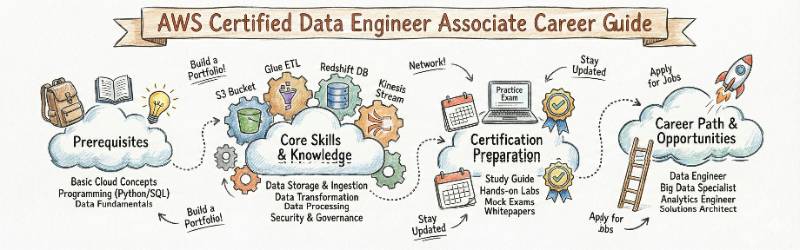
The AWS Certified Data Engineer – Associate validates your ability to design, build, and maintain data pipelines. It covers the entire life cycle of data: how to bring it in (ingestion), where to put it (storage), how to clean it (transformation), and how to make sure it is safe and correct (governance).
Who should take it
- Software Engineers: If you are tired of just building CRUD apps and want to work on complex data systems.
- Data Analysts: If you want to move beyond just querying data and start building the systems that provide that data.
- Engineering Managers: To understand the modern “Lakehouse” architecture so you can lead your teams more effectively.
- Cloud Practitioners: Those who want a specialized, high-demand career path in the cloud.
Skills you’ll gain
- Data Ingestion: Learning how to use Kinesis for real-time streams and AWS DMS for migrating existing databases.
- Data Transformation: Mastering AWS Glue (Spark-based ETL) and Amazon EMR for big data processing.
- Data Orchestration: Using AWS Step Functions and Amazon Managed Workflows for Apache Airflow (MWAA) to keep your pipelines running in order.
- Data Lakes & Warehousing: Designing scalable storage in S3 and high-performance querying in Amazon Redshift and Athena.
- Data Governance: Using AWS Lake Formation to manage fine-grained permissions and ensure data quality.
Real-world projects you should be able to do
- Automated Log Analytics: Build a system that takes logs from thousands of servers, cleans them using AWS Glue, and allows security teams to query them instantly with Athena.
- Real-time Sales Dashboard: Create a pipeline that captures retail transactions via Kinesis Data Streams and updates a PowerBI or QuickSight dashboard in under 30 seconds.
- Secure Data Lake: Set up an S3-based data lake where different departments (Marketing, Finance, HR) can only see the specific rows and columns of data they are authorized to access.
Preparation Plan: Your Roadmap to Success
Depending on your current experience, I recommend one of these three paths. I have mentored hundreds of engineers, and these timelines generally hold true:
7–14 Days (The Fast Track)
- Profile: You are already using AWS Glue, S3, and Redshift every day at work.
- Strategy: Read the official Exam Guide. Take 3–5 full-length practice exams to identify your weak spots. Spend your remaining time reading the “FAQs” section of the AWS website for Kinesis and Lake Formation.
30 Days (The Standard Path)
- Profile: You have a solid IT background and have used AWS, but you aren’t a “Data Expert” yet.
- Strategy: Spend the first 2 weeks on a structured course (like those at DevOpsSchool). Spend the 3rd week doing hands-on labs—actually building pipelines in the console. Spend the final week on practice questions and refining your knowledge of security and cost optimization.
60 Days (The Thorough Path)
- Profile: You are a software engineer or manager who is relatively new to the specific world of Cloud Data.
- Strategy: Month 1 should be all about the “Why.” Learn the difference between ETL and ELT, Row-based vs. Columnar storage, and Batch vs. Stream. Month 2 should be all “How.” Build at least three end-to-end projects from scratch. By the end, the AWS Console should feel like home.
Common Mistakes to Avoid
In my experience, even smart engineers fail this exam for a few specific reasons:
- Ignoring the “Cheap” Option: AWS loves to ask “Which solution is the most cost-effective?” You might pick a solution that works, but if it costs $10,000 a month when a $100 solution was available, you will get the answer wrong.
- Forgetting Security: Data Engineering is 50% moving data and 50% protecting it. If you don’t understand IAM roles, KMS encryption, and Lake Formation permissions, you will struggle.
- Underestimating Orchestration: Don’t just learn how to run a Glue job. Learn how to handle what happens when that job fails. How do you retry? How do you send an alert?
Best next certification after this
Option 1: The Specialist Path (Same Track)
Next Step: AWS Certified Data Analytics – Specialty
If you love working with data and want to be the “go-to” person for the most complex problems, this is your path. While the Associate exam covers how to build pipelines, the Specialty exam goes much deeper into how to actually analyze that data.
You will learn advanced tuning for Amazon Redshift, how to manage massive search clusters with Amazon OpenSearch, and how to create complex visual stories in QuickSight. This is for the engineer who wants to master every corner of the AWS data ecosystem.
Option 2: The Architect Path (Cross-Track)
Next Step: AWS Certified Solutions Architect – Professional
Data does not live in a vacuum. It sits inside a larger network, connects to web apps, and must follow strict security rules. If you want to understand how the entire “house” is built—not just the data plumbing—this is the right move.
The Solutions Architect – Professional is one of the most respected certifications in the industry. It proves that you can design complex, multi-account systems that are reliable and secure. It is a great choice for software engineers who want to move into Senior Architect or Principal Engineer roles.
Option 3: The Leadership Path (Management)
Next Step: AWS Certified Cloud Practitioner or FinOps Certification
If you are a manager or looking to become one, your goals are different. You don’t necessarily need to know how to write every line of code, but you do need to understand the business of the cloud.
- Cloud Practitioner: If you haven’t taken this yet, it provides a high-level view of billing, support, and global infrastructure that is vital for managers.
- FinOps Practitioner: This is becoming very popular for leaders. It focuses on the “Financial Operations” of the cloud—how to manage budgets and make sure the company isn’t wasting money on idle resources. This helps you bridge the gap between the engineering team and the finance department.
Choose Your Path: 6 Strategic Learning Paths
Data engineering doesn’t exist in a vacuum. It intersects with every other part of the tech stack. Here are six ways you can specialize:
1. The DevOps Path
This is for the engineer who wants to automate the data factory. You won’t just build a pipeline; you will write the code (Terraform or CloudFormation) that deploys the pipeline. You focus on “Data Infrastructure as Code.”
2. The DevSecOps Path
Data is a company’s most valuable—and dangerous—asset. In this path, you focus on building “Security by Design.” You automate data masking, implement “Least Privilege” access, and ensure every piece of data is encrypted the moment it hits S3.
3. The SRE (Site Reliability Engineering) Path
If a data pipeline breaks, the CEO’s dashboard goes blank. That is a “Level 1” emergency. This path teaches you how to build highly available data systems, how to monitor them with CloudWatch, and how to create “self-healing” pipelines.
4. The AIOps/MLOps Path
Machine Learning is useless without good data. This path bridges the gap. You learn how to build “Feature Stores” and how to automate the flow of clean data into SageMaker so that your AI models are always up to date.
5. The DataOps Path
DataOps is about speed and quality. You learn how to use version control for your data, how to run automated “Data Quality” tests in the middle of your pipeline, and how to make data “discoverable” for the whole company.
6. The FinOps Path
The cloud is expensive. A FinOps-focused data engineer knows exactly how much every byte of data costs. You learn how to use S3 Lifecycle policies to move old data to cheaper storage (Glacier) and how to optimize Redshift clusters to save thousands of dollars.
Role → Recommended Certifications Mapping
| Current or Goal Role | Step 1: Foundation | Step 2: Core Focus | Step 3: Expertise/Specialty |
| DevOps Engineer | Cloud Practitioner | SysOps Associate | DevOps Professional |
| SRE (Site Reliability) | Solutions Architect Associate | SysOps Associate | Security Specialty |
| Platform Engineer | Solutions Architect Associate | Developer Associate | DevOps Professional |
| Cloud Engineer | Cloud Practitioner | Solutions Architect Associate | Advanced Networking Specialty |
| Security Engineer | Solutions Architect Associate | Security Specialty | DevSecOps Certified Professional |
| Data Engineer | Solutions Architect Associate | Data Engineer Associate | Data Analytics Specialty |
| FinOps Practitioner | Cloud Practitioner | Solutions Architect Associate | FinOps Certified Professional |
| Engineering Manager | Cloud Practitioner | Solutions Architect Associate | Data Engineer Associate |
Top Institutions for Training and Certification
I have observed that having a mentor or a structured program can cut your learning time in half. Here are the top institutions that provide excellent support for this specific AWS certification:
DevOpsSchool This is a top choice for those who love hands-on learning. They don’t just give you slides; they give you real projects to build. Their mentors are experts who focus on making you ready for a real job, ensuring you understand how to handle data pipelines in the real world.
Cotocus This place is known for deep technical training. They focus on how things work under the hood instead of just memorizing facts. It is perfect if you want to understand complex AWS data architectures and become a true technical specialist.
Scmgalaxy This is a massive community for learning and sharing knowledge. They provide great tutorials that mix data engineering with automation and version control. They focus on the modern tools that big companies use every day.
BestDevOps They offer very practical training that is easy to follow. Their courses are designed to help you build a career quickly by focusing on what employers want. They make complex cloud concepts feel simple and easy to learn.
devsecopsschool Security is a huge part of data engineering today. This school teaches you how to keep your data safe from the start. They show you how to build data pipelines that are secure and follow all the latest safety rules.
sreschool If you want your data systems to stay online and run fast, this is the place. They teach you how to monitor and fix data pipelines before they cause problems. It is all about making sure your data is always reliable.
aiopsschool This school is for those who want to use AI to manage their data operations. They show you how to automate complex tasks using smart technology. It is a great path for those who want to stay ahead of the curve in tech.
dataopsschool This institution focuses entirely on the data lifecycle. They teach you how to manage data quality and how to get data to the right people faster. It is perfect for anyone who wants to be a dedicated data professional.
finopsschool Cloud costs can get very high if you aren’t careful. This school teaches you how to keep your AWS bill low while still getting the best performance. You learn how to save your company money by choosing the right tools.
Next Certifications to Take
Once you have that “Associate” badge, you have three main ways to grow:
- Same Track (Specialization): AWS Certified Data Analytics – Specialty. This is for those who want to become “The Guru” of data on AWS.
- Cross-Track (Broadening): AWS Certified Solutions Architect – Professional. This helps you understand how the data warehouse fits into the entire corporate network and application stack.
- Leadership (Management): Consider a Senior Management Program or a specialized certification in FinOps to prove you can manage both the tech and the budget.
FAQs: General AWS Certification & Career
1. How hard is the Data Engineer Associate exam?
It is more difficult than the Cloud Practitioner but slightly more focused than the Solutions Architect Associate. You need to know “Command Line” level details for Glue and Redshift.
2. How much time do I need to study?
If you are working full-time, expect to put in 5–10 hours a week for 2 months.
3. Are there any prerequisites?
None officially, but I strongly suggest you know basic SQL and have used the AWS console before.
4. What is the best sequence to follow?
Start with Cloud Practitioner, then Solutions Architect Associate, and then Data Engineer Associate.
5. Is this certification worth it for a Software Engineer?
Yes. Modern applications are data-heavy. Being the “Dev who knows Data” makes you indispensable.
6. Will this help me get a job in India?
The demand in India for Cloud Data Engineers is currently at an all-time high. Companies in Bangalore, Hyderabad, and Pune are constantly looking for certified pros.
7. Does the exam involve coding?
You don’t need to write a full app, but you must be able to read and understand small snippets of Python and SQL.
8. What are the salary expectations?
Certified Data Engineers often command 20-30% higher salaries than generalist cloud engineers.
9. Is the exam multiple choice?
Yes, it consists of multiple-choice and multiple-response questions.
10. How long is the certificate valid?
It is valid for 3 years.
11. Can I take the exam from home?
Yes, AWS offers online proctored exams through Pearson VUE.
12. What happens if I fail?
You can retake the exam after 14 days, but you will have to pay the registration fee again.
FAQs: AWS Certified Data Engineer – Associate Specifics
1. What is the most important service to study for this exam?
AWS Glue. It is the “Swiss Army Knife” of this certification. You must know it inside and out.
2. How much focus is there on “Cost Optimization”?
A lot. Many questions will ask you to choose the “most cost-effective” way to store or move data.
3. Do I need to know about Third-Party tools like Snowflake?
No, the exam is 100% focused on AWS native services.
4. Is there a lot of Machine Learning on the test?
Only at a high level. You need to know how to feed data into ML, but you don’t need to know how to build the models themselves.
5. How important is S3?
It is the foundation. You must understand S3 storage classes, bucket policies, and encryption.
6. What is the difference between this and the old Data Analytics Specialty?
This Associate exam is more about the engineering (building pipelines), while the Specialty was more about the analysis (visualizing and querying).
7. Is AWS Lake Formation a big part of the exam?
Yes. It is the modern way to manage data security on AWS, so expect several questions on it.
8. Where can I find the official syllabus?
The most up-to-date details are always available at: AWS Certified Data Engineer – Associate
Final Thoughts
In my time watching the tech world change, I have learned that tools come and go, but the need for clean, reliable data stays the same. Data is the lifeblood of every modern company. Without someone to build the pipes and keep the water flowing, the smartest AI in the world is useless. The AWS Certified Data Engineer – Associate is more than just a certificate to hang on your wall. It is a sign that you have the skills to handle the most important asset a business owns. It shows you can build systems that don’t just work, but work cheaply, safely, and at a massive scale.
