Introduction
The role of a DevOps Engineer has evolved from a “nice-to-have” specialist to the backbone of modern software organizations. In my two decades navigating the shifts from physical data centers to virtualized environments and now to cloud-native ecosystems, I’ve seen many tools come and go. However, the integration of development and operations has remained the most consistent factor in successful delivery. Microsoft’s Azure DevOps Engineer Expert (AZ-400) is more than just a certificate; it is a validation of your ability to manage the entire lifecycle of software. This guide is designed to help working engineers and managers understand the depth of this program and how to navigate it effectively.
What is Azure DevOps Engineer Expert (AZ-400)?
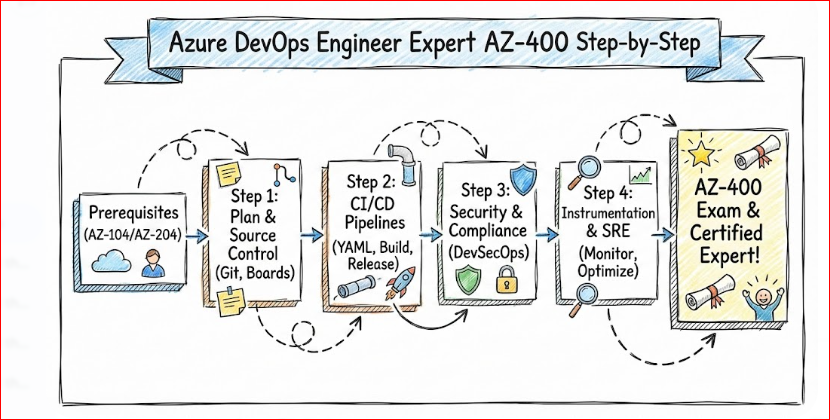
The AZ-400 is an expert-level certification that focuses on the “how” of DevOps. While Associate exams like AZ-104 (Admin) or AZ-204 (Developer) teach you how to build or manage resources, the AZ-400 teaches you how to automate, secure, and monitor those resources in a repeatable way. It covers the cultural and technical aspects of merging development and operations.
Who Should Take It?
- Software Engineers: If you are tired of “throwing code over the wall” and want to understand how your application actually runs in production.
- System Administrators: For those moving away from manual configurations toward Infrastructure as Code (IaC) and automated scaling.
- Engineering Managers: To understand the metrics that matter—like deployment frequency and lead time for changes—and how to implement them.
- Site Reliability Engineers (SREs): To master the Azure-native tools for monitoring, incident response, and maintaining high availability.
Skills You’ll Gain
- Advanced CI/CD Design: Moving beyond simple scripts to multi-stage, environment-aware pipelines.
- Infrastructure as Code (IaC): Mastering Bicep, ARM templates, and Terraform to treat your infrastructure exactly like your application code.
- Modern Security (DevSecOps): Implementing “Shift Left” by integrating automated vulnerability scanning and secret management into the build process.
- Observability & Feedback: Using Azure Monitor and Application Insights to create a closed-loop system where production data informs the next development cycle.
- Strategic SRE: Learning to balance the speed of innovation with the stability of the system using SLIs and SLOs.
Real-World Projects You Should Master
- Multi-Region Disaster Recovery: Setting up a pipeline that can deploy an entire stack to a secondary region in minutes if the primary fails.
- Containerized Microservices: Building a full “code-to-Kubernetes” pipeline involving Azure Container Registry and Azure Kubernetes Service (AKS).
- Automated Compliance: Creating “Guardrails” using Azure Policy that automatically prevent the deployment of non-compliant resources.
- Zero-Trust Security Pipelines: Configuring pipelines that use Managed Identities and Key Vault, ensuring no human or machine ever sees a raw password.
Detailed Certification Track
| Track | Level | Who it’s for | Prerequisites | Skills Covered | Recommended Order |
| DevOps | Expert | Engineers/SREs | AZ-104 or AZ-204 | CI/CD, IaC, SRE, Security | 2nd (After Associate) |
Preparation Plan: Choose Your Pace
The 14-Day Sprint (For Veterans)
This is for those who are already using Azure DevOps daily and just need to align their knowledge with the exam objectives.
- Days 1-3: Focus on Azure Boards, Repo branching strategies (Gitflow vs. Trunk-based), and Project Security.
- Days 4-7: Deep dive into YAML-based Multi-stage Pipelines and Environment Gates.
- Days 8-11: Master Infrastructure as Code (Bicep/Terraform) and Container strategy.
- Days 12-14: Practice Exams. Focus specifically on the “Case Studies” section of the exam.
The 30-Day Plan (The Standard Path)
- Week 1 (Planning & Source Control): Configure Azure Boards for Scrum, manage technical debt with SonarCloud, and master Git hooks.
- Week 2 (CI/CD & Release): Build pipelines for various stacks (.NET, Java, Node.js). Practice “Gates” and “Approvals.”
- Week 3 (IaC & Security): Automate environment provisioning. Integrate WhiteSource Bolt for open-source license compliance.
- Week 4 (Instrumentation & SRE): Setup App Insights, log analytics, and define health probes. Take 3 full-length mock exams.
The 60-Day Journey (For Career Switchers)
- Month 1: Focus entirely on the Associate level (AZ-104 or AZ-204). You cannot build a pipeline for something you don’t understand how to manage manually.
- Month 2: Work through the Microsoft Learn modules for AZ-400, building every lab from scratch. Spend the final 10 days on exam-specific practice.
Common Mistakes to Avoid
- The “UI Only” Trap: Azure DevOps has a great web interface, but the exam focuses heavily on YAML. If you can’t write a pipeline in code, you will struggle.
- Ignoring Open Source: The exam isn’t just about Microsoft tools. You need to know how it integrates with GitHub, Jenkins, Terraform, and Docker.
- Skipping the Prerequisite: Don’t try to pass AZ-400 without passing your Associate exam first. The concepts are cumulative.
- Overlooking the “Feedback” Pillar: Many candidates focus on the “Build” and “Release” parts but forget to study the “Monitor” and “Optimize” sections, which make up a significant portion of the score.
Choose Your Path: 6 Specialized Learning Tracks
DevOps is a wide field. Once you have the AZ-400 foundation, you should specialize:
- DevOps: The generalist path. Focus on end-to-end automation and culture.
- DevSecOps: Focus on security automation. You become the bridge between the security team and the developers.
- SRE: Focus on reliability. You care about latency, traffic, errors, and saturation.
- AIOps/MLOps: The frontier. You apply CI/CD to machine learning models, ensuring they retrain and deploy correctly.
- DataOps: Crucial for big data. You bring version control and automated testing to data pipelines and SQL changes.
- FinOps: The money path. You use DevOps to monitor cloud spend and optimize resource usage to save the company money.
Role → Recommended Certifications Mapping
| Role | Recommended Path | Why? |
| DevOps Engineer | AZ-104 → AZ-400 | Foundation + Expert Automation. |
| SRE | AZ-104 → AZ-400 → SRE Prep | Focus on reliability and automation. |
| Platform Engineer | AZ-104 → AZ-400 → Terraform | Building the internal developer platform. |
| Cloud Engineer | AZ-104 → AZ-305 → AZ-400 | Knowing how to build and how to automate. |
| Security Engineer | AZ-500 → AZ-400 | Securing the infrastructure and the pipeline. |
| Data Engineer | DP-203 → AZ-400 | Automating complex data workflows. |
| FinOps Practitioner | AZ-104 → FinOps Cert | Controlling cloud costs through automation. |
| Engineering Manager | AZ-900 → AZ-400 (Audit) | Understanding the lifecycle and KPIs. |
Top Institutions for Training & Certification
When choosing where to learn, look for labs and expert mentorship.
1. DevOpsSchool
As one of the pioneers in the DevOps training space, DevOpsSchool offers an exhaustive curriculum that mirrors the complexities of enterprise-scale Azure environments. Their program is famous for its “Zero-to-Hero” approach, providing integrated labs that cover everything from advanced YAML pipelines to complex dependency management. It is particularly well-suited for engineers looking to move into lead or architect roles.
2. Cotocus
Cotocus stands out for its focus on the “Practice of DevOps” rather than just the “Tools of DevOps.” Their AZ-400 training is highly interactive, featuring mentorship from industry veterans who bring real-world production scenarios into the classroom. They excel at helping students understand the cultural shift required for DevOps, making it a favorite for corporate teams and transitioning managers.
3. Scmgalaxy
With a deep heritage in Software Configuration Management, Scmgalaxy provides a unique perspective on the AZ-400. They focus heavily on the “Source Control” and “Compliance” pillars of the exam, ensuring that students master the intricacies of Git, branching strategies, and governance. It is an excellent resource for those who want a solid foundation in the “Dev” side of DevSecOps.
4. BestDevOps
BestDevOps lives up to its name by offering a streamlined, project-centric learning path designed for busy professionals. Their training modules are broken down into digestible, high-impact sessions that focus on the most frequently tested areas of the AZ-400 exam. If you are looking for an efficient way to get certified without sacrificing depth, this is a strong contender.
5. DevSecOpsSchool.com
In an era where security cannot be an afterthought, this institution focuses on the “Shift Left” philosophy. Their AZ-400 training integrates advanced security tooling directly into the Azure DevOps lifecycle. You’ll learn how to automate vulnerability scanning, manage secrets via Key Vault, and ensure your pipelines are “Secure by Design.”
6. SREschool.com
For those who want to focus on the “Ops” and “Reliability” portions of the AZ-400, SREschool is the gold standard. They deep-dive into the Site Reliability Engineering aspects of the exam, such as instrumentation, logging, and error budget management. It is the perfect choice for engineers who aim to manage high-availability, global-scale applications on Azure.
7. AIOpsSchool.com
As AI and Machine Learning become central to business, AIOpsSchool bridges the gap between traditional DevOps and MLOps. Their training explores how to use Azure DevOps to automate the training and deployment of AI models. This is a forward-looking choice for engineers who want to stay ahead of the next major wave in technology.
8. DataOpsSchool.com
DataOpsSchool addresses the specific challenges of bringing agility to data engineering. Their curriculum focuses on versioning data, automating SQL deployments, and managing complex data pipelines within the Azure ecosystem. This is highly recommended for Data Engineers who are looking to add the “Expert” DevOps credential to their profile.
9. FinOpsSchool.com
With cloud costs spiraling, the FinOps track is more relevant than ever. This institution teaches you how to use Azure DevOps and Azure Monitor to track spend, optimize resource utilization, and build a culture of financial accountability. It’s an essential path for those looking to manage the business side of cloud engineering.
FAQs on Azure DevOps Engineer Expert (AZ-400)
1. How difficult is the AZ-400 exam compared to Associate exams? The AZ-400 is significantly more challenging than the AZ-104 or AZ-204. While Associate exams test your ability to use Azure services, the AZ-400 tests your ability to design and implement end-to-end strategies. It requires a mindset shift from managing resources to automating the entire lifecycle, including cultural and process-oriented questions.
2. Is there a mandatory prerequisite for the AZ-400? Yes. To officially earn the “Microsoft Certified: Azure DevOps Engineer Expert” title, you must first hold either the Azure Administrator Associate (AZ-104) or the Azure Developer Associate (AZ-204) certification. You can take the AZ-400 exam first, but the expert credential will not be awarded until the prerequisite is completed.
3. How much real-world experience do I need before attempting this? Microsoft recommends having at least one to two years of experience working with Azure and DevOps practices. In my experience, even veteran engineers benefit from 4–6 weeks of dedicated study to understand the specific “Microsoft way” of implementing these patterns and to master YAML syntax for pipelines.
4. What is the exam format and passing score? The exam typically consists of 40–60 questions, including multiple-choice, drag-and-drop, and active-screen scenarios. You will also encounter Case Studies that require you to analyze a complex business problem and provide a technical solution. The passing score is 700 out of 1000.
5. How heavily does the exam focus on coding and scripting? You don’t need to be a full-stack developer, but you must be comfortable reading and writing YAML for pipelines and JSON for ARM templates or Bicep. You should also understand basic PowerShell or Bash scripting, as many automation tasks in the exam involve these languages.
6. Does the AZ-400 cover third-party tools like Jenkins, Terraform, or Ansible? Yes. While the focus is on Azure DevOps and GitHub, the “Expert” level requires you to know how to integrate external tools. You may see questions regarding Terraform for IaC, SonarCloud for code quality, or how to migrate from Jenkins to Azure Pipelines.
7. How long is the certification valid, and how do I renew it? The certification is valid for one year. Microsoft has simplified the renewal process: you can renew it for free by passing an online, unproctored assessment on the Microsoft Learn portal during the six months before your certification expires.
8. Can I take the exam in my local language? The AZ-400 is available in multiple languages, including English, Japanese, Chinese (Simplified/Traditional), Korean, German, French, Spanish, Portuguese (Brazil), Russian, Arabic (Saudi Arabia), and Italian.
9. What is the “sequence” of learning you recommend? I recommend the following sequence: Master the basics of Azure (AZ-900 if new), gain the Associate badge (AZ-104 is usually the most robust foundation), and then dive into AZ-400. This ensures you aren’t just memorizing pipeline steps but actually understanding the infrastructure they deploy.
10. What are the key “Pillars” covered in the AZ-400 curriculum? The exam is divided into five main domains:
- Configure processes and communications.
- Design and implement source control.
- Design and implement build and release pipelines.
- Develop a security and compliance plan.
- Implement an instrumentation (monitoring) strategy.
11. How does this certification impact my career and salary? The AZ-400 is highly regarded globally. It qualifies you for high-demand roles like DevOps Architect, Site Reliability Engineer, and Platform Engineer. In markets like India and the US, professionals with this “Expert” badge often see a significant increase in salary and are prioritized for leadership roles in cloud transformations.
12. Is the AZ-400 worth it if my company uses GitHub Actions? Absolutely. Microsoft has aligned Azure DevOps and GitHub closely. Much of the logic you learn for Azure Pipelines (YAML, environments, runners, and secrets) is directly transferable to GitHub Actions. The AZ-400 curriculum now includes substantial content on GitHub integration.
General Career FAQs
1. Should I learn Docker before AZ-400?
Yes. Containerization is a massive part of modern DevOps. Knowing the basics of Docker will make the “Release” section of the exam much easier.
2. Does the AZ-400 expire?
Yes, it is valid for one year. However, the renewal process is a free, unproctored assessment you can do online to stay current.
3. What is the difference between AZ-400 and AZ-204?
AZ-204 is for developers building apps on Azure. AZ-400 is for the engineers building the pipelines that deploy those apps.
4. Is there a lab in the actual exam?
Microsoft occasionally includes performance-based testing (labs), but they are not always present. You should be prepared for them regardless.
5. Which DevOps tool is most important for the exam?
Azure Pipelines is the core, followed closely by Azure Repos and Azure Boards.
6. How do I get hands-on experience without a job?
Use the Azure Free Tier and Azure DevOps for individuals (which is free for up to 5 users). Build your own personal projects there.
7. What is the most common reason people fail?
Lack of practical experience. People who only read the books often get tripped up by the “Case Study” questions that require real-world logic.
8. Will this help me become an SRE?
It is the perfect foundation. The AZ-400 covers the “Operations” and “Reliability” pillars that every SRE needs.
Testimonials
“I had the experience but not the title. Taking the AZ-400 helped me organize my knowledge and gave me the confidence to apply for Senior roles. The focus on YAML pipelines was a game-changer for my daily work.”
— Rajesh M., Lead DevOps Engineer
“After 15 years in IT, I felt I was falling behind. This certification path gave me a clear roadmap to modernize my skills. The SRE concepts specifically helped our team reduce production incidents by 40%.”
— Vikram S., Engineering Manager
Conclusion
The Azure DevOps Engineer Expert (AZ-400) is a significant milestone for any technical professional. It signals that you are not just a user of tools, but a designer of systems. By mastering the pillars of Planning, Development, Delivery, and Operations, you position yourself as an indispensable asset to any modern organization.
Next Certifications to Take
- Same Track: AZ-305 (Solutions Architect) – To see the bigger picture of how systems are designed.
- Cross-Track: AZ-500 (Security) – To become a true DevSecOps leader.
- Leadership: CKA (Certified Kubernetes Administrator) – To master the world of orchestration.
