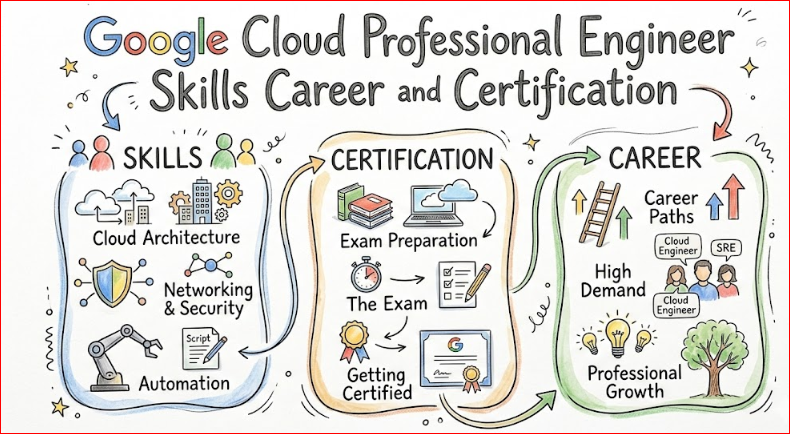
Introduction
The world of cloud engineering is evolving at a breakneck pace, and for working software engineers, system administrators, and engineering managers globally, mastering a major public cloud is no longer optional. It is the absolute baseline for building scalable, reliable, and secure applications in today’s demanding enterprise environments. Throughout my career architecting large-scale operational frameworks and mentoring engineers, I have watched the Google Cloud Platform (GCP) become a dominant force in the industry. Its unparalleled Kubernetes engine (GKE), advanced data analytics pipelines, and developer-friendly tooling make it a top choice for modern, forward-thinking enterprises. This guide is designed to be your ultimate, field-tested roadmap. Whether you are an individual contributor looking to aggressively upskill or a manager mapping out a comprehensive training program for your team, this breakdown of the Google Cloud Professional Engineer program will provide you with absolute, actionable clarity.
Certification Overview at a Glance
Before we dive into the granular technical details, here is a high-level view of the certification landscape for this track. Understanding this matrix is critical for aligning your current skill set with the expectations of the exam and the broader cloud engineering market.
| Track | Level | Who it’s for | Prerequisites | Skills covered | Recommended order |
|---|---|---|---|---|---|
| Cloud DevOps / Site Reliability | Professional | DevOps Engineers, SREs, Cloud Architects, Software Engineers | Hands-on experience with Linux, networking, and basic cloud operations | CI/CD automation, Kubernetes (GKE), Infrastructure as Code (Terraform), Monitoring & Logging | GCP Associate Cloud Engineer → GCP Professional Engineer |
Deep Dive: Google Cloud Professional Engineer
What it is
The Google Cloud Professional Engineer certification is an advanced, industry-recognized credential that aggressively validates an engineer’s ability to build, deploy, manage, and monitor highly scalable applications on GCP. It effectively bridges the historical gap between software development and IT operations, proving definitively that you can balance rigorous service reliability with high-velocity delivery speed.
Who should take it
This certification is tailor-made for working software engineers, DevOps practitioners, and SREs who want to standardize and elevate their cloud deployment methodologies using Google’s best practices. It is equally valuable for Engineering Managers and Technical Leads who need to deeply understand GCP’s operational capabilities to make informed, cost-effective architectural and hiring decisions.
Skills you’ll gain
Passing this certification—and absorbing the rigorous training behind it—fundamentally transforms how you handle modern infrastructure. You will gain deep, practical expertise in:
- Infrastructure as Code (IaC): Writing robust, reusable, and modular Terraform and Deployment Manager scripts to completely automate environment provisioning and eliminate configuration drift.
- Container Orchestration: Mastering Google Kubernetes Engine (GKE), advancing from basic cluster creation and node pool management to complex pod auto-scaling and intricate service networking.
- Continuous Integration / Continuous Delivery (CI/CD): Designing highly automated, zero-touch pipelines using Cloud Build, Artifact Registry, and modern GitOps practices to accelerate software delivery.
- Observability and Monitoring: Implementing comprehensive, proactive logging, alerting, and distributed tracing using the Google Cloud Operations Suite (formerly Stackdriver) to minimize mean time to resolution (MTTR).
- Security and Compliance: Securing complex software supply chains, managing least-privilege IAM permissions at scale, and utilizing Secret Manager for flawless credential rotation.
Real-world projects you should be able to do after it
Theoretical knowledge alone does not make a reliable engineer; the market demands proven execution. After completing this intensive program, you will be fully equipped to independently execute high-impact, enterprise-grade projects, such as:
- Zero-Downtime Deployment Pipelines: Building a fully automated CI/CD pipeline that rigorously tests, builds, and deploys microservices via Blue/Green or Canary release strategies without disrupting end users.
- Multi-Region High Availability Architectures: Designing and deploying a globally distributed, resilient application utilizing Global HTTP(S) Load Balancing, Cloud SQL cross-region replicas, and multi-zone GKE clusters.
- Automated Incident Response Systems: Setting up sophisticated custom metrics that trigger automated alerts to Slack or PagerDuty, while simultaneously kicking off self-healing auto-remediation scripts via Cloud Functions.
- Cost-Optimized Infrastructure: Auditing an existing, bloated GCP footprint, accurately identifying idle resources, and implementing aggressive auto-scaling policies to drastically reduce monthly cloud spend.
Preparation plan
Your preparation timeline heavily depends on your current hands-on experience level, requiring a brutally honest self-assessment before you begin. Here are three distinct, battle-tested paths:
7–14 Days (The Fast Track for Veterans)
If you are already working heavily in GCP on a daily basis and just need to validate your skills, spend the first week reviewing the official exam guide and identifying technical blind spots (often complex IAM or specific Cloud Build configurations). Spend the second week aggressively doing timed practice exams to get used to the grueling question format and pacing.
30 Days (The Standard Path for Working Engineers)
- Week 1: Focus entirely on foundational compute and complex orchestration; you must master GKE, Compute Engine, and serverless options like Cloud Run.
- Week 2: Dive deeply into automated CI/CD pipelines, mastering Cloud Build, Artifact Registry, and declarative Infrastructure as Code using Terraform.
- Week 3: Dedicate this week entirely to observability; learn how to configure custom metrics, trace distributed latency issues, and meticulously set up SLIs/SLOs.
- Week 4: Take multiple practice tests, review critical security best practices (IAM, VPC Service Controls), and rest your mind before sitting for the grueling exam.
60 Days (The Comprehensive Path for Beginners)
Spend the first 30 days painstakingly building foundational cloud knowledge; take your time executing hands-on labs, setting up a free-tier GCP account, and intentionally breaking things to learn how to fix them. Use the second 30 days to strictly follow the structured “Standard Path” above, ensuring every single theoretical concept is backed by solid, hands-on muscle memory.
Common mistakes
- Ignoring Service Level Objectives (SLOs): Many engineers focus only on shiny tools (like GKE) and completely fail to understand the core SRE principles (SLIs, SLOs, Error Budgets) that Google heavily emphasizes on the exam.
- Skipping Hands-on Labs: Reading documentation is simply not enough to pass; if you haven’t deployed a complex VPC or configured granular IAM roles via the CLI, you will actively struggle with the scenario-based questions.
- Underestimating Networking: Assuming cloud networking is identical to traditional on-premise networking is a fatal flaw; you must deeply understand Google’s global VPC architecture, custom subnets, and precise firewall rules.
- Rushing the Exam: The questions are notoriously long, wordy, and scenario-based; misreading a single, subtle constraint (e.g., “minimize cost” vs. “maximize availability”) can easily lead you to select the wrong answer.
Best next certification after this
To continue your aggressive career growth and marketability, you should plan your next strategic move carefully based on your long-term goals:
- Same track: GCP Professional Cloud Architect. This highly respected credential broadens your scope from tactical operational deployment to strategic, enterprise-wide architectural design and business alignment.
- Cross-track: Certified Kubernetes Administrator (CKA). If you want to remain deeply technical, hands-on, and vendor-neutral, mastering vanilla Kubernetes cluster administration is the absolute perfect next step.
- Leadership: FinOps Certified Practitioner. For those transitioning into management or director roles, learning how to govern, forecast, and optimize massive cloud financial spend is an incredibly lucrative and rare skill.
Choose Your Path: Modern Engineering Tracks
The technology landscape is no longer a simple, one-size-fits-all progression; it demands deep specialization. Once you understand the fundamental core of cloud engineering, you must intentionally choose a specialized path to maximize your impact. Here are the six primary paths defining the modern, high-velocity IT industry:
1. DevOps
DevOps is the foundational, cultural philosophy of bridging development and operations to maximize delivery velocity. In this path, your relentless focus is on extreme automation; you will champion CI/CD tools, strict version control, and infrastructure automation. Your daily, primary goal is to remove every ounce of friction from the software delivery lifecycle so developers can push code safely multiple times a day.
2. DevSecOps
Security can no longer be an afterthought treated as a final roadblock; it must be shifted left. The DevSecOps path seamlessly integrates aggressive security testing directly into the daily development pipeline. As a practitioner here, you will implement automated static and dynamic code analysis, continuous container vulnerability scanning, and strict automated compliance checks to ensure speed never compromises safety.
3. Site Reliability Engineering (SRE)
Originated by Google, SRE applies a rigorous software engineering mindset to complex system administration and operations. If you choose this highly analytical path, you will focus heavily on system availability, latency optimization, performance tuning, and capacity planning. You will live and breathe SLIs, SLOs, and Error Budgets, acting as the ultimate, data-driven guardian of the end-user experience.
4. AIOps / MLOps
Artificial Intelligence and Machine Learning are completely transforming traditional IT operations and software delivery. AIOps focuses on leveraging advanced AI models to automate rapid IT incident resolution, log analysis, and proactive anomaly detection. MLOps, conversely, is about creating robust, repeatable pipelines to train, test, and deploy complex machine learning models continuously into production environments.
5. DataOps
Data is the lifeblood of modern business intelligence, but moving it securely and reliably at scale is incredibly complex. The DataOps path focuses intensely on creating reliable, scalable, and highly automated data pipelines. You will apply core DevOps principles to data engineering—ensuring strict data quality, automating complex ETL/ELT deployments, and providing seamless, secure data access for analytics teams.
6. FinOps
Infinite cloud elasticity is an incredible engineering feat, but unchecked, it can lead to massive, unexpected, and crippling monthly bills. FinOps (Cloud Financial Management) is the vital cultural practice of bringing strict financial accountability to the variable spend model of the public cloud. In this critical path, you will work across engineering, finance, and business teams to relentlessly optimize cloud costs and maximize organizational ROI.
Role → Recommended Certifications Mapping
| Current / Target Role | Recommended Certifications to Pursue |
|---|---|
| DevOps Engineer | Google Cloud Professional Engineer, CKA, Terraform Associate |
| Site Reliability Engineer (SRE) | Google Cloud Professional Engineer, SRE Foundation |
| Platform Engineer | CKA, CKAD, Google Cloud Professional Architect |
| Cloud Engineer | GCP Associate Cloud Engineer, Google Cloud Professional Engineer |
| Security Engineer | GCP Professional Cloud Security Engineer, CKS (Kubernetes Security) |
| Data Engineer | GCP Professional Data Engineer, DataOps Certification |
| FinOps Practitioner | FinOps Certified Practitioner, GCP Professional Cloud Architect |
| Engineering Manager | GCP Cloud Digital Leader, ITIL 4, FinOps Certified Practitioner |
Top Institutions for Google Cloud Professional Engineer Training
DevOpsSchool
DevOpsSchool is a premier, globally recognized training provider known for its rigorously demanding, hands-on curriculum and elite industry-veteran instructors. They offer the highly acclaimed Google Cloud Professional Engineer program, which deliberately focuses heavily on complex, real-world projects rather than just passing theoretical book knowledge. Their massive global reach and proven track record make them a top choice for both ambitious individual engineers and large corporate teams.
Cotocus
Cotocus excels remarkably in providing high-end IT consulting combined with bespoke, enterprise-grade training solutions tailored for complex environments. They specialize in directly helping large organizations successfully transition from fragile legacy on-premise systems to robust, modern cloud-native architectures. Their unique training methodology is deeply rooted in solving complex, client-specific architectural challenges rather than generic scenarios.
Scmgalaxy
Scmgalaxy boasts one of the most vibrant, highly active, community-driven learning platforms dedicated to software configuration management and advanced CI/CD. Their courses are intensely practical and lab-focused, giving engineers direct, unfiltered exposure to the absolute latest tools in the continuous delivery pipeline. They are highly recommended for detailed-oriented engineers looking to master the granular intricacies of version control and build automation.
BestDevOps
BestDevOps focuses relentlessly on mastering the complete, end-to-end tooling ecosystems required for modern, high-velocity software delivery. Their comprehensive training programs are meticulously structured to help professionals deeply understand how disparate tools—from Jira to Jenkins to GCP—integrate seamlessly into a single workflow. They are an excellent, pragmatic choice for operational teams looking to aggressively standardize their entire DevOps toolchain.
devsecopsschool.com
As enterprise security becomes absolutely paramount, devsecopsschool.com provides laser-focused, specialized training on embedding rigorous security directly into cloud pipelines. Their advanced curriculum covers everything from complex threat modeling to implementing automated container scanning and policy-as-code in GCP environments. This is the ultimate, premium destination for ambitious engineers wanting to pivot quickly into the high-demand, high-paying DevSecOps space.
sreschool.com
Built purely around the foundational, math-driven principles of Site Reliability Engineering, sreschool.com teaches the exact Google methodology for managing massive distributed systems. Students learn the rigorous mathematics behind true reliability, how to define and enforce strict SLOs, and the delicate cultural art of conducting blameless post-mortems. It is the absolute best place to permanently shift your mindset from reactive traditional ops to proactive, modern reliability engineering.
aiopsschool.com
Leading the aggressive charge in next-generation, intelligent operations, aiopsschool.com focuses entirely on integrating advanced artificial intelligence into IT monitoring and automated incident management. Their cutting-edge courses teach engineers how to train and deploy predictive models that accurately forecast system outages long before they actually happen. They are actively pioneering the vital educational space required for building true, self-healing infrastructure.
dataopsschool.com
Modern data operations require a highly unique, specialized blend of robust pipeline architecture and rigorous quality assurance, which is exactly what dataopsschool.com provides. Their intensive training ensures that data engineers know exactly how to build resilient, automated data workflows using modern, scalable cloud services. They successfully bridge the critical, often-ignored gap between agile software delivery and massive big data management.
finopsschool.com
With enterprise cloud budgets frequently spiraling completely out of control, finopsschool.com offers absolutely essential training on strict cloud cost management and financial optimization. Their detailed programs teach engineers and financial managers how to enforce strict resource tagging, accurately track complex unit economics, and implement aggressive auto-scaling efficiently. They empower technical teams to finally treat cloud infrastructure as a deeply optimized, highly transparent financial asset.
FAQs on Google Cloud Professional Engineer
1) What is a Google Cloud “Professional Engineer” certification?
It is a professional-level Google Cloud credential under the Google Cloud Certifications program.
It is meant to validate real job skills (designing, building, and operating solutions on Google Cloud) rather than only basic awareness.
2) Who should take it?
Working engineers (DevOps/SRE/Cloud/Platform engineers) should take it if they manage production systems and want a structured way to prove capability.
Engineering managers can also use it to understand modern cloud operations and set a consistent skills bar for teams.
3) Are there any prerequisites?
Google Cloud certifications generally do not have enforced prerequisites to sit for an exam.
Still, most candidates do better when they already have hands-on experience on Google Cloud and are comfortable with core cloud concepts.
4) How much does the exam cost?
Google Cloud professional certification exams are priced at $200 USD (plus applicable taxes where relevant).
5) What is the exam format and duration?
Professional-level exams are timed and typically have a 2-hour duration (exact details vary by specific professional certification).
Questions are scenario-based and test decision-making, not just definitions.
6) How long is the certification valid?
Google Cloud professional certifications are valid for two years.
After that, you need to recertify to keep the credential current.
7) If I fail, can I retake the exam?
Yes—Google allows retakes, but you must follow their official retake policy and waiting rules.
Plan to review your weak areas and do more hands-on practice before the next attempt.
8) Where do I register and how do I take the exam?
Registration and delivery options (such as online proctoring and/or test-center delivery) are covered in Google’s official certification FAQs and certification portal.
Always use the official Google Cloud certification pages to confirm the latest scheduling and identification requirements.
Frequently Asked Questions (FAQs)
1. How difficult is the Google Cloud Professional Engineer certification?
It is widely considered one of the more brutally challenging professional-level cloud exams currently available in the market. It goes far beyond simple, rote service identification and strictly requires a deep, nuanced understanding of complex architectural trade-offs, rigorous SRE principles, and hands-on troubleshooting of broken deployments.
2. How much time does it take to prepare?
For an experienced engineer with consistent, daily, hands-on cloud experience, 3-4 weeks of highly focused, dedicated study is usually sufficient. However, for someone transitioning from a purely on-premise background or a siloed software development role, expect to dedicate 60 to 90 days of consistent, grueling learning and lab work.
3. What are the strict prerequisites?
Google does not actually enforce any mandatory prerequisites; technically, you can pay the fee and sit for the exam immediately. However, to actually pass, it is highly recommended to have 1-3 years of solid industry experience and a very strong foundational knowledge of Linux administration and TCP/IP networking.
4. What sequence of certifications should I follow?
A standard, highly effective, and proven sequence is to start with the GCP Associate Cloud Engineer to build vital foundational CLI and console skills. Follow that immediately with the Google Cloud Professional Engineer to master daily operations, and finally cap it with the GCP Cloud Architect for high-level, strategic enterprise design.
5. Is this certification valued in the Indian and Global markets?
Absolutely; global enterprises, particularly in finance, retail, and tech, are heavily and aggressively adopting GCP to modernize their stacks. In major tech hubs across India, the US, and Europe, possessing this specific certification strongly signals to elite employers that you can handle massive, enterprise-scale cloud environments, making you a premium, highly sought-after candidate.
6. What career outcomes can I expect?
Dedicated professionals who successfully achieve this certification typically move rapidly into lucrative Senior Cloud Engineer, Site Reliability Engineer, or Lead DevOps roles. It is also an excellent, proven catalyst for traditional Software Engineers looking to transition seamlessly into highly paid, highly respected Platform Engineering positions.
7. Can a pure Software Engineer take this?
Yes, and they absolutely should; modern “Shift Left” paradigms strictly require SWEs to deeply understand exactly how their code runs and fails in production. This rigorous certification will make you a significantly better, more holistic developer by teaching you how to write truly cloud-native, easily deployable, and highly observable code.
8. Why does this exam focus so heavily on SRE?
Google literally invented the SRE discipline to manage their own massive global infrastructure efficiently. They firmly believe that standard DevOps tools (like Jenkins or Terraform) are merely the “how,” while the rigorous mathematics of SRE provides the crucial “why.” Deeply understanding Error Budgets and SLOs is absolutely critical to passing this exam because it is the exact methodology Google uses internally.
9. Are there hands-on labs in the actual exam?
Currently, the GCP Professional exams are heavily scenario-based multiple-choice and complex multiple-select questions rather than live lab environments. However, the theoretical scenarios are so incredibly complex and nuanced that attempting to pass via simple memorization without deep, hands-on lab experience is highly likely to result in a failing score.
10. How long is the certification valid?
The certification is strictly valid for only two years from the exact date you successfully pass the exam. Because cloud technologies, managed services, and best practices evolve so incredibly rapidly, Google requires aggressive recertification to ensure your skills remain highly relevant to the current, modern state of the platform.
11. Does this certification require coding knowledge?
You do not need to be a master, daily programmer in complex languages like Java or C++, but you must be highly comfortable reading, writing, and debugging declarative languages (like complex YAML for Kubernetes) and Infrastructure as Code (HCL for Terraform), as well as writing robust, automated bash/shell scripts.
12. I am an Engineering Manager; should I take this?
If you actively manage technical cloud infrastructure teams, taking this certification (or at least rigorously studying the curriculum) is highly and undeniably beneficial. It gives you the precise technical vocabulary required to communicate effectively with your SREs, critically evaluate proposed architectural changes, and confidently lead massive technical transformations.
Testimonials
“Transitioning from a traditional, siloed sysadmin role to a modern cloud-native platform team felt completely overwhelming until I strictly structured my learning around the rigorous Google Cloud Professional Engineer track. The intense, hands-on focus on mastering Kubernetes and Terraform completely changed my daily workflow and completely accelerated my career trajectory.”
— Rahul M., Senior Site Reliability Engineer
“As an Engineering Manager responsible for critical systems, I absolutely need my teams to deploy software safely, rapidly, and reliably without constant hand-holding. I now strictly mandate this specific certification track for all of my tech leads because it ensures we are all speaking the exact same operational language when it comes to CI/CD and complex system observability.”
— Sarah J., Director of Cloud Operations
“I was a traditional Java developer who frankly didn’t understand why my code behaved so radically differently in a production environment compared to my local machine. Taking the comprehensive training through DevOpsSchool completely opened my eyes to the realities of modern infrastructure; now, I design my applications specifically to leverage the power of GKE and Cloud Build.”
— Amit P., Lead Software Engineer
Conclusion
The aggressive transition to cloud-native operations is undeniably the defining, non-negotiable shift of our modern era in enterprise technology. Relying on fragile manual deployments, blindly guessing at necessary system capacity, and willfully ignoring detailed cost metrics are archaic practices of the past that will doom modern businesses. Earning the highly respected Google Cloud Professional Engineer certification is far more than just adding a shiny logo to your resume; it is a definitive, public declaration of your deep technical maturity and operational expertise.
