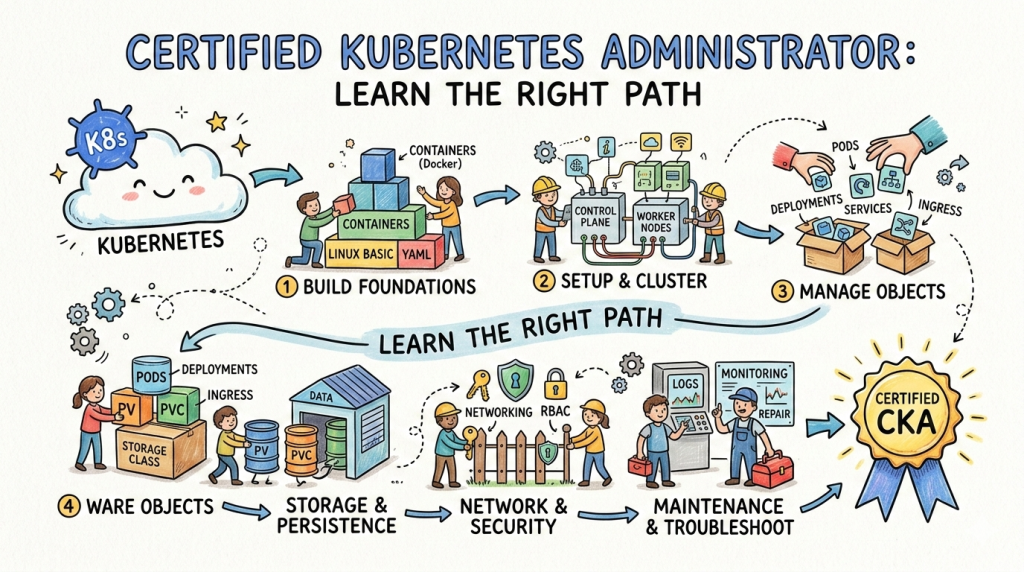
Intorduction
In the rapidly evolving landscape of IT infrastructure, few technologies have made an impact quite like Kubernetes. Having watched the industry shift from physical servers to virtual machines, and now to container orchestration, I can confidently say that Kubernetes is the operating system of the modern cloud. For engineers and managers today, understanding Kubernetes isn’t just a “nice-to-have”—it is essential. However, there is a big difference between understanding the concepts and actually being able to manage a production cluster when things go wrong. That is where the Certified Kubernetes Administrator (CKA) certification comes in. It is hands-on proof that you have the skills to run Kubernetes in the real world. This guide will walk you through everything you need to know about the CKA, why it matters for your career, and how to prepare effectively.
Certification Overview
Below is an overview of the primary certification focus for administrators looking to validate their skills.
| Track | Level | Who it’s for | Prerequisites | Skills Covered | Recommended Order |
| Kubernetes Administration | Intermediate to Advanced | SysAdmins, DevOps Engineers, SREs, Cloud Engineers | Solid understanding of Linux, Networking, and Basic Docker | Cluster installation, Networking, Storage, Troubleshooting, Security primitives | Typically taken after gaining some hands-on experience or foundational knowledge. |
Deep Dive: Certified Kubernetes Administrator (CKA)
What it is
The CKA is a performance-based certification. This means there are no multiple-choice questions. You are given access to a command line in a real Kubernetes environment and tasked with solving practical problems, such as fixing a broken cluster or deploying a complex application stack, under a time limit.
Who should take it
This certification is designed for infrastructure engineers who are responsible for the “care and feeding” of Kubernetes clusters. If you are a Systems Administrator, Site Reliability Engineer (SRE), or a DevOps Engineer whose job involves keeping the platform running smoothly, this is for you.
Skills you’ll gain
By preparing for this exam, you will move beyond surface-level knowledge and master the core components of Kubernetes:
- Cluster Architecture & Installation: How to build a cluster from scratch using tools like
kubeadmand how to manage highly available setups. - Workloads & Scheduling: Understanding how to run applications efficiently and control where they run using taints, tolerations, and node affinity.
- Services & Networking: Mastering how pods communicate internally and how to expose applications to the outside world using Ingress.
- Storage: Learning how to manage persistent data using Persistent Volumes and Claims.
- Troubleshooting: Gaining the ability to diagnose crashed nodes, failed deployments, and networking issues quickly.
Real-world projects you should be able to do after it
Once you have mastered the CKA curriculum, you will be ready to handle production tasks such as:
- Diagnosing and fixing a production cluster node that has stopped reporting its status.
- Setting up a secure, multi-tenant environment using namespaces, resource quotas, and network policies to isolate different teams.
- Performing a zero-downtime upgrade of a Kubernetes cluster from one minor version to the next.
- Implementing a robust backup and restore strategy for the cluster’s etcd datastore.
Preparation plan
The 7–14 Day Sprint (For Experienced Users)
If you use Kubernetes daily, focus entirely on speed and muscle memory. Spend your time doing practice labs and getting comfortable with imperative commands to save time during the exam.
The 30 Day Plan (For Intermediate Users)
Deduct one hour a day. Spend the first two weeks going through structured training materials and documentation. Spend the last two weeks exclusively on hands-on labs, repeating difficult scenarios until they feel second nature.
The 60 Day Journey (For Beginners)
Start with the basics of Linux and containerization (Docker) for the first few weeks. Don’t rush into Kubernetes until the foundations are solid. Spend the remaining six weeks meticulously going through each domain of the CKA curriculum, ensuring you understand the “why” along with the “how.”
Common mistakes
- Poor Time Management: Getting stuck on one hard question for 30 minutes. If you don’t know it, flag it and move on.
- YAML Indentation Errors: A single wrong space can break a deployment. Get comfortable spotting these quickly.
- Ignoring Contexts: The exam uses multiple clusters. Failing to switch to the correct cluster context before running commands is a guaranteed way to fail a task.
- Relying on GUI tools: The exam is 100% CLI-based. You must be comfortable in the terminal.
Best next certification after this
The most logical progression for an administrator is the Certified Kubernetes Security Specialist (CKS). It builds directly on the CKA foundations but focuses intensely on securing the cluster supply chain and runtime environment.
Choose Your Path: Learning Journeys
Kubernetes is a foundational technology that supports many different specialized career paths. Depending on your goals, here is how you can leverage CKA.
DevOps
For DevOps professionals, CKA is about enabling speed. You need to understand the platform deeply so you can build robust CI/CD pipelines that deploy applications seamlessly into the cluster, handle rollbacks automatically, and ensure consistency across environments.
DevSecOps
Security is no longer an afterthought. In this path, CKA provides the knowledge of how the cluster works so you can secure it. You will focus on integrating security scanning into pipelines, managing secrets securely, and configuring strict network policies to limit blast radius.
SRE (Site Reliability Engineering)
For an SRE, the platform is the product. CKA is crucial for understanding failure domains. Your focus will be on observability, setting up Prometheus and Grafana for monitoring, configuring auto-scaling to handle load, and mastering troubleshooting to minimize MTTF (Mean Time To Recovery).
AIOps/MLOps
Running machine learning workloads involves unique challenges, particularly with GPU resources. CKA helps you understand how to schedule these heavy workloads efficiently, manage their complex dependencies, and use tools like Kubeflow to streamline the ML lifecycle on Kubernetes.
DataOps
Data-intensive applications require stable, persistent storage. CKA gives you the skills to manage StatefulSets, integrate with external storage providers, and ensure databases running on Kubernetes are highly available and backed up correctly.
FinOps
Cloud costs can spiral quickly with Kubernetes. A FinOps path uses CKA knowledge to implement governance. You will focus on setting resource requests and limits, using namespaces for cost allocation, and utilizing tools to identify idle resources to optimize spending.
Role → Recommended Certifications Mapping
| Job Role | Core Certification | Recommended Add-on Certifications | Focus Area |
| DevOps Engineer | CKA | Jenkins / GitLab CI + Terraform Associate | CI/CD pipelines and infrastructure as code. |
| Site Reliability Engineer (SRE) | CKA | Prometheus Certified Associate + LFCS (Linux) | System health, monitoring, and uptime. |
| Platform Engineer | CKA | CKS + Service Mesh (like Istio) | Building internal developer tools and secure networking. |
| Cloud Engineer | CKA | AWS Solutions Architect / Azure Administrator | Connecting Kubernetes with major cloud providers. |
| Security Engineer | CKA | Certified Kubernetes Security Specialist (CKS) | Hardening clusters and securing the supply chain. |
| Data Engineer | CKA | Kafka or Spark on Kubernetes Certifications | Managing heavy data workloads in containers. |
| FinOps Practitioner | CKA | FinOps Certified Practitioner | Tracking and cutting down cloud computing costs. |
| Engineering Manager | CKA | Agile / Scrum Master Certifications | Technical team leadership and project delivery. |
General FAQs: Career & Value
1. Is the CKA exam difficult?
Yes, it is widely considered challenging because it is practical. You cannot guess your way through it. You must possess actual hands-on ability to perform the required tasks under time pressure.
2. Does the CKA expire?
Yes, the CKA certification is valid for three years. This ensures that certified professionals stay current with the fast-paced changes in the Kubernetes ecosystem.
3. Is CKA valuable for managers?
Absolutely. While managers may not be configuring clusters daily, the CKA gives them the technical literacy to understand the challenges their teams face, estimate project timelines accurately, and make informed vendor decisions.
4. What is the difference between CKAD and CKA?
CKAD (Application Developer) focuses on using the cluster to run apps (Pods, Deployments, Services). CKA (Administrator) focuses on managing the cluster itself (Nodes, Networking, Storage, Troubleshooting).
5. Should I learn Docker before Kubernetes?
Yes. Kubernetes orchestrates containers. You must understand container fundamentals (what an image is, how a container runs) before you can effectively manage them at scale with Kubernetes.
6. How much does a CKA certified engineer earn?
While salaries vary by region and experience, CKA certified engineers typically command a significant premium over non-certified peers due to the high demand for proven practical skills in cloud-native technologies.
7. Can I take the exam from home?
Yes, it is an online, proctored exam. You need a quiet, private location, a reliable internet connection, and a computer with a webcam.
8. Is Linux knowledge necessary?
It is critical. You should be comfortable navigating the file system, editing files (using vim or nano), checking system processes, and understanding basic networking concepts in Linux.
9. How long does it take to prepare?
Depending on your starting experience, it usually takes between one to three months of consistent study and hands-on practice.
10. Do I need to know programming?
You do not need to be a software developer, but you must be comfortable reading and writing YAML files, as this is how nearly everything is configured in Kubernetes.
11. Will this cert get me a job?
No certification guarantees a job, but the CKA is highly respected by hiring managers. It is often used as a filter to short-list candidates because it proves practical competency.
12. Is it open book?
Yes, during the exam, you have access to one terminal window and one browser tab with access to the official Kubernetes documentation (kubernetes.io/docs). Knowing how to search the docs quickly is a key skill.
Top Training Institutions for CKA
If you are looking for structured guidance to pass the CKA, these institutions offer specialized training.
- DevOpsSchool: Known for comprehensive, industry-aligned curriculum that blends theoretical knowledge with intense hands-on labs, specifically designed to get you job-ready.
- Cotocus: Focuses on deep technical dives and practical implementation, helping engineers understand complex cloud-native concepts through real-world scenarios.
- Scmgalaxy: A great hub for community-driven learning, offering resources and training focused on the broader DevOps toolchain and configuration management.
- BestDevOps: Provides streamlined learning paths aimed at helping professionals quickly upskill and transition into high-demand DevOps roles.
- devsecopsschool.com: The premier destination if your focus is integrating security directly into your Kubernetes and CI/CD workflows.
- sreschool.com: Tailored specifically for those focusing on reliability, scalability, and monitoring of large-scale systems.
- aiopsschool.com: Bridges the gap between AI/ML workloads and infrastructure, teaching you how to support data scientists with robust platforms.
- dataopsschool.com: Focuses on the unique challenges of managing stateful applications, databases, and big data pipelines in a containerized environment.
- finopsschool.com: Essential for understanding cloud economics and learning how to manage and optimize costs in dynamic Kubernetes environments.
FAQs: Certified Kubernetes Administrator (CKA) Focus
1. What is the passing score for CKA?
The passing score is currently 66%. It is a pass/fail exam.
2. How many questions are on the exam?
The exam usually consists of 15-20 performance-based tasks. Some are short, while others involve multiple steps.
3. Which version of Kubernetes is tested?
The exam runs on a very recent version of Kubernetes. It is usually updated within a few weeks of a new minor K8s release. You should always study on a current version.
4. Are there free retakes?
Typically, when you purchase the exam voucher directly from the official provider, it includes one free retake in case you do not pass on your first attempt.
5. How is the exam graded?
It is graded automatically based on the final state of your cluster resources. It doesn’t matter how you achieved the result, only that the result is correct according to the task requirements.
6. What tools can I use during the exam?
You will primarily use kubectl. You are also allowed to use standard Linux tools available in the environment, such as jq, tmux, and text editors like vim or nano.
7. Do I need to build a cluster from scratch in the exam?
Yes, one of the tasks often involves using kubeadm to create a cluster or add nodes to an existing cluster.
8. Can I use external websites like StackOverflow during the exam?
No. You are strictly limited to the official Kubernetes documentation domain. Accessing other websites will result in automatic failure.
Next Certifications to Take
Once you have achieved the CKA, here are three distinct directions for your continued growth:
- Same Track (Deepen your skills): Certified Kubernetes Security Specialist (CKS). This makes you a true expert in the platform.
- Cross-Track (Broaden your skills): HashiCorp Certified: Terraform Associate. This will help you manage the underlying infrastructure that Kubernetes runs on.
- Leadership (Advance your career): Project Management Professional (PMP) or Certified ScrumMaster (CSM), to help you lead teams and manage large-scale migration projects.
Testimonials
“I had been working with Kubernetes for a year, but I always felt like I was just following tutorials. Studying for the CKA forced me to understand what was happening under the hood. Passing the practical exam gave me incredible confidence in my daily job.”
— Rajesh K., Senior DevOps Engineer
“As a manager, I took the CKA to better support my SRE team. It was tough, but it changed the way we communicate. I can now have meaningful technical discussions about architecture and resourcing. Highly recommended for technical leaders.”
— Sarah L., Director of Infrastructure
“The hands-on nature of this certification is its biggest strength. It’s not about memorizing facts; it’s about fixing things when they break. The skills I gained during my CKA preparation saved our production environment more than once.”
— Ahmed B., Site Reliability Engineer
Conclusion
Throughout my career, I have seen many certifications come and go. The Certified Kubernetes Administrator (CKA) is different because it proves you have practical, hands-on ability in a technology that is defining the future of infrastructure. It is not an easy exam, but the journey of preparing for it will make you a better engineer. It moves you from “guessing and checking” to truly understanding the systems you manage. Whether you are looking to secure your current role or step up into a new one, mastering Kubernetes via the CKA is one of the best investments you can make in your future.
