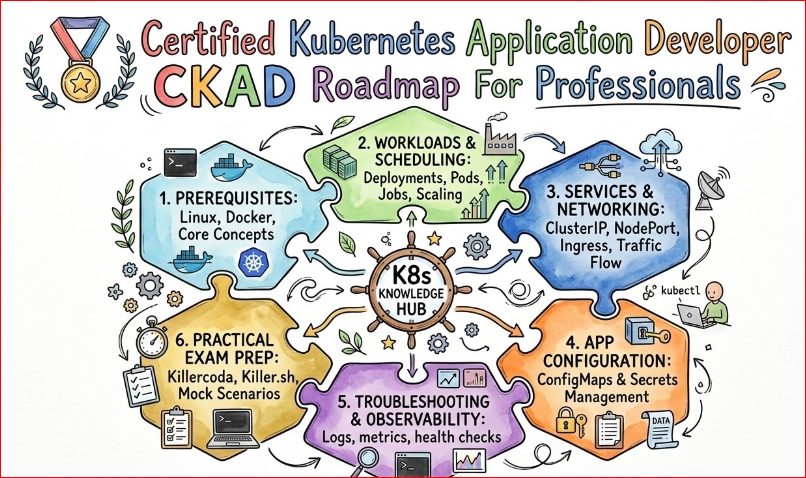
Introduction
Kubernetes is no longer just a buzzword; it is the default operating system of the cloud. If you are building, deploying, or managing applications today, understanding how to make them run efficiently inside Kubernetes is non-negotiable. Throughout my career, I have seen the tech landscape shift dramatically. What used to take dedicated operations teams weeks to provision can now be done by software engineers in minutes using container orchestration. This shift has created a massive demand for professionals who do not just write code, but know how to containerize it, configure it, and deploy it securely at scale. This brings us to one of the most respected credentials in the industry: the Certified Kubernetes Application Developer (CKAD) program. Unlike multiple-choice exams that test your memory of acronyms, the CKAD is a grueling, 100% hands-on performance test. It proves that you can actually sit at a terminal and make Kubernetes do what you want it to do under pressure. In this complete guide, I will break down everything you need to know about the CKAD certification. We will look at what it takes to pass, the skills you will gain, how it fits into your broader career path, and the best ways to prepare. Whether you are a software engineer looking to upskill, or an engineering manager trying to figure out the right training path for your team, this guide will give you a clear roadmap.
Kubernetes Certification Landscape
Before diving deep into the CKAD, it helps to understand where it sits in the broader ecosystem of cloud-native certifications. Kubernetes offers several tracks, and knowing the difference will save you time and money.
| Certification | Track | Level | Who it’s for | Prerequisites | Skills covered | Recommended order |
|---|---|---|---|---|---|---|
| KCNA | Foundation | Beginner | Students, Managers, Beginners | None | Cloud-native architecture, K8s basics | 1st (Optional) |
| CKAD | Development | Intermediate | Software Engineers, DevOps | Linux basics, Docker | Pod design, Configuration, Observability | 2nd |
| CKA | Administration | Advanced | DevOps, SRE, Platform Engineers | CKAD (Recommended) | Cluster architecture, Networking, Troubleshooting | 3rd |
| CKS | Security | Expert | Security Engineers, DevSecOps | Active CKA Certification | Cluster hardening, Microservice vulnerabilities | 4th |
Deep Dive: Certified Kubernetes Application Developer (CKAD)
Let us unpack the CKAD certification to understand exactly what it requires and what you will get out of it.
What it is
The Certified Kubernetes Application Developer (CKAD) is a performance-based exam that tests your ability to design, build, configure, and expose cloud-native applications for Kubernetes. It validates that you can comfortably work with Kubernetes core primitives to run scalable applications.
Who should take it
This certification is tailor-made for Software Engineers, Application Developers, and early-career DevOps practitioners. It is also highly valuable for Engineering Managers who want a hands-on understanding of the deployment environments their teams use daily. If your day-to-day job involves writing code that eventually runs in a container, you should take this exam.
Skills you’ll gain
Preparing for and passing the CKAD will force you to master a specific set of practical skills. You will learn to:
- Design and build Kubernetes-ready Docker images.
- Define application resources using declarative YAML manifests.
- Manage application state, persistent volumes, and configuration data using ConfigMaps and Secrets.
- Implement observability through liveness and readiness probes.
- Route internal and external traffic to your applications using Services and Ingress networks.
- Secure your pods with proper service accounts and security contexts.
Real-world projects you should be able to do after it
Once you are CKAD certified, you will not just have a piece of paper; you will have practical abilities. You should comfortably be able to:
- Take a legacy monolithic application, containerize it, and deploy it to a Kubernetes cluster.
- Set up a robust CI/CD pipeline that automatically updates deployments without downtime.
- Debug a failing pod in a production environment by inspecting logs and cluster events.
- Implement auto-scaling for web applications based on CPU or memory usage metrics.
- Secure sensitive application credentials so they are not hardcoded into your source code.
Preparation plan
Your preparation timeline depends entirely on your current familiarity with Linux, Docker, and YAML.
- 7–14 days (The Sprint): This is for engineers who already use Kubernetes daily but need to learn the specific exam objectives and get comfortable doing tasks imperatively (using
kubectlcommands instead of writing YAML from scratch). Focus strictly on timed practice tests. - 30 days (The Standard Path): Ideal for developers who know Docker and Linux but are new to Kubernetes. Spend the first two weeks learning the core concepts (Pods, Deployments, Services, Volumes). Spend the last two weeks doing hands-on labs every single day.
- 60 days (The Beginner Path): If you are relatively new to containers, take your time. Spend month one mastering Docker, container runtimes, and basic YAML syntax. Spend month two learning Kubernetes concepts and doing mock exams.
Common mistakes
I have mentored many engineers through this process, and the same traps catch people every time:
- Relying too much on YAML: Writing YAML from scratch during the exam is too slow. You must learn to use
kubectl createandkubectl runwith the--dry-run=client -o yamlflags to generate templates. - Poor time management: Getting stuck on a 2% question and wasting 20 minutes. If you don’t know it, flag it and move on.
- Ignoring context switching: The exam uses multiple clusters. If you forget to switch to the correct cluster context before answering a question, you will get zero points for that task, even if your solution was perfect.
- Not using aliases: Typing
kubectlover and over wastes precious seconds. Setalias k=kubectlat the very start of your exam.
Best next certification after this
Once you have the CKAD, the logical next step is the Certified Kubernetes Administrator (CKA). The CKA will teach you how to build and maintain the actual clusters that your CKAD applications run on, completing your fundamental Kubernetes knowledge.
Choose Your Path
The CKAD is a stepping stone. Once you understand how to deploy applications, you need to decide how you want to specialize your career. Here are six distinct paths you can take:
1. DevOps
The DevOps path focuses on automating the software delivery lifecycle. You will use your CKAD knowledge to build better CI/CD pipelines. You will integrate tools like Jenkins, GitLab CI, or ArgoCD to ensure that the code developers write is seamlessly built, tested, and deployed into Kubernetes clusters with zero manual intervention.
2. DevSecOps
If you shift toward DevSecOps, your focus becomes security without sacrificing speed. You will build on your CKAD skills by learning how to scan container images for vulnerabilities before they are deployed. You will learn to write Open Policy Agent (OPA) rules to prevent developers from deploying insecure pods, and you will focus heavily on network policies and RBAC.
3. SRE (Site Reliability Engineering)
Site Reliability Engineers care about uptime, latency, and performance. On this path, you will use your CKAD foundation to master observability tools like Prometheus, Grafana, and Jaeger. You will write automation to auto-remediate failing services, manage incident response, and ensure that applications in Kubernetes meet their Service Level Objectives (SLOs).
4. AIOps / MLOps
Machine Learning Operations is exploding. Data scientists need platforms to train and serve their models. On this path, you will use Kubernetes as the underlying infrastructure for ML workloads using tools like Kubeflow. You will need your CKAD skills to configure GPU resources for pods, manage massive data volumes, and expose inference APIs to the public.
5. DataOps
DataOps is about bringing agile and DevOps practices to data analytics. You will manage data pipelines, databases, and message queues (like Kafka or RabbitMQ) running inside Kubernetes. Your CKAD knowledge of StatefulSets, Persistent Volumes, and Headless Services will be critical here, as stateful applications require far more care than stateless web servers.
6. FinOps
Cloud computing is expensive, and Kubernetes can easily hide costs if mismanaged. FinOps practitioners bridge the gap between engineering and finance. You will use your understanding of Kubernetes resource requests and limits to optimize cluster sizing. You will implement chargeback models so the company knows exactly which application (and which team) is spending the most money on cloud infrastructure.
Role → Recommended Certifications Mapping
| Role | Recommended certifications (in order) |
|---|---|
| DevOps Engineer | CKAD → CKA → AWS DevOps Engineer – Professional |
| SRE | CKA → CKAD → Observability / Monitoring certifications |
| Platform Engineer | CKA → CKS → HashiCorp Terraform Associate |
| Cloud Engineer | Cloud Architect Associate (AWS/Azure/GCP) → CKAD → CKA |
| Security Engineer | Security+ (or equivalent) → CKA → CKS |
| Data Engineer | CKAD → Cloud Data Engineer / Data Analytics certification |
| FinOps Practitioner | FinOps Certified Practitioner → Cloud Practitioner → CKAD |
| Engineering Manager | Agile/Scrum certification → CKAD → Cloud Architect Associate |
Next Certifications to Take
After completing the CKAD, you have three distinct directions for your next credential, depending on your career goals:
- Same Track (Deepening your Kubernetes expertise):
Go for the Certified Kubernetes Administrator (CKA). It builds directly on your CKAD knowledge but shifts the perspective from the application developer to the cluster operator. - Cross-track (Broadening your cloud ecosystem knowledge):
Take the HashiCorp Certified: Terraform Associate. Knowing how to deploy apps is great, but knowing how to automate the provisioning of the underlying cloud infrastructure (VPCs, Load Balancers, VMs) makes you a complete end-to-end engineer. - Leadership (Moving toward architecture or management):
Aim for the AWS Certified Solutions Architect – Professional (or the Azure/GCP equivalent). This teaches you how to design highly available, cost-effective, and fault-tolerant distributed systems at a macro level, moving beyond just the container layer.
Top Institutions for CKAD Training
If you are looking for structured training, hands-on labs, and expert mentorship to pass the CKAD, several specialized institutions stand out. These organizations provide training programs that blend theoretical knowledge with the intense practical labs required for this exam.
- DevOpsSchool: A premier global institute offering comprehensive, real-world scenario-based training. Their CKAD program seamlessly integrates DevOps, DevSecOps, and SRE principles, backed by lifetime LMS access and unlimited AWS labs.
- Cotocus: Specializes in cloud-native consulting and training, offering deep dives into container orchestration. Their instructors are known for their rigorous, hands-on approach to Kubernetes preparation.
- Scmgalaxy: A massive community and training hub for software configuration management and DevOps. They provide excellent peer-supported learning tracks and robust mock exams for CKAD candidates.
- BestDevOps: Focuses on bootcamps that take engineers from absolute beginners to certified professionals. Their CKAD path is highly structured, focusing heavily on imperative command speed drills.
- devsecopsschool.com: While their primary focus is on security integration, their CKAD training ensures that developers learn how to build securely from day one, emphasizing security contexts and network policies.
- sreschool.com: Tailors their Kubernetes training for future Site Reliability Engineers. Their CKAD modules focus heavily on observability, logging, and application resilience.
- aiopsschool.com: Blends Kubernetes training with AI integrations. Their CKAD program is perfect for developers who plan to deploy machine learning models and need to understand container orchestration.
- dataopsschool.com: Focuses on managing stateful workloads. Their application developer training heavily emphasizes Persistent Volumes, StatefulSets, and running databases inside Kubernetes.
- finopsschool.com: Provides a unique angle on Kubernetes training by combining core deployment skills with cost optimization, teaching developers how to set proper resource limits and requests.
Frequently Asked Questions (FAQs)
1. Is the CKAD a multiple-choice exam?
No. It is a 100% performance-based exam. You will be given a command-line environment and a set of practical tasks to solve within a live Kubernetes cluster.
2. How long does the CKAD exam take?
You have exactly 2 hours to complete the exam, which consists of approximately 15 to 20 performance-based tasks.
3. Do I need to know programming languages like Java or Python to pass?
No. While it is an “Application Developer” exam, it does not test your ability to write source code. It tests your ability to configure, deploy, and troubleshoot applications using Docker and Kubernetes YAML/JSON.
4. What are the prerequisites for taking the CKAD?
There are no official prerequisites required to purchase and sit for the exam. However, practically, you must have a solid understanding of Linux command-line basics and Docker containerization.
5. Should I take CKA or CKAD first?
I highly recommend taking the CKAD first. It focuses on the core building blocks (Pods, Deployments, Services) which are easier to grasp. The CKA covers harder topics like cluster bootstrapping, control plane troubleshooting, and complex networking.
6. Can I use the Kubernetes documentation during the exam?
Yes. It is an open-book exam, but you are strictly limited to official Kubernetes documentation domains (kubernetes.io). You cannot use Google, StackOverflow, or external blogs.
7. How much time do I need to prepare?
If you have a full-time job and basic container knowledge, expect to study 1-2 hours a day for about 4 to 6 weeks.
8. What happens if I fail the exam?
The Linux Foundation provides one free retake per exam registration. If you fail the first attempt, you can retake it without paying again, provided you do so within your eligibility period.
9. Is the CKAD valuable for Engineering Managers?
Absolutely. Managers do not need to be daily operators, but going through the CKAD preparation ensures you understand the constraints, capabilities, and vocabulary of your deployment environments, allowing you to lead your technical teams more effectively.
10. How long is the CKAD certification valid?
The certification is valid for 24 months (2 years) from the date you pass the exam. After that, you must recertify.
11. What score do I need to pass?
The passing score for the CKAD is 66%. Tasks are weighted differently based on their complexity.
12. Does this certification actually help get jobs?
Yes. Because it is performance-based, hiring managers trust it deeply. Having a CKAD proves you have tangible, terminal-level skills, which instantly elevates your resume past candidates who only hold theoretical certifications.
FAQs
1. What is the biggest curriculum change in the latest CKAD version? The most significant shift is the increased focus on Helm and Kustomize. It’s no longer enough to just know kubectl. You are now expected to know how to deploy and manage existing application packages using Helm and how to apply overlays using Kustomize. This matches the real-world shift where almost no one writes raw YAML from scratch anymore.
2. Has the exam environment itself changed recently? Yes. The Linux Foundation has moved to a Remote Desktop-based environment (using VSCodium or a browser-based terminal). Unlike the older terminal-only setup, you now have a full desktop interface. This is helpful but can be slightly slower; I recommend practicing with the Killer.sh simulator to get used to the copy-paste shortcuts (which are often Ctrl+Shift+C/V in the remote terminal).
3. Are there new networking topics I need to worry about? Absolutely. There is a much heavier emphasis on the Gateway API. While Ingress is still tested, the Gateway API is the modern standard for managing external access. You should be comfortable moving from standard Ingress rules to Gateway and HTTPRoute resources.
4. Did the weightage of the domains change? While the domain titles remained similar, the weighting has shifted to prioritize Application Deployment (20%) and Security (25%). This means you’ll see more tasks related to SecurityContexts, ServiceAccounts, and NetworkPolicies. Security is no longer “optional” for a developer; it’s a core requirement.
5. How often is the Kubernetes version updated in the exam? The exam generally follows the “N-1” or “N” rule of Kubernetes releases. Currently, it is based on Kubernetes v1.34/v1.35. Whenever a new version is released, the exam usually updates within 4–8 weeks. Always check the official CNCF curriculum page a week before your exam to see the exact version you’ll be tested on.
6. Is the “Open Book” policy still the same? It has actually become stricter. Previously, you could have multiple tabs. Now, you are restricted to one single tab for documentation within the exam’s secure browser. You can access kubernetes.io/docs, kubernetes.io/blog, and the documentation for tools like Helm. You can no longer access external GitHub repos unless they are part of the official documentation.
7. Is the certification still valid for 3 years? Actually, there has been a change here. Most CNCF certifications, including CKAD, are now moving toward a 2-year validity period. This is because the cloud-native landscape moves so fast that a 3-year-old certification is often considered outdated. Always verify your specific badge expiration date in your Linux Foundation portal.
8. Do I still need to memorize aliases for the new environment? In the new Remote Desktop environment, many common aliases (like k for kubectl) are now pre-configured. However, I still recommend knowing how to set them up manually just in case. The “new” speed hack is learning to use the built-in VSCodium editor to quickly edit YAML files rather than struggling with vi or nano in a laggy terminal.
Testimonials
“I spent years writing code but always handed it off to the ops team to deploy. Taking the CKAD training completely changed my perspective. The hands-on labs were brutal but exactly what I needed. I now manage my own CI/CD pipelines and deployment manifests, and I recently got promoted to a senior platform role.”
— Amit S., Senior Software Engineer
“As an Engineering Manager, I was struggling to understand the constant bottlenecks my team faced with our cloud migrations. I took a CKAD course to bridge my own knowledge gap. It was the best decision I’ve made. I now understand our infrastructure at a practical level, which has made our sprint planning and architectural discussions incredibly efficient.”
— Sarah L., Director of Engineering
“The imperative command practice during my CKAD preparation saved me. During the actual exam, the clock is your biggest enemy. Learning how to rapidly generate YAML and troubleshoot failing pods gave me the confidence to pass on my first try. It is easily the most rewarding certification I hold.”
— Rajesh M., DevOps Engineer
Conclusion
The Certified Kubernetes Application Developer (CKAD) is not just a badge for your LinkedIn profile; it is a transformational learning experience. In my professional journey, I have rarely seen a certification that so accurately reflects the real-world skills needed on the job. By committing to this training, you are forcing yourself to become proficient in the core technology that powers the modern internet. Whether you decide to stay on the software development path, pivot into DevOps, or build secure pipelines as a DevSecOps engineer, the foundational knowledge you gain from the CKAD will serve you for years to come. Remember to focus heavily on hands-on lab practice, master the imperative kubectl commands, and lean on reputable training institutions to guide your study plan. Good luck on your Kubernetes journey.
