Introduction
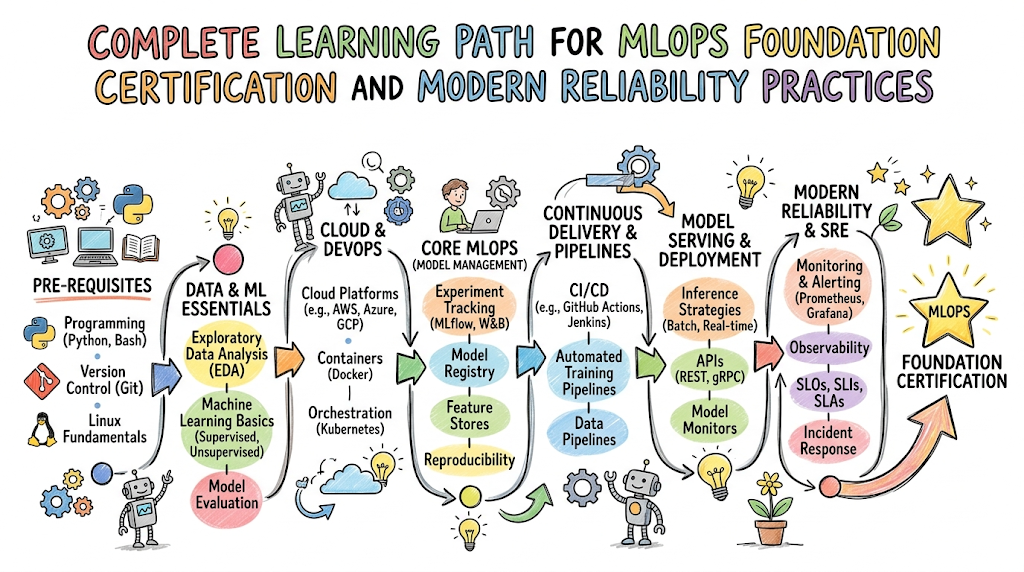
Machine Learning Operations is the critical bridge between data science experimentation and reliable production software. The MLOps Foundation Certification provides a structured approach for engineers to master the lifecycle of machine learning models. This guide is designed for professionals looking to transition from traditional software roles into the high-growth field of AI-driven infrastructure.
Understanding how to automate the deployment, monitoring, and scaling of models is no longer optional for modern platform teams. By following the curriculum hosted at AIOps School, professionals can move beyond manual model handovers to automated pipelines. This guide helps you evaluate the curriculum and decide how this credential fits into your long-term career roadmap.
What is the MLOps Foundation Certification?
The MLOps Foundation Certification is a practitioner-led program that focuses on the operationalization of machine learning. Unlike academic courses that focus on building algorithms, this certification emphasizes the operational side of the equation. It covers how to treat models as code, ensuring they are versioned, tested, and deployed with the same rigor as any microservice.
This certification exists to solve the “last mile” problem in data science, where many models never reach production due to infrastructure gaps. It aligns with modern engineering workflows by introducing concepts like Continuous Integration, Continuous Delivery, and Continuous Training. By earning this credential, you demonstrate an ability to manage the technical debt associated with ML systems in an enterprise environment.
Who Should Pursue MLOps Foundation Certification?
This program is highly beneficial for DevOps engineers and Site Reliability Engineers who are increasingly asked to support data science teams. Cloud architects and platform engineers who need to design scalable environments for model training will find the curriculum directly applicable. It also serves as an entry point for data engineers who want to automate their workflows.
Managers and technical leaders should pursue this certification to understand the resource requirements and risks associated with ML projects. In the Indian and global markets, there is a massive talent gap for professionals who can bridge the gap between pure coding and data science. Whether you are a beginner or a veteran engineer, this foundation provides the common language needed to succeed in AI-driven enterprises.
Why MLOps Foundation Certification is Valuable and Beyond
The demand for MLOps practitioners is skyrocketing as enterprises move from AI experimentation to full-scale adoption. Large-scale organizations are investing heavily in model governance and reliability, making MLOps skills highly recession-proof. As long as companies collect data and use it for decision-making, the need for people who can manage those models will remain high.
This certification ensures you stay relevant despite the rapid changes in specific tooling. While individual frameworks may come and go, the core principles of model versioning and monitoring are universal. The return on investment for this certification is reflected in the access to specialized roles that offer higher compensation and greater technical challenges than traditional administration.
MLOps Foundation Certification Overview
The MLOps Foundation Certification program is delivered via the MLOps Foundation Certification official page and hosted on AIOps School. The program uses a modular assessment approach that combines theoretical understanding with practical application. It is designed to be accessible to those already working in tech while maintaining the high standards required by top-tier employers.
The ownership of the curriculum resides with industry experts who update the content to reflect current best practices in cloud-native engineering. The structure is built around a practitioner-focused model, ensuring that candidates do not just memorize definitions but understand how to apply them. This makes it a respected credential for those looking to prove their hands-on capabilities in a production environment.
MLOps Foundation Certification Tracks & Levels
The certification is structured into three primary levels: Foundation, Professional, and Advanced. The Foundation level introduces the core concepts and terminology required for cross-functional communication. It ensures that everyone on the team, from developers to managers, understands the basic pipeline of a machine learning project and the associated risks.
The Professional level moves into deep technical implementation, focusing on specific toolchains and automation strategies. The Advanced level is geared towards architects and leads who must design entire MLOps platforms from scratch. This progression allows professionals to grow their skills incrementally as they take on more responsibility and lead complex engineering initiatives.
Complete MLOps Foundation Certification Table
| Track | Level | Who it’s for | Prerequisites | Skills Covered | Recommended Order |
| Core MLOps | Foundation | Beginners, Managers | Basic IT Knowledge | ML Lifecycle, CI/CD, Monitoring | 1 |
| Engineer | Professional | DevOps, SREs | Foundation Cert | Pipelines, Versioning, Scaling | 2 |
| Architect | Advanced | Senior Engineers | Professional Cert | Governance, Security, Strategy | 3 |
| DataOps | Specialized | Data Engineers | Basic ML | Data Versioning, ETL Automation | Concurrent |
| FinOps | Specialized | Finance, Leads | Foundation Cert | Cloud Cost for ML, Resource Optimization | Concurrent |
Detailed Guide for Each MLOps Foundation Certification
MLOps Foundation Certification – Foundation Level
What it is
This certification validates a candidate’s understanding of the end-to-end machine learning lifecycle. It confirms that the individual knows how to integrate data science workflows into standard DevOps practices and maintain model reliability.
Who should take it
It is suitable for entry-level engineers, project managers, and traditional IT administrators. It is also ideal for developers who want to understand how their code interacts with machine learning models in production environments.
Skills you’ll gain
- Understanding the ML pipeline from data preparation to model deployment.
- Knowledge of model versioning and experiment tracking techniques.
- Familiarity with monitoring model drift and performance metrics.
- Core concepts of automation in machine learning environments.
Real-world projects you should be able to do
- Setting up a basic automated model training pipeline using standard tools.
- Configuring a version control system for ML metadata and artifacts.
- Creating a dashboard to track model health in a staging environment.
Preparation plan
- 7-14 Days: Focus on terminology and the theoretical differences between DevOps and MLOps principles.
- 30 Days: Complete hands-on labs involving model deployment on standard cloud platforms.
- 60 Days: Review case studies of enterprise ML failures and how MLOps solves these specific issues.
Common mistakes
- Focusing too much on building algorithms instead of the infrastructure required to deploy them.
- Ignoring the importance of data quality and data versioning in the training phase.
- Underestimating the complexity of monitoring models in real-time production.
Best next certification after this
- Same-track option: MLOps Professional Certification.
- Cross-track option: DataOps Foundation Certification.
- Leadership option: AIOps Manager Certification.
Choose Your Learning Path
DevOps Path
The DevOps path focuses on extending existing CI/CD pipelines to accommodate machine learning artifacts. Engineers on this path will learn how to treat models as software packages that require automated testing and deployment. The goal is to create a seamless flow from the data scientist’s notebook to the production cluster. This path is essential for those looking to maintain high availability for AI-driven applications.
DevSecOps Path
In the DevSecOps path, the priority is securing the machine learning supply chain. This involves scanning models for vulnerabilities, ensuring data privacy during training, and managing access controls for sensitive datasets. It is a critical path for professionals working in regulated industries like finance or healthcare. You will learn how to implement security gates without slowing down the model deployment process.
SRE Path
The SRE path focuses on the reliability and scalability of ML systems in production. Site Reliability Engineers will learn how to define SLIs and SLOs specifically for model performance and latency. This includes managing high-performance computing resources and ensuring that model inference stays within cost and performance budgets. This path bridges the gap between infrastructure stability and dynamic model behavior.
AIOps Path
The AIOps path is for engineers who want to use machine learning to improve IT operations themselves. It focuses on using AI to analyze logs, predict outages, and automate incident response across the enterprise. This path is less about deploying business models and more about building a self-healing infrastructure. It requires a deep understanding of both operational data and predictive analytics.
MLOps Path
The MLOps path is the dedicated track for those who want to specialize exclusively in the machine learning lifecycle. It covers the full spectrum of experiment tracking, hyperparameter tuning, and continuous training. Professionals on this path often work closely with data scientists to optimize the entire research-to-production loop. It is the core path for anyone aiming to become a dedicated MLOps Engineer.
DataOps Path
The DataOps path emphasizes the quality and flow of data that feeds the machine learning models. It focuses on automating data pipelines, ensuring data lineage, and reducing the cycle time of data delivery. Without solid DataOps, MLOps cannot function effectively, making this a vital path for data engineers. You will learn how to apply DevOps principles specifically to data management.
FinOps Path
The FinOps path addresses the massive costs often associated with training and running large-scale machine learning models. This path teaches professionals how to monitor cloud spend, optimize GPU utilization, and allocate costs to specific business units. It is essential for engineering managers who need to justify the ROI of AI projects. You will learn to balance technical performance with financial accountability.
Role → Recommended MLOps Foundation Certification
| Role | Recommended Certifications |
| DevOps Engineer | MLOps Foundation, MLOps Professional |
| SRE | MLOps Foundation, SRE Practitioner |
| Platform Engineer | MLOps Foundation, Cloud Architect |
| Cloud Engineer | MLOps Foundation, DataOps Foundation |
| Security Engineer | MLOps Foundation, DevSecOps Expert |
| Data Engineer | DataOps Foundation, MLOps Foundation |
| FinOps Practitioner | MLOps Foundation, FinOps Specialist |
| Engineering Manager | MLOps Foundation, AIOps Manager |
Next Certifications to Take After MLOps Foundation Certification
Same Track Progression
After mastering the foundation, the logical next step is the MLOps Professional level. This certification dives deeper into specific automation tools like Kubeflow, MLflow, or cloud-native ML services. It moves from conceptual understanding to building robust, production-grade systems that can handle thousands of concurrent users. Deep specialization here makes you an expert in the technical execution of complex AI strategies.
Cross-Track Expansion
For those looking to broaden their impact, moving into DataOps or DevSecOps is a smart choice. Machine learning does not exist in a vacuum; it relies on secure infrastructure and clean data. Expanding your skills into these adjacent areas makes you a more versatile professional. This cross-track knowledge is highly valued in startups and large enterprises where silos are being broken down in favor of unified engineering.
Leadership & Management Track
If your goal is to lead teams, the AIOps Manager or technical leadership track is the best route. This transition focuses on the strategic implementation of AI within an organization rather than the day-to-day coding. You will learn how to hire the right talent, manage project budgets, and align technical capabilities with business goals. It is the ideal path for senior engineers looking to move into management roles.
Training & Certification Support Providers for MLOps Foundation Certification
DevOpsSchool
DevOpsSchool is a major player in technical training, offering comprehensive programs that cover the entire DevOps and MLOps ecosystem. They provide a mix of instructor-led sessions and self-paced modules that are designed to help professionals clear certifications on their first attempt. Their curriculum is updated frequently to include the latest industry tools and methodologies. Many engineers choose this platform because of its long-standing reputation and the depth of its technical resources. The support team is known for assisting students with practical labs, which is crucial for gaining hands-on experience in MLOps. It provides the global exposure needed for career advancement.
Cotocus
Cotocus specializes in high-end technical consulting and training, with a strong focus on emerging technologies like AIOps and MLOps. They provide tailored learning paths that are specific to the needs of modern enterprises, ensuring that the skills learned are immediately applicable. Their instructors are typically active industry consultants who bring real-world scenarios into the classroom. This makes Cotocus an excellent choice for experienced engineers who want to go beyond the basics. Their focus on architectural patterns and production stability sets them apart from more generalist training providers in the technical education market. They bridge the gap between theory and execution.
Scmgalaxy
Scmgalaxy is a well-known community and training portal that has supported software configuration management and DevOps professionals for years. They offer a wealth of free resources, tutorials, and specialized courses that cater to both beginners and advanced practitioners. For those pursuing MLOps certifications, Scmgalaxy provides a solid foundation in the automation and versioning aspects of the curriculum. Their community-driven approach means that students can often find peer support and diverse perspectives on technical challenges. It remains a go-to destination for professionals who value a strong community and a vast library of technical content for continuous career growth and learning.
BestDevOps
BestDevOps focuses on delivering high-quality, practical training that is designed to get engineers job-ready in the shortest time possible. Their courses are structured around real-world projects, ensuring that candidates can demonstrate their skills to potential employers. They offer specialized support for MLOps Foundation Certification candidates, including mock exams and detailed feedback on lab assignments. The platform is designed to be user-friendly, making it easy for busy professionals to fit learning into their daily schedules. Their emphasis on current market demands makes them a popular choice for those looking to transition into new roles quickly with validated and verified skills.
devsecopsschool.com
This platform is dedicated entirely to the intersection of development, security, and operations. For MLOps practitioners, it provides the essential security context that is often missing from general courses. Their curriculum covers how to secure ML pipelines and protect sensitive data, which is a top priority for modern enterprises. The courses are designed to be rigorous and thorough, reflecting the high stakes of security-focused roles. Students benefit from specialized labs that simulate security threats and teach how to mitigate them in a production environment. It is the premier choice for anyone focusing on the security track within the MLOps field.
sreschool.com
As the name suggests, sreschool.com is focused on the principles of Site Reliability Engineering. They provide specific training on how to maintain the reliability and performance of complex systems, including those that involve machine learning models. Their approach is data-driven and focuses on metrics like error budgets and latency. For MLOps candidates, this platform offers invaluable insights into the operational side of model management. The instructors emphasize the importance of automation in reducing manual toil, which is a core tenet of both SRE and MLOps. It is an essential resource for stability-focused engineers who want to master system performance.
AIOps School is the primary host and delivery partner for the certification discussed in this guide. They offer a specialized curriculum that focuses on the integration of artificial intelligence into IT operations. Their programs are designed to be cutting-edge, covering the latest advancements in MLOps and automated infrastructure. The platform provides a seamless learning experience, from initial enrollment to the final certification exam. Because they are the primary host, their materials are perfectly aligned with the certification requirements. It is the most direct route for anyone looking to master the MLOps Foundation curriculum and gain immediate industry recognition.
dataopsschool.com
DataOps School focuses on the foundational element of all machine learning: data. Their training covers the automation of data pipelines and the management of data quality at scale. For MLOps professionals, understanding these concepts is critical for ensuring that models are trained on reliable and timely information. The curriculum emphasizes the use of DevOps principles to solve data-related bottlenecks. Their courses are highly technical and focus on the tools and processes required to manage modern data platforms. It is the ideal companion for those looking to strengthen the data side of their MLOps expertise and build better end-to-end systems.
finopsschool.com
FinOps School addresses the growing need for financial management in cloud-native and AI-driven environments. They provide specialized training on how to track, manage, and optimize the costs associated with high-performance computing and ML training. This is a critical skill set for engineering leaders and architects who must manage large-scale budgets. Their curriculum teaches professionals how to balance technical innovation with financial responsibility. As cloud costs continue to rise, the skills taught here are becoming increasingly valuable for senior technical professionals. It is the definitive source for learning the financial side of modern operations and showing true business value for AI.
Frequently Asked Questions (General)
- How difficult is the certification exam?
The exam is designed to be challenging but fair, focusing on practical knowledge over rote memorization. If you have a solid understanding of the ML lifecycle and have completed the recommended labs, you should be well-prepared. It is less about difficult math and more about understanding the operational workflow of machine learning in a production setting.
- What is the average time required to prepare?
Most professionals find that 30 to 60 days of consistent study is sufficient to master the material. This allows time to go through the theoretical modules and complete the hands-on projects required for depth. Those with prior DevOps experience may be able to move faster through the infrastructure-related modules.
- Are there any prerequisites for the foundation level?
There are no strict technical prerequisites, but a basic understanding of software development and cloud computing is helpful. Being familiar with how applications are traditionally deployed will give you a good frame of reference for the changes ML introduces. It is designed to be an accessible entry point into the world of MLOps.
- Is this certification recognized globally?
Yes, the certification follows industry-standard practices that are applicable across the globe. The principles taught are universal and not tied to a specific geographic region or niche market. It is highly regarded by international tech companies and consulting firms that prioritize automated infrastructure and reliability.
- Will this certification help me get a salary hike?
Specializing in MLOps often leads to significant salary increases because it is a high-demand, low-supply field. Many organizations are willing to pay a premium for engineers who can manage the complexity of ML infrastructure. It positions you for more senior and specialized roles that command higher market value.
- Do I need to be a data scientist to pass?
No, this is an operations-focused certification. While you need to understand what data scientists do, you do not need to build complex algorithms yourself. Your role is to build the environment where those algorithms can run reliably and at scale without manual intervention.
- How often does the certification need to be renewed?
The certification is typically valid for two to three years, reflecting the fast-paced nature of the industry. Renewal often involves taking an updated exam or completing continuing education modules to stay current. This ensures that certified professionals stay up to date with new tools and architectural best practices.
- What kind of tools will I learn about?
You will learn about the categories of tools used for CI/CD, model versioning, monitoring, and orchestration. This includes familiarizing yourself with platforms like Kubernetes, MLflow, and cloud-specific ML services. The focus is on the purpose and integration of these tools rather than just one vendor.
- Is there a hands-on component to the learning?
Yes, the curriculum emphasizes practical application through labs and projects. You are expected to demonstrate that you can set up pipelines and manage model deployments in a simulated environment. This hands-on experience is what makes the certification valuable to prospective employers.
- Can I take the exam online?
Yes, the certification is delivered through a secure online platform, allowing you to take the exam from anywhere. This provides flexibility for working professionals across different time zones and locations. You will need a stable internet connection and a compatible computer for the proctoring process.
- What is the ROI of this certification?
The return on investment is high, both in terms of career longevity and compensation. It opens doors to roles that are central to the future of technology and enterprise automation. The time spent learning these skills pays off as you become a key player in your organization’s AI strategy.
- How does this differ from a standard DevOps cert?
While standard DevOps focuses on general software, MLOps adds the complexity of data and model behavior. You have to deal with things like data drift and retraining cycles that do not exist in traditional software environments. It is an evolution of DevOps for a more data-centric world.
FAQs on MLOps Foundation Certification
- Why is MLOps Foundation better than a general ML course?
General ML courses often stop at the point where a model is built in a notebook. This certification focuses on what happens next—getting that model into production and keeping it running reliably. It is the difference between a science experiment and a scalable business product.
- How does this program handle model monitoring?
The program teaches you how to track model performance over time and detect when the model’s accuracy begins to decline due to changing data. You will learn to set up alerts and automated retraining triggers to maintain quality. This ensures that the AI remains useful long after it is first deployed.
- Does it cover cloud-native MLOps?
Yes, the curriculum is heavily focused on cloud-native practices using containers and orchestration tools. It assumes that most modern ML workloads will run in the cloud or on scalable on-premises clusters. This makes the skills highly relevant to modern enterprise environments across various industries.
- What role does automation play in this certification?
Automation is the core of the entire program and the main focus of every module. You will learn how to automate the testing, packaging, and deployment of machine learning models. The goal is to reduce human error and speed up the delivery of AI features to the end-user.
- How is data versioning handled?
The certification covers the importance of tracking exactly which version of data was used to train which version of a model. This is critical for debugging, reproducibility, and regulatory compliance. You will learn the tools and processes used to manage this complex data lineage effectively.
- Is the curriculum updated for modern trends?
Yes, the program is regularly reviewed by industry experts to ensure it reflects current best practices and emerging tools. As new strategies emerge in the MLOps space, they are integrated into the learning path. This prevents the certification from becoming obsolete in a fast-moving market.
- What is the focus on governance and compliance?
The certification introduces concepts of model governance, ensuring that AI is used responsibly and transparently. This includes tracking who deployed which model and why it was updated. It is an increasingly important topic for large organizations and government agencies concerned with AI ethics.
- Can a manager benefit from this foundation?
Absolutely. Managers need to understand the lifecycle of MLOps to properly resource their teams and set realistic timelines. It helps them communicate more effectively with both data scientists and infrastructure engineers, leading to more successful and predictable project outcomes.
Final Thoughts
If you are looking to future-proof your career in infrastructure or software engineering, the answer is a definitive yes. The tech industry is moving toward a future where every application will have some form of embedded intelligence. Being the person who knows how to manage that intelligence in a production environment is an incredibly strong position to be in for years to come.
This certification provides the structure and the credibility needed to make that transition effectively. It focuses on the practical work of operations that is often ignored in more academic settings. By mastering these skills, you become a bridge-builder in your organization, solving the complex problems that stand in the way of true AI innovation. It is a solid investment in your technical depth and your professional future.
