Introduction
The transition from traditional software development to machine learning requires a fundamental shift in how we manage production environments. The Certified MLOps Professional designation is designed to bridge the gap between data science and operational excellence. This guide is intended for engineers and managers who recognize that building a model is only a small fraction of the overall lifecycle. By focusing on the intersection of DevOps, cloud-native architecture, and platform engineering, this guide helps professionals make better career decisions. At AIOpsSchool, the focus is on ensuring that these complex systems remain resilient, scalable, and fully automated within the modern enterprise landscape.
What is the Certified MLOps Professional?
The Certified MLOps Professional is a rigorous credential that validates an individual’s ability to automate and operationalize machine learning models at scale. Unlike academic courses that focus solely on algorithms, this certification emphasizes the engineering side of the house. It exists because the industry has realized that manual model deployment is a recipe for technical debt and system failure.
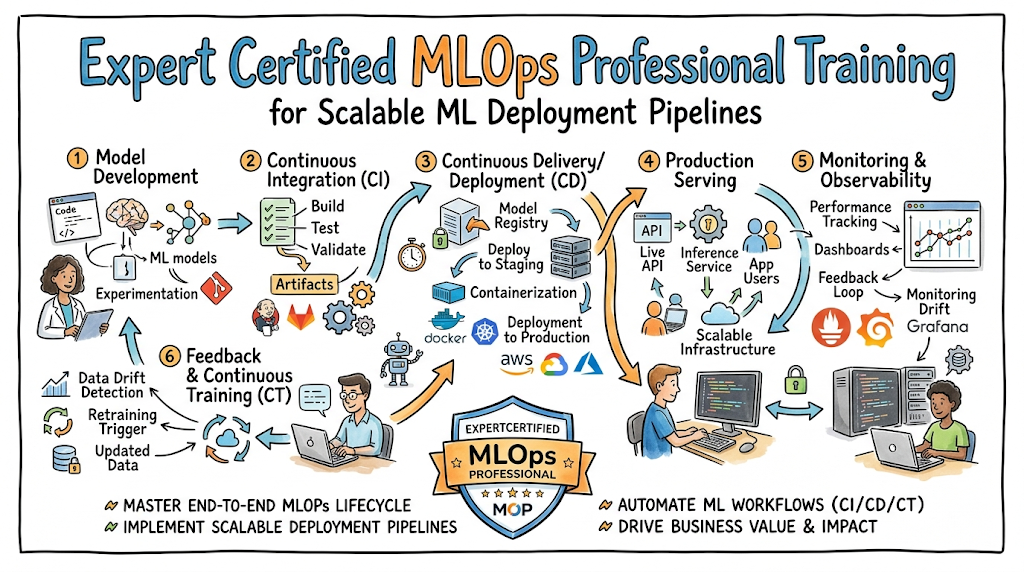
The curriculum is built around real-world, production-focused learning rather than abstract theory. It covers the entire lifecycle, from data versioning and model registry to continuous monitoring and automated retraining. This aligns perfectly with modern engineering workflows, ensuring that machine learning is treated with the same discipline as any other enterprise software practice.
Who Should Pursue Certified MLOps Professional?
This certification is highly beneficial for DevOps engineers and Site Reliability Engineers who are increasingly tasked with managing data-heavy infrastructure. Cloud professionals who want to specialize in high-growth niches will find the curriculum directly applicable to their daily tasks. Security and data roles also benefit, as the framework includes governance and compliance standards essential for modern data handling.
Beginners with a strong interest in automation can use this as a foundational pillar, while experienced engineers can use it to formalize their existing skills. For managers, the certification provides the vocabulary and strategic oversight needed to lead technical teams. Given the global demand for efficient automation, this credential holds significant weight for professionals in India and across international tech hubs.
Why Certified MLOps Professional is Valuable in the Future
As organizations move away from experimental AI and toward integrated enterprise solutions, the demand for MLOps expertise continues to climb. Toolsets will inevitably change, but the core principles of reliability, observability, and automation taught in this program remain constant. This longevity ensures that your skills do not become obsolete when a new library or framework emerges.
The return on career investment is substantial because companies are desperate for professionals who can reduce the time-to-market for machine learning products. By mastering these skills, you move from being a generalist to a specialist capable of managing the most complex parts of the software stack. Enterprise adoption of these practices is now a requirement rather than an option, making this a stable career path.
Certified MLOps Professional Certification Overview
The program is delivered via the official AIOpsSchool certification portal and is hosted on the main AIOpsSchool website. The assessment approach is designed to be practical, moving beyond simple multiple-choice questions to evaluate how an engineer handles real-world scenarios. It is structured to accommodate various professional backgrounds, offering a clear path from entry-level understanding to expert-level execution.
The ownership of the program lies with industry experts who have spent years managing large-scale distributed systems. The structure focuses on hands-on labs and case studies that mirror the challenges faced by top-tier tech companies. By completing the program, candidates prove they have the technical depth to manage the delicate balance between data science agility and operational stability.
Certified MLOps Professional Certification Tracks & Levels
The certification is categorized into three primary levels: foundation, professional, and advanced. The foundation level focuses on the terminology and basic architecture of MLOps pipelines. It is the starting point for those new to the field, ensuring everyone has a shared understanding of how models interact with infrastructure.
The professional level dives deep into the implementation of CI/CD for machine learning, including automated testing and deployment strategies. The advanced level is reserved for those who can design multi-cloud architectures and complex governance frameworks. These levels align with typical career progression, allowing an engineer to grow from an individual contributor to a technical lead or architect.
Complete Certified MLOps Professional Certification Table
| Track | Level | Who it’s for | Prerequisites | Skills Covered | Recommended Order |
| Core MLOps | Foundation | Beginners and Managers | Basic IT knowledge | MLOps Lifecycle, Tools | First |
| Engineering | Professional | DevOps/SRE Engineers | Python and Linux | CI/CD, Containerization | Second |
| Architecture | Advanced | Senior Architects | Professional Level | Scalability, Governance | Third |
| Security | Specialist | Security Engineers | Core MLOps | IAM, Model Privacy | Optional |
| Data | Specialist | Data Engineers | SQL and ETL basics | Data Versioning, Feature Store | Optional |
Detailed Guide for Each Certified MLOps Professional Certification
Certified MLOps Professional – Foundation Level
What it is
This certification validates a candidate’s understanding of the fundamental concepts of machine learning operations and how they differ from traditional DevOps practices.
Who should take it
It is suitable for project managers, junior engineers, or business analysts who need to understand the lifecycle of an ML project without necessarily writing complex code.
Skills you’ll gain
- Understanding the ML lifecycle and various operational frameworks.
- Knowledge of common tools and platforms used in the industry.
- Basic understanding of data pipelines and model monitoring requirements.
Real-world projects you should be able to do
- Mapping out an MLOps workflow for a small team.
- Identifying bottlenecks in a manual deployment process.
Preparation plan
- 7 Days: Review the core vocabulary and high-level architecture diagrams provided in the study guide.
- 30 Days: Read case studies on successful MLOps implementations to understand real-world constraints.
- 60 Days: Participate in community discussions and webinars to see how principles are applied in different industries.
Common mistakes
- Ignoring the cultural shift required for MLOps and treating it only as a technical problem.
- Focusing too much on specific tools rather than the overall process and integration points.
Best next certification after this
- Same-track option: Professional Level MLOps.
- Cross-track option: Certified DevOps Professional.
- Leadership option: Engineering Manager Track.
Certified MLOps Professional – Professional Level
What it is
This level confirms that the engineer can build and maintain automated pipelines for machine learning models using industry-standard tools and practices.
Who should take it
Mid-level DevOps engineers, SREs, and Data Engineers who are responsible for the day-to-day operations and scalability of ML infrastructure.
Skills you’ll gain
- Automating CI/CD pipelines specifically tailored for machine learning models.
- Implementing model registries, version control, and feature stores for consistency.
- Setting up comprehensive monitoring and alerting systems for performance and drift.
Real-world projects you should be able to do
- Building a fully automated retraining pipeline that triggers based on data changes.
- Deploying models to Kubernetes using blue-green or canary deployment strategies.
Preparation plan
- 7 Days: Intensive focus on pipeline automation syntax and environment configuration.
- 30 Days: Hands-on labs building and breaking ML environments to test resiliency.
- 60 Days: Implementing a full-scale project from data ingestion through to production deployment.
Common mistakes
- Neglecting data versioning while focusing only on code versioning, leading to reproducibility issues.
- Failing to set up proper observability for model drift, which results in silent failures in production.
Best next certification after this
- Same-track option: Advanced MLOps Architect.
- Cross-track option: Certified Kubernetes Administrator.
- Leadership option: Technical Lead Certification.
Choose Your Learning Path
DevOps Path
The DevOps path focuses on integrating machine learning into existing CI/CD workflows. Engineers on this path prioritize the speed and reliability of model delivery. They learn how to treat models as software artifacts, ensuring that every change is tested and documented. This path is ideal for those who want to apply software engineering rigors to the data science world.
DevSecOps Path
In this path, the emphasis is on securing the machine learning pipeline from end to end. This includes managing sensitive data, securing model endpoints, and ensuring that the training data hasn’t been tampered with. Professionals learn how to implement automated security scans within the MLOps lifecycle. This is critical for industries like finance and healthcare where data privacy is paramount.
SRE Path
The SRE path focuses on the reliability and performance of machine learning systems in production. These professionals deal with latency, scaling, and high availability of model inference services. They use error budgets and service level objectives to manage the inherent uncertainty of ML models. This is the best path for those interested in large-scale distributed systems.
AIOps Path
The AIOps path is about using artificial intelligence to improve traditional IT operations and infrastructure management. Engineers learn how to deploy models that can predict outages, automate incident response, and analyze vast amounts of log data for anomalies. This is a distinct shift from managing ML models to using them as a tool for proactive system maintenance.
MLOps Path
The MLOps path is the standard route for those who want to master the entire machine learning lifecycle from start to finish. It covers everything from data engineering and experimentation to model deployment and continuous monitoring. This path ensures a holistic view of the system, making it perfect for dedicated professionals who want to lead MLOps initiatives.
DataOps Path
The DataOps path focuses on the flow and quality of data that feeds the machine learning models. Without high-quality, reliable data, the MLOps pipeline cannot function effectively or provide accurate results. Professionals on this path learn how to build resilient data lakes, feature stores, and automated data validation checks to ensure data integrity.
FinOps Path
The FinOps path addresses the massive costs often associated with training and running machine learning models at scale. These professionals focus on cloud cost optimization, resource allocation, and budget management. They ensure that the business gets a positive return on investment for their ML initiatives while maintaining technical performance.
Role → Recommended Certified MLOps Professional Certifications
| Role | Recommended Certifications |
| DevOps Engineer | MLOps Professional, CI/CD Specialist |
| SRE | MLOps Advanced, Observability Specialist |
| Platform Engineer | Infrastructure as Code, MLOps Professional |
| Cloud Engineer | Multi-Cloud MLOps, Foundation Level |
| Security Engineer | DevSecOps for ML, Governance Track |
| Data Engineer | DataOps Specialist, MLOps Foundation |
| FinOps Practitioner | Cost Optimization Track, MLOps Foundation |
| Engineering Manager | MLOps Foundation, Strategic Leadership |
Next Certifications to Take After Certified MLOps Professional
Same Track Progression
Once you have mastered the professional level, the logical next step is to move toward an architect or expert designation. This involves looking at the bigger picture, such as multi-regional deployments and enterprise-wide MLOps strategies. You might also focus on specific niches like Edge AI or real-time streaming MLOps to further differentiate your profile. Deepening your knowledge in a single track allows you to become a subject matter expert that organizations rely on for high-stakes decisions and long-term planning.
Cross-Track Expansion
If you want to broaden your impact, consider expanding into cloud-specific certifications or general DevOps mastery. Gaining credentials in container orchestration or specialized cloud security can make you a much more versatile engineer. Broadening your skills allows you to understand how MLOps fits into the larger ecosystem of an organization, from networking to storage and beyond. This makes you more adaptable to different project requirements and organizational structures, ensuring you can solve problems across the entire technical stack.
Leadership & Management Track
For those looking to move away from day-to-day coding and into strategic roles, the leadership track is the appropriate next step. This involves certifications in engineering leadership, project management, and business strategy. You will learn how to build high-performing teams, manage technical budgets, and align complex MLOps projects with the overall goals of the business. Transitioning to leadership requires a shift in mindset from solving technical problems yourself to empowering your team members to solve them effectively.
Training & Certification Support Providers for Certified MLOps Professional
DevOpsSchool provides a comprehensive environment for learners to pick up the necessary tools for modern automation and infrastructure management. Their curriculum is frequently updated to reflect the latest changes in the industry, making it a reliable source for those starting their journey. They focus on hands-on practice, which is essential for mastering the complexities of production environments and ensuring that students can handle real-world scenarios upon completion. The community support provided is a significant advantage for networking.
Cotocus offers specialized training that bridges the gap between theoretical knowledge and practical application in the enterprise. They are known for their deep-dive sessions on specific tools, helping engineers get comfortable with the software they will use daily in high-pressure environments. Their approach is focused on troubleshooting common issues and building resilient systems. This provider is particularly useful for those who prefer a structured, lab-intensive learning environment that mirrors the challenges faced by top-tier technology companies globally.
Scmgalaxy serves as a massive community resource and training platform for configuration management and automation across various industries. They provide a wealth of information that supports the learning process for multiple certification tracks, including detailed tutorials and forum discussions. Their focus on the community aspect ensures that learners have access to shared experiences and peer support throughout their career. This is an excellent platform for those who want to stay updated on the latest trends in the broader DevOps and MLOps ecosystem.
BestDevOps focuses on providing high-quality, curated content for professionals looking to advance their technical careers quickly and effectively. They offer a structured approach to learning that helps candidates stay focused on the most important topics for their specific career path. Their training modules are designed to be efficient, respecting the limited time of working professionals who need to balance study with full-time employment. The quality of their instructional material makes it a popular choice for those aiming for professional-level certifications.
devsecopsschool.com is a dedicated platform for those who want to integrate security into every stage of the development and operations lifecycle. Their courses are essential for anyone looking to follow the DevSecOps path within a machine learning context. They emphasize the importance of automated security checks, compliance as code, and securing the supply chain. In an era where data privacy is under constant scrutiny, the skills taught here are invaluable for protecting both the organization and its customers.
sreschool.com provides specialized training for Site Reliability Engineers who need to maintain high availability and performance in complex distributed systems. Their curriculum covers observability, incident management, and performance tuning in great detail. This is a critical resource for those focusing on the reliability aspect of machine learning and big data platforms. They teach how to apply SRE principles to ML models, ensuring that inference services remain stable and responsive even under heavy load and unpredictable conditions.
aiopsschool.com is the primary host for the MLOps and AIOps certification tracks discussed in this comprehensive guide. They provide a specialized focus on the intersection of artificial intelligence and technical operations. Their labs and certification exams are designed to be some of the most practical and industry-relevant assessments available today. By focusing on the specific challenges of operationalizing AI, they provide a learning path that is both deep and wide, covering the latest innovations in the field.
dataopsschool.com focuses entirely on the data management and data engineering side of the modern automation world. They teach engineers how to handle data pipelines with the same agility and reliability as application code. Their training is vital for those looking to excel in DataOps and ensure the consistent quality of the data feeding their ML models. Without the foundation of solid data practices, even the best machine learning models will fail to deliver value, making this training a core pillar.
finopsschool.com addresses the financial management and cost optimization of cloud and machine learning resources in the enterprise. They help professionals understand how to track, analyze, and optimize costs in a cloud-native environment where resources can quickly become expensive. This is a unique and increasingly important skill set for any senior technical professional who wants to demonstrate the business value of their work. They provide the frameworks needed to balance technical performance with financial accountability.
Frequently Asked Questions (General)
- How difficult is the certification exam for most candidates?
The exam is designed to be challenging but fair, focusing primarily on practical application rather than the simple memorization of facts or definitions.
- Is there a specific prerequisite for taking the professional level exam?
While not strictly mandatory, having a basic understanding of Linux systems and Python programming is highly recommended for success in the labs.
- How long does it typically take to prepare for the certification?
Most working professionals find that 30 to 60 days of consistent, focused study is sufficient to pass the professional level certification.
- What is the immediate return on investment for this certification?
Engineers often see immediate benefits in terms of project efficiency and may see significant career growth as they move into specialized roles.
- Do I need to have a background in data science to take this course?
No, this is an engineering-focused certification intended for those who manage the infrastructure, pipelines, and operational aspects of machine learning.
- Does the certification have an expiration date?
Most technical certifications require renewal or continuing education every two to three years to ensure that your skills remain current with technology.
- Are the hands-on labs included in the training packages?
Yes, hands-on labs are a core component of the curriculum to ensure that you can actually perform the technical tasks required in production.
- Can I take the certification exam online from home?
Yes, the certification exams are typically offered via a proctored online platform, allowing for global accessibility regardless of your location.
- Is this certification recognized by international employers?
The principles and tools taught are industry standards, making the credential valuable and recognized in tech hubs across the world.
- How does this compare to a general DevOps certification?
This is a specialized track that builds upon general DevOps principles but adds the unique challenges associated with data versioning and model drift.
- What kind of support is available if I get stuck during the course?
Most training providers offer access to community forums, mentor sessions, and technical support for their specific lab environments and exercises.
- Can non-technical managers benefit from the foundation program?
Absolutely, the foundation level is specifically tailored to give managers the technical oversight and vocabulary they need to lead AI initiatives.
FAQs on Certified MLOps Professional
- What specific tools are covered throughout the MLOps certification track?
The curriculum covers a broad range of industry tools including Kubernetes, Docker, MLflow, and various cloud-native machine learning services.
- How does the certification handle different cloud providers like AWS or Azure?
The program is designed to be cloud-agnostic, teaching fundamental principles that apply to AWS, Azure, and Google Cloud Platform equally.
- Are there any coding requirements for the more advanced levels?
For the professional and advanced levels, a working knowledge of Python and shell scripting is necessary for automating complex operational tasks.
- What is the primary focus of the monitoring and observability section?
It focuses on both system health, such as CPU and memory usage, and model health, including accuracy drift and data skew detection.
- Is data versioning considered a major part of the certification exam?
Yes, understanding how to version and track data alongside your code is a fundamental requirement of the MLOps framework.
- How are the real-world projects evaluated during the assessment?
Projects are evaluated based on their ability to successfully automate a task and maintain system stability under simulated production loads.
- Is there a focus on ethical AI and corporate governance in the curriculum?
Yes, the advanced tracks include sections on model explainability, bias detection, and compliance with modern data privacy regulations.
- Can I move directly to the advanced level without the professional certificate?
It is highly recommended to complete the professional level first to ensure a solid foundation in the core mechanics before moving to architecture.
Final Thoughts
If you are looking for a way to future-proof your career in an increasingly automated world, this certification is a solid investment. It moves you past the hype of AI and into the reality of how these systems are actually built, deployed, and maintained. The focus on engineering discipline over academic theory is exactly what the industry needs right now as it matures.
As a mentor, my advice is to stop viewing machine learning as a mysterious “black box” handled by another team. By mastering MLOps, you become the bridge that makes these systems viable and profitable for the business. There is no sales pitch here; the demand for these skills is visible in every job board and engineering roadmap across the globe. If you are willing to put in the work to master the labs and understand the underlying principles, the career rewards will follow.
