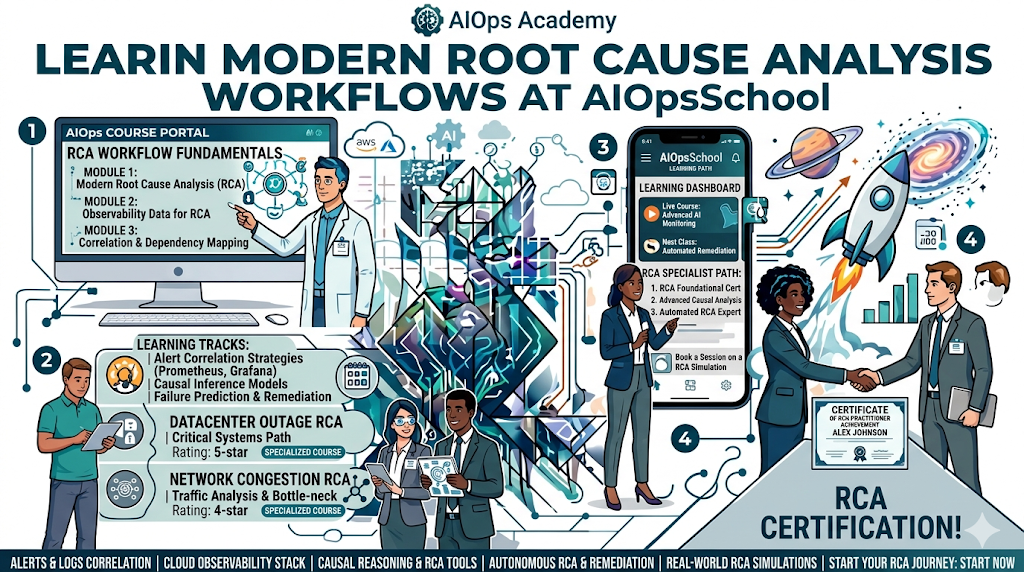
Managing distributed systems has passed the point of human scale. As enterprise software shifts completely to multi-cloud setups and dense microservices meshes, the operational data generated by logs, traces, and metrics has turned into an overwhelming flood. When systems fail, engineering groups do not suffer from a lack of information; they suffer from a chaotic excess of it. For technology professionals trying to navigate this transition, mastering these intelligent operational practices is the most direct path to staying relevant. AIOpsSchool provides a comprehensive, vendor-neutral educational ecosystem designed to take engineers from foundational telemetry mechanics up to deploying enterprise-scale, automated platforms. This guide provides a strategic blueprint for mastering AI-driven IT operations and maximizing career growth.
What Is AIOps?
AIOps stands for Artificial Intelligence for IT Operations. It represents the intersection of big data, machine learning, and automation tools applied directly to the engineering challenges of managing large-scale software platforms.
Instead of manual operators writing endless rules to capture known error conditions, an AIOps platform uses mathematical models to actively observe data streams, learn normal behavior, and isolate unknown system anomalies.
The Structural Evolution of Operations
The discipline of system administration has advanced through distinct developmental waves:
[System Administration] ──> [Component Monitoring] ──> [Centralized Observability] ──> [AIOps Integration]
  Manual server triage,        Siloed dashboards tracking   Unified metrics, logs, and      Algorithmic analytics
  isolated local scripts       specific hardware layers     distributed traces              driving self-healing loops
- System Administration: Manual validation of local configuration states and physical hardware targets.
- Component Monitoring: Isolating health checks into distinct layers (e.g., database performance vs. network uptime) via standalone management dashboards.
- Centralized Observability: Aggregating granular telemetry data—metrics, logs, and traces—to expose the internal state of a distributed application.
- AIOps Integration: Overlaying algorithmic analysis across the observability pipeline to automate decision-making and orchestrate self-healing systems.
What Is AIOpsSchool?
AIOpsSchool operates as a specialized online learning platform focused on closing the technical skills gap between traditional infrastructure support and automated software engineering. Rather than emphasizing specific commercial software interfaces, the curriculum focuses on fundamental engineering principles, vendor-neutral architectures, and data workflows.
Through comprehensive AIOps course tracks, project-based tutorials, and hands-on laboratory exercises, the ecosystem helps students build the practical expertise required to implement intelligent monitoring. The platform maps its educational modules directly to global certification standards, including the entry-level AIOps Foundation Certification, allowing engineers to validate their practical problem-solving abilities to enterprise employers.
Why AIOps Is Essential in Modern Environments
Modern production infrastructure is defined by short-lived containers, transient microservices, and rapid cloud deployments. In a dynamic Kubernetes cluster, a performance degradation rarely stems from a single isolated server failure. Instead, it is typically an emergent failure—a subtle interaction between network latency, unexpected database locks, and a recent code push.
Static monitoring fails here because it cannot anticipate these non-linear behaviors. If a rule specifies a strict alert for high CPU usage, it may fire during routine batch processing while completely missing a progressive memory leak that shows normal CPU utilization.
AIOps platforms eliminate this blind spot by looking at the entire environment simultaneously. By running continuous log analytics and event management, the system discovers multi-variable correlations that humans cannot see, helping teams proactively protect their service level objectives (SLOs) before end users experience any service degradation.
Who Should Pursue AIOps Training?
- DevOps Engineers: Embed algorithmic validation loops directly into continuous integration and delivery pipelines to prevent unstable software releases from degrading live systems.
- Site Reliability Engineers (SREs): Minimize persistent operational noise and alert fatigue, enabling teams to protect strict error budgets while scaling massive systems.
- Cloud & Infrastructure Engineers: Automate the mapping of intricate multi-cloud topologies and predict progressive capacity exhaustion across distributed storage tiers.
- Monitoring & NOC Specialists: Move beyond manual, passive dashboard observation and learn to design the underlying AI automation platforms that handle frontline incident classification.
- Automation & Systems Architects: Transition from writing fragile, static triage scripts to deploying adaptive, self-healing runtime systems.
- Tech Leaders & Enterprise Executives: Acquire the technical decision-making frameworks needed to evaluate enterprise-wide AIOps platform tools and justify deployment ROI.
- Students & Tech Transitions: Establish an engineering career path built on the future-proof methodologies of intelligent automation and machine learning for IT operations.
Strategic Features of AIOps Learning Programs
A high-impact AIOps learning path goes far beyond theoretical concepts, focusing instead on the actual data science and engineering mechanics of infrastructure automation:
- Linear Learning Progression: Curriculums that start with fundamental telemetry collection frameworks before introducing complex time-series anomaly detection models.
- Deep Observability Foundations: Hands-on instruction detailing how to instrument software to produce clean metrics, structured logs, and distributed traces.
- Algorithmic Correlation Mechanics: Understanding the mathematical and structural methods used to clean up alert streams, filter out redundant data, and isolate true incidents.
- Topology-Aware Analysis: Using live dependency mapping to track how an error in a single microservice propagates across a distributed application graph.
- Automated Runbook Orchestration: Building closed-loop feedback mechanisms that safely trigger programmatic fixes for known, repetitive errors without human intervention.
- Targeted Certification Prep: Matching educational modules with practical exam blueprints to ensure students can efficiently validate their technical skill sets.
AIOps Certification: Industry Value
As organizations scale up their investments in automated operations, they need clear validation that engineers possess genuine architecture skills rather than just surface-level tool knowledge. Completing an official AIOps Foundation Certification provides distinct professional advantages:
- Objective Skill Verification: Confirms a reliable command of algorithmic alerting, event correlation, and predictive analytics in production environments.
- Senior Career Pathing: Qualifies engineers for advanced architectural and leadership positions by proving they understand how to structurally minimize corporate downtime.
- Professional Trust: Establishes clear, technical credibility when leading digital transformation efforts within conservative enterprise organizations.
- High-Demand Alignment: Connects your personal portfolio directly with large enterprises seeking specialized engineers to build out their internal AI operations roadmaps.
Core Pillars of the AIOps Curriculum
An enterprise-ready AIOps course structure must include several vital technical pillars:
- Telemetry Engineering Foundations: Principles of collecting, structuring, and routing unstructured log telemetry, metrics, and trace headers across multi-cloud infrastructure.
- Machine Learning Applied to Telemetry: Utilizing clustering techniques, statistical distributions, and classification algorithms to detect infrastructure performance shifts.
- Algorithmic Event Correlation: Strategies for grouping related alerts based on temporal proximity and structural topology to remove non-actionable alert noise.
- Predictive Infrastructure Analytics: Applying time-series forecasting models to predict resource constraints, disk exhaustion events, and database bottlenecks before they occur.
- Intelligent Incident Lifecycle Management: Connecting real-time AI insight streams with enterprise ticketing platforms, chatops channels, and incident response matrices.
- Closed-Loop Remediation: Designing, testing, and safely deploying autonomous runbooks that allow infrastructure to fix common operational failures independently.
Mapping the Technical Ecosystem
Understanding where individual tools and technologies sit within an operational data pipeline is key to designing an effective AIOps architecture.
| Tool Category | Purpose | Benefits | Typical Use Cases |
| Observability Platforms | Collecting and aggregating high-fidelity metrics, application logs, and distributed traces. | Feeds the downstream AI system with the clean data streams needed for learning. | Tracking end-user transaction latency, debugging cross-service microservices requests. |
| Log Analytics Tools | Ingesting, parsing, and indexing massive streams of unstructured text records from machines. | Normalizes text data into clear structured patterns for machine learning models. | Tracking system error signatures, running audit trails across large container fleets. |
| Event Management Platforms | Capturing, deduplicating, and correlating raw alerts from disparate monitoring sources. | Drastically cuts alert noise, combining thousands of separate alarms into one incident ticket. | Suppressing background noise during critical network switch or hardware failures. |
| Automation Solutions | Running programmatic workflows, programmatic API scripts, and configuration updates. | Removes human error from repetitive triage steps and enables rapid self-healing loops. | Auto-scaling cluster nodes, restarting application processes that cross error thresholds. |
| AI/ML Components | Processing telemetry pipelines to identify multi-variable performance anomalies. | Surfaces hidden, complex system degradations that standard alert rules miss. | Creating dynamic performance baselines, predicting creeping memory leak events. |
Enterprise Use Cases: Real-World Scenarios
Dynamic Event Deduplication & Noise Reduction
When a database tier experiences sudden connection timeouts, it can trigger secondary failures across hundreds of dependent frontend services, web servers, and payment getaways. An AIOps platform uses topology data to understand that all these components rely on the same database. Instead of letting an alert storm overwhelm the engineering team, the platform groups those thousands of alerts into a single incident ticket pointing directly to the database.
Automated Root Cause Analysis
If an enterprise web app experiences a sudden slowdown at checkout, tracing the problem manually across a modern microservices mesh can take hours. An AIOps engine traces the distributed transaction flow backward through the system topography graph, matching error timings and metrics across layers. Within seconds, it isolates the exact unoptimized database query or service update responsible for the delay, cutting down triage time.
Proactive Resource Management
Instead of setting a simple alert for when a disk reaches 90% capacity, time-series forecasting models evaluate real-time storage consumption patterns. The AIOps platform calculates the exact time remaining until the volume fills up and alerts cloud engineering weeks in advance, letting them automate storage provisioning during normal working hours.
Empowering Site Reliability Engineering
Site Reliability Engineering focuses on applying software engineering mindsets directly to infrastructure reliability challenges, using core metrics like Service Level Indicators (SLIs) and Service Level Objectives (SLOs) to protect error budgets.
AIOps acts as an analytical force multiplier for SRE teams. Instead of spending valuable time writing and updating static threshold alerts for dynamic software environments, SREs use algorithmic anomaly detection to establish flexible, dynamic baselines.
When a critical incident does impact a system, AIOps accelerates post-mortem analysis by instantly generating unified event timelines and behavioral dependency paths. This allows SREs to spend less time troubleshooting active incidents and more time engineering long-term resilience into the application architecture.
Strategic Distinctions: AIOps vs. DevOps
While AIOps and DevOps operate within the same modern software environment, they serve entirely different engineering goals.
| Area | DevOps | AIOps |
| Primary Focus | Fostering structural collaboration and integration between development and operations teams. | Applying big data and machine learning models to automate analytical operations. |
| Core Goal | Streamlining code deployment speed, build frequency, and continuous delivery pipelines. | Ensuring high application availability, removing alert noise, and automating triage. |
| Business Impact | Accelerates software feature time-to-market and shortens deployment cycles. | Minimizes MTTR, lowers support costs, and stabilizes complex production scale. |
DevOps optimizes how teams build and ship code to production. AIOps optimizes how systems analyze and protect that code once it is live in a highly complex running state.
Strategic Distinctions: AIOps vs. MLOps
It is equally important not to confuse AIOps with MLOps, as they focus on completely opposite sides of the operational equation.
| Area | AIOps | MLOps |
| Primary Goal | Using machine learning to optimize and protect backend IT infrastructure and workflows. | Applying operational principles to streamline the development and deployment of ML models. |
| Data Ingested | Systems telemetry streams: logs, application metrics, traces, and alert events. | Model training datasets, hyperparameters, model weights, and performance logs. |
| Primary User | SREs, Cloud Operations Engineers, System Administrators, Network Teams. | Data Scientists, Machine Learning Engineers, MLOps Engineers. |
Simply put: AIOps applies AI to make infrastructure run efficiently, whereas MLOps applies operational practices to make machine learning models run efficiently.
Mechanics of Algorithmic Anomaly Detection
Traditional infrastructure management operates on a pass-fail system (e.g., alert if memory usage crosses 90%). However, modern applications experience natural, cyclical shifts based on user behavior, time zones, and business calendar cycles.
[Live Telemetry Pipeline Ingestion]
                │
                ▼
[Algorithmic Baseline Profiling (Time-Series / Clustering)]
                │
                ▼
[Dynamic Behavioral Boundaries Established]
                │
                ▼
[Real-Time Deviation Scoring & Filtering]
- Telemetry Pipeline Ingestion: The AIOps system continuously absorbs time-series performance metrics from across the distributed landscape.
- Algorithmic Profiling: Machine learning models analyze historical performance patterns across days, weeks, and seasons to understand normal behavior for specific time frames.
- Dynamic Boundary Definition: The engine builds a flexible baseline envelope that automatically scales up or down based on context, time, and external traffic drivers.
- Deviation Scoring & Filtering: If a metric moves outside this dynamic envelope, the engine scores it for severity. This surfaces true anomalies early while ignoring normal traffic peaks that would trip static alerts.
Transforming Root Cause Analysis
When a distributed microservices platform begins to fail, the apparent symptom is rarely the true origin of the problem. For instance, a sudden surge in API gateway errors might look like a web tier failure, but the actual cause could be an unindexed database query slowing down downstream transactions.
[App Outage Triggered] ──> [AIOps Topology Graph Traversal] ──> [Root Cause Isolated]
  API gateway throws         Engine traces transaction path       Isolated to unindexed DB
  504 gateway errors.        back across microservices.           query running in background.
In standard environments, resolving this requires bringing diverse engineering teams into an emergency “war room” to manually correlate different logs and timelines.
An AIOps platform handles this process automatically using real-time topology traversal and temporal correlation. The engine maps the relationships between infrastructure layers and application services. When an alert fires, it traces the transaction path backward across these dependencies, matching error timings and code shifts to isolate the true root cause in seconds instead of hours.
The Indispensable Link: Observability & AIOps
To fully master intelligent operations, one must understand that observability and AIOps are deeply interdependent. Observability focuses on exposing the internal state of a complex system by gathering comprehensive data outputs—specifically metrics, logs, and distributed traces.
AIOps acts as the analytical brain that interprets this telemetry data. Without comprehensive observability datasets, an AIOps model has no information to learn from. Conversely, without AIOps analytics, the sheer volume of data produced by modern observability systems quickly becomes too complex for human operators to process. Together, they form a complete loop: observability provides the raw system sight, while AIOps provides the actionable insight.
Practical Learning Scenarios
- The DevOps Professional: A DevOps engineer notices that rapid application updates occasionally cause minor, hard-to-detect performance degradations. After completing structured AIOps training, they learn to place event correlation engines directly into their CI/CD loops, enabling their pipelines to automatically catch and roll back unstable code versions.
- The SRE Team Member: An SRE is constantly interrupted by thousands of minor, non-critical alerts from a production Kubernetes cluster. Through practical training labs, they learn to implement dynamic anomaly thresholds, reducing background alert noise by 85% and freeing up time for high-value engineering work.
- The Enterprise Operations Director: A technology leader needs to upgrade a legacy, manual network operations center. By studying vendor-neutral AIOps architectures and data strategy, they gain the exact technical perspective needed to select the right platform tools and successfully lead their team’s operational transformation.
Evolving Career Frameworks
Developing expertise in AI-driven operations opens up critical, high-impact career paths across the technology sector:
- AIOps Platform Architect: Designs, builds, and manages the large-scale data systems, stream processors, and machine learning components that run corporate IT operations.
- Site Reliability Engineer (SRE): Leverages automated telemetry analysis and dynamic alerts to keep large-scale, highly distributed enterprise systems consistently available.
- Cloud Platform Engineer: Designs elastic, automated multi-cloud environments that use algorithmic analytics for proactive resource sizing and auto-scaling.
- Intelligent Automation Engineer: Engineers closed-loop self-healing systems that automatically fix production infrastructure issues based on real-time AIOps signals.
Mistakes Beginners Must Avoid
- Learning UIs Instead of Concepts: Spending time learning specific vendor interfaces before mastering the underlying machine learning models, statistical rules, and data architectures that power the entire discipline.
- Ignoring Telemetry Fundamentals: Attempting to implement advanced anomaly detection without first mastering how metrics, log schemas, and distributed tracing fields are structured and collected.
- Overlooking Human Workflows: Forgetting that an AIOps tool must connect seamlessly with team ticketing tools, collaboration channels, and response processes to provide real enterprise value.
- Expecting Instant Full Autonomy: Assuming an AI platform can run an entire infrastructure independently on day one, rather than building trust over time through iterative baseline tuning.
Actionable Tips for Mastery
To learn AI-driven operations effectively, follow a logical, step-by-step path:
- Solidify Systems Basics: Ensure you have a clear understanding of cloud networking, system administration, and microservice communications.
- Master Telemetry Collection: Learn how to instrument systems to gather clean, structured, and consistent logs, metrics, and trace headers.
- Understand Foundational ML: Get comfortable with the core principles of time-series data analysis, clustering models, and automated log pattern recognition.
- Prioritize Vendor-Neutral Concepts: Focus on learning universal architectural patterns and data management strategies before specializing in a particular tool.
- Leverage Structured Ecosystems: Use specialized resources like AIOpsSchool to access linear study tracks, clear tutorials, and practical certification preparation materials.
Evaluating AIOps Learning Approaches
| Training Feature | Purpose | Core Learning Benefit | Long-Term Career Value |
| Structured Learning Path | Leads students logically from basic telemetry concepts to advanced production ML applications. | Prevents learning gaps by ensuring a solid foundation before tackling advanced AI models. | Demonstrates a thorough, structured understanding of advanced operations to employers. |
| Conceptual Tutorials | Deeply explains the underlying mathematical models, time-series distributions, and patterns. | Ensures you understand the why behind system behaviors, not just how to push buttons. | Builds vendor-neutral expertise, allowing you to adapt quickly as commercial tools change. |
| Enterprise Use Case Study | Analyzes actual historical production system failures and infrastructure bottlenecks. | Connects abstract academic data theory with practical real-world troubleshooting. | Develops the high-level system analysis skills required for senior and lead engineering roles. |
| Certification Guidance | Aligns training modules directly with global industry certification blueprints. | Structures study time efficiently around clear, industry-recognized learning targets. | Provides a validated credential that instantly proves technical readiness to hiring teams. |
Future Landscape of Intelligent Operations
The future of IT operations points directly toward autonomous, self-healing systems. Over the coming years, production environments will rely less on manual configuration adjustments, moving instead toward closed-loop systems that optimize themselves in real time. Machine learning platforms will shift from identifying active incidents to automatically preventing them by continuously reconfiguring cloud allocations.
At the same time, large language models (LLMs) and generative artificial intelligence are transforming how engineers interact with infrastructure. Future operational platforms will allow teams to query complex telemetry data using normal, everyday language—instantly surfacing dependency paths, generating remediation scripts, and compiling automated post-mortem reviews. Engineers who master AIOps principles today will be the architects who design and run these autonomous enterprise systems tomorrow.
Frequently Asked Questions (FAQs)
1.What is an AIOps tutorial?
An AIOps tutorial is a practical, step-by-step instructional guide that focuses on a specific task within intelligent operations—such as configuring a text log parsing pipeline, creating event correlation rules, or setting up a time-series anomaly detection algorithm.
2.Why should I choose AIOpsSchool for my learning path?
AIOpsSchool provides focused, vendor-neutral educational frameworks built specifically around modern infrastructure, observability, and AI automation. Its structured pathways ensure you develop the deep conceptual insight and certification readiness needed to excel in senior enterprise roles.
3.What topics are covered in a comprehensive AIOps course?
A complete course generally covers telemetry data collection, applied machine learning for time-series anomalies, algorithmic alert deduplication, topology-aware root cause analysis, incident platform integration, and closed-loop runbook automation.
4.Is deep coding experience required to work in AIOps?
While you don’t need to be a senior machine learning researcher, having a solid grasp of foundational scripting languages (like Python or Bash) and data query syntax is highly beneficial for setting up data routing and automated workflows.
5.How does event correlation help infrastructure teams?
Event correlation automatically evaluates thousands of incoming alerts across separate systems, deletes redundant messages, and groups related notifications based on time and system topology. This removes background alert noise, letting engineers focus on a single, clear incident ticket instead of being overwhelmed by an alert storm.
6.Can beginners transition directly into AIOps?
Yes, by following a methodical, linear learning path. Beginners should first master infrastructure monitoring and basic observability concepts before moving on to the advanced machine learning models and automated remediation architectures taught via platforms like AIOpsSchool.
7.What is the AIOps Foundation Certification?
It is an industry-recognized credential that verifies an engineer’s technical understanding of foundational AIOps concepts, terminology, telemetry data structures, and the machine learning models used to run predictive and automated enterprise operations.
8.How does AIOps improve Mean Time to Repair (MTTR)?
AIOps lowers MTTR by automatically clearing out non-actionable alert noise, identifying the true root cause of a system issue via real-time dependency mapping, and triggering automated runbooks to resolve common infrastructure errors instantly.
9.What is the role of machine learning in IT operations?
Machine learning processes massive volumes of unstructured telemetry data in real time to uncover hidden patterns, generate dynamic behavioral baselines, and flag subtle system degradations that manual threshold filters would miss entirely.
10.What is the difference between observability and monitoring?
Monitoring tracks whether a system component is working based on predefined, static rules (checking if a system is up or down). Observability allows you to infer the internal state of a complex system by analyzing all its external outputs (metrics, logs, and traces), enabling you to diagnose novel, unmapped performance issues.
11.How do AIOps platforms process unstructured log data?
AIOps systems leverage natural language processing (NLP) and token clustering models to ingest raw textual logs, automatically group common system patterns, filter out routine entries, and isolate rare log messages that point to infrastructure issues.
12.What are the main benefits of predictive operations?
Predictive operations allow engineering teams to move away from stressful, reactive firefighting. By forecasting resource consumption patterns and structural failures early, teams can proactively fix issues before they impact end-user transaction performance.
13.How does AIOps integrate with existing DevOps pipelines?
AIOps interfaces directly with continuous deployment tools to observe infrastructure health immediately following a code push. If the platform identifies an anomaly correlated with a recent release, it flags the issue and can trigger an automated rollback to protect the system.
14.What industries benefit most from deploying AIOps?
Any sector operating high-volume, mission-critical digital platforms benefits heavily—including financial services, global e-commerce systems, cloud-based healthcare architectures, telecom networks, and large-scale software-as-a-service (SaaS) providers.
15.How long does it take to prepare for an AIOps certification?
By using a structured, linear platform like AIOpsSchool, professionals who already understand basic system monitoring can typically master the core competencies and successfully pass a foundational certification exam within 4 to 8 weeks of focused study.
Final Recommendation
As enterprises continue to expand their distributed cloud environments, the gap between traditional operations and automated system design is widening. Relying on manual threshold tuning and siloed dashboards is no longer viable for modern systems. For DevOps specialists, SRE teams, and infrastructure managers, learning how to leverage machine learning for IT operations is the most practical step toward securing a future-proof, senior technical career.
Validating your practical skills through a structured learning curriculum and industry certification is key to demonstrating high-level capability to prospective employers. By providing vendor-neutral foundations, deep conceptual tutorials, and focused certification preparation paths, AIOpsSchool offers the exact educational ecosystem needed to achieve operational excellence. Take charge of your professional trajectory—explore the linear training tracks and certification programs at AIOpsSchool today to position yourself as an expert in the future of automated IT operations.
