Introduction
Data is now one of the most important assets for modern organizations. Companies depend on data pipelines, analytics dashboards, reporting systems, cloud platforms, and automated workflows to make better business decisions. Because of this, DataOps has become an important career area for students, junior engineers, analytics professionals, and career changers. For beginners, DataOps can feel confusing because it combines data engineering, DevOps, automation, monitoring, collaboration, and data quality practices. A structured learning approach is very important. DataOpsSchool.com is an educational learning resource that helps beginners understand DataOps concepts, tools, and career paths in a practical way through DataOpsSchool.com. In this article, you will learn what DataOps means, why it matters, which skills beginners should develop, common mistakes to avoid, useful tools, career opportunities, and the best practices every entry-level DataOps professional should follow.
What Is DataOps?
DataOps is a modern approach to building, managing, automating, monitoring, and improving data pipelines and analytics workflows.
In simple words, DataOps helps teams deliver reliable data faster.
It combines ideas from data engineering, DevOps, automation, agile teamwork, testing, monitoring, and continuous improvement. The goal is to make sure data moves smoothly from source systems to business users with better quality, fewer errors, and faster delivery.
A typical DataOps workflow may include:
- Collecting data from different sources
- Cleaning and transforming data
- Automating data pipelines
- Testing data quality
- Monitoring pipeline failures
- Managing code with version control
- Deploying pipeline changes safely
- Collaborating with business and analytics teams
DataOps is closely related to data engineering because both focus on data pipelines and platforms. It is connected to DevOps because it uses automation, CI/CD, monitoring, and version control. It also supports analytics engineering because clean and trusted data is needed for reports, dashboards, and business insights.
In modern data platforms, DataOps is important because organizations cannot depend on slow, manual, and error-prone data processes. They need reliable systems that can handle growing data volume, changing business needs, and continuous delivery.
Why Entry-Level Professionals Should Learn DataOps
Growing Industry Demand
Companies are collecting more data from websites, applications, cloud systems, customer platforms, finance tools, marketing platforms, and internal operations. This creates a strong demand for professionals who understand how to manage data pipelines reliably.
Entry-level professionals who learn DataOps can support teams that need clean, timely, and trusted data.
Automation in Data Engineering
Manual data work can lead to delays and errors. DataOps introduces automation into pipeline creation, testing, deployment, and monitoring.
For example, instead of manually checking whether a data pipeline ran successfully, a DataOps process can automatically send alerts when a job fails or when data quality drops.
Better Career Opportunities
DataOps knowledge can help beginners move into roles such as junior DataOps engineer, data engineer, analytics engineer, data platform engineer, or data reliability engineer.
Even if someone starts with SQL or reporting, learning DataOps practices can open more technical and higher-growth career paths.
Continuous Learning Culture
DataOps encourages continuous improvement. Beginners learn how to test, monitor, document, automate, and improve workflows over time.
This mindset is useful because data platforms keep changing. New tools may come and go, but strong fundamentals and problem-solving skills remain valuable.
Enterprise Adoption
Large organizations need reliable data systems across departments such as finance, healthcare, retail, manufacturing, operations, and marketing.
DataOps helps enterprises reduce pipeline failures, improve collaboration, and deliver better analytics. This makes DataOps skills useful in both startups and large companies.
Essential Skills Every Beginner Should Learn
SQL Fundamentals
SQL is one of the most important skills for any DataOps beginner. It helps you read, filter, join, aggregate, and analyze data stored in databases.
Beginners should learn:
- SELECT queries
- WHERE conditions
- JOIN operations
- GROUP BY and ORDER BY
- Window functions
- Basic query optimization
Workplace example: A business team may ask why sales numbers look different in two dashboards. SQL helps you investigate the source tables and compare the data.
Python Programming
Python is widely used for automation, scripting, data processing, API integration, and pipeline development.
Beginners should focus on:
- Variables and functions
- File handling
- Error handling
- Working with CSV and JSON
- API basics
- Data processing libraries
Workplace example: You may write a Python script to extract daily data from an API and load it into a database.
Linux Basics
Many data tools run on Linux-based systems. Entry-level professionals should understand basic Linux commands.
Useful commands include:
- ls
- cd
- mkdir
- cat
- grep
- chmod
- tail
- ps
Workplace example: If a pipeline log file shows an error, Linux commands help you inspect the file and identify the failure.
Git Version Control
Git helps teams track changes in code, collaborate safely, and roll back mistakes.
Beginners should learn:
- git clone
- git add
- git commit
- git push
- git pull
- branches
- pull requests
Workplace example: When you update a data transformation script, Git helps your team review the change before it reaches production.
Data Pipelines
A data pipeline moves data from one system to another. It may include extraction, transformation, validation, loading, and monitoring.
Beginners should understand:
- Source systems
- Data ingestion
- Data transformation
- Scheduling
- Dependencies
- Pipeline failures
Workplace example: A daily sales pipeline may collect order data, clean it, transform it, and load it into a reporting table.
ETL and ELT Concepts
ETL means Extract, Transform, Load. ELT means Extract, Load, Transform.
In ETL, data is transformed before loading into the target system. In ELT, data is loaded first and transformed later inside the warehouse or lakehouse.
Beginners should understand both approaches because different organizations use different architectures.
Cloud Fundamentals
Many modern data platforms run on cloud services. Beginners should learn the basics of cloud storage, compute, databases, networking, and access control.
Important concepts include:
- Object storage
- Managed databases
- Virtual machines
- Serverless services
- Identity and access management
- Cloud cost awareness
Data Quality
DataOps is not only about moving data. It is also about making sure data is correct, complete, consistent, and useful.
Beginners should learn how to check:
- Missing values
- Duplicate records
- Incorrect formats
- Unexpected data volume changes
- Invalid business rules
CI/CD Basics
CI/CD means Continuous Integration and Continuous Delivery. In DataOps, CI/CD helps test and deploy pipeline changes safely.
For beginners, the goal is to understand how code changes move from development to testing and production.
Communication and Collaboration
DataOps professionals work with data engineers, analysts, business teams, DevOps teams, cloud teams, and project managers.
Good communication helps reduce confusion. A beginner should be able to explain technical issues in simple language.
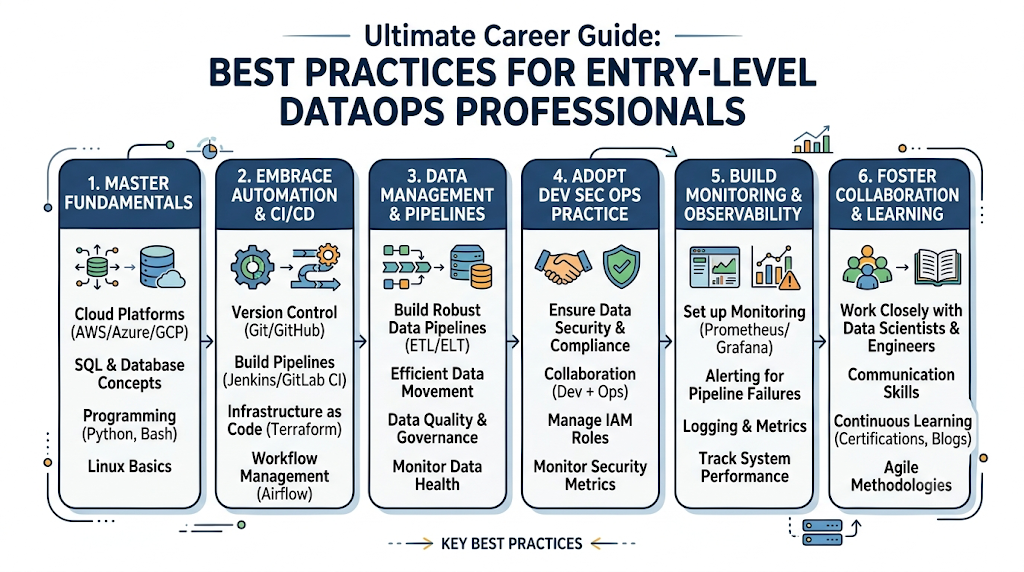
Best Practices for Entry-Level DataOps Professionals
Build Strong Fundamentals
Do not start with advanced tools before learning the basics. SQL, Python, Linux, Git, databases, and pipeline concepts are more important than memorizing tool names.
Practical example: If a pipeline fails because of duplicate records, a beginner with strong SQL fundamentals can investigate the issue faster than someone who only knows how to click buttons in a tool.
Learn One Tool at a Time
Many beginners try to learn multiple orchestration tools, cloud platforms, databases, and monitoring systems together. This creates confusion.
Start with one tool category at a time. For example, first learn Git properly, then learn one pipeline tool, then one cloud service.
Practical example: If you are learning pipeline orchestration, build a small workflow that extracts data from a file, transforms it, and loads it into a table. Do not try to learn every orchestration tool at once.
Practice with Real Projects
Theory is useful, but DataOps is a hands-on career path. Build small projects that look like workplace problems.
Project ideas include:
- Daily CSV data pipeline
- Sales reporting pipeline
- Data quality validation script
- Automated database backup workflow
- Dashboard data refresh pipeline
Practical example: Create a pipeline that reads customer order data, removes invalid rows, calculates daily revenue, and stores the result in a database.
Document Your Work
Documentation is a professional habit. It helps your team understand what a pipeline does, where data comes from, and how to fix common issues.
Good documentation should include:
- Pipeline purpose
- Source and target systems
- Schedule
- Dependencies
- Common errors
- Owner or contact person
- Recovery steps
Practical example: If your pipeline fails during the night, documentation helps another team member troubleshoot it without waiting for you.
Understand Data Quality
A pipeline that runs successfully is not always correct. It may still produce wrong or incomplete data.
Beginners should learn to add checks for row counts, null values, duplicate records, and business rules.
Practical example: If a daily revenue pipeline usually processes thousands of records but suddenly processes only a few, the system should detect the change before business users see incorrect reports.
Learn Monitoring and Observability
Monitoring helps you know whether a data pipeline is working. Observability helps you understand why something went wrong.
Beginners should track pipeline status, logs, error messages, processing time, data freshness, and data quality results.
Practical example: If a dashboard is showing old data, monitoring can help identify whether the pipeline failed, ran late, or received incomplete source data.
Improve Problem-Solving Skills
DataOps work often involves troubleshooting. Beginners should learn how to break problems into smaller parts.
A good troubleshooting approach:
- Read the error message
- Check recent changes
- Review logs
- Validate source data
- Test one step at a time
- Document the fix
Practical example: If a pipeline fails after a schema change, you should check whether a new column was added, removed, or renamed in the source system.
Keep Learning Continuously
DataOps is a long-term career path. Tools will change, but learning habits matter more.
Beginners should regularly practice, read documentation, build projects, review real-world scenarios, and improve communication skills.
Practical example: After learning basic pipelines, move to automation, monitoring, cloud deployment, and data reliability practices.
DataOpsSchool.com Learning Tips for Beginners
Create a Structured Learning Plan
Beginners should avoid random learning. A structured plan helps you move step by step from fundamentals to projects.
A good starting path can be:
- SQL basics
- Python basics
- Linux commands
- Git version control
- Database concepts
- ETL and ELT
- Pipeline automation
- Monitoring and troubleshooting
Focus on Hands-On Practice
Reading concepts is not enough. Build small labs and repeat them until you understand the workflow.
For example, create a small pipeline that reads a CSV file, cleans the data, loads it into a database, and creates a simple summary report.
Build a Portfolio
A portfolio shows your practical ability. Entry-level professionals can create small projects and explain them clearly.
Your portfolio can include:
- Project goal
- Tools used
- Workflow diagram
- Data quality checks
- Challenges faced
- Final output
Practice Automation
Automation is a major part of DataOps. Start with simple scripts before moving into advanced automation.
For example, automate a daily file validation task or write a script that checks whether required files arrived on time.
Stay Updated with Industry Trends
Beginners should understand common trends such as cloud data platforms, data observability, automated testing, AI-assisted operations, and data reliability.
You do not need to master every trend immediately. First understand what each trend means and where it fits in the DataOps workflow.
Common Tools Used in DataOps
DataOps includes many tool categories. Beginners do not need to master all tools at once, but they should understand what each category does.
| Tool Category | Primary Purpose | Beginner Difficulty | Typical Usage |
|---|---|---|---|
| Pipeline Orchestration Tools | Schedule and manage data workflows | Medium | Running ETL jobs, managing dependencies, retrying failed tasks |
| Version Control Systems | Track code changes and team collaboration | Easy to Medium | Managing pipeline scripts, reviewing changes, rollback support |
| Data Transformation Tools | Clean and transform raw data | Medium | Creating analytics-ready datasets and reusable models |
| Monitoring Platforms | Track pipeline health and failures | Medium | Detecting failed jobs, late data, errors, and performance issues |
| Cloud Platforms | Provide storage, compute, and managed services | Medium to High | Hosting data warehouses, pipelines, databases, and applications |
| Container Technologies | Package applications and dependencies | Medium | Running consistent environments for data jobs and services |
Common Beginner Mistakes
Learning Too Many Tools Together
Many beginners try to learn every trending tool at the same time. This often leads to shallow knowledge.
Solution: Learn one tool deeply enough to understand the core concept. Once you understand one orchestration tool, it becomes easier to understand others.
Ignoring Data Fundamentals
Some beginners focus only on automation and cloud tools but ignore databases, SQL, data types, and data modeling.
Solution: Build strong foundations in databases, query writing, schema design, and data validation before moving into advanced platforms.
Skipping Documentation
Beginners sometimes think documentation is less important than coding. In real teams, poor documentation creates confusion and delays.
Solution: Document every project, pipeline, error, and recovery step. Treat documentation as part of engineering work.
Avoiding Practical Projects
Only watching tutorials does not build job-ready skills. DataOps requires hands-on experience.
Solution: Build projects that simulate workplace problems. Start small and gradually add monitoring, automation, and error handling.
Not Understanding Business Requirements
A pipeline may be technically correct but still fail to solve the business problem.
Solution: Always ask what the data is used for, who uses it, how often it is needed, and what accuracy level is required.
Step-by-Step DataOps Learning Roadmap
Step 1: Learn Programming Basics
Start with Python fundamentals. Learn how to write scripts, handle files, process data, and manage errors.
Step 2: Understand Databases
Learn relational databases, SQL queries, table design, joins, indexes, and basic performance concepts.
Step 3: Build ETL Pipelines
Create small ETL workflows that extract data from files or APIs, transform it, and load it into a database.
Step 4: Learn Cloud Services
Understand cloud storage, managed databases, compute services, access control, and cost basics.
Step 5: Explore Automation
Automate repetitive tasks such as file checks, pipeline execution, data validation, and report generation.
Step 6: Practice Monitoring
Add logs, alerts, status checks, and quality checks to your pipelines. Learn how to troubleshoot failures.
Step 7: Build Portfolio Projects
Create practical projects and publish clear documentation. Your portfolio should show your learning journey and problem-solving skills.
Real-World Applications of DataOps
Financial Services
Banks and financial companies use DataOps to manage transaction data, fraud detection pipelines, risk reports, and compliance analytics.
Reliable pipelines are important because incorrect financial data can affect reporting and decision-making.
Healthcare Analytics
Healthcare organizations use DataOps for patient data analysis, appointment trends, operational reporting, and quality improvement.
Data quality and privacy awareness are very important in this area.
Retail
Retail companies use DataOps to analyze sales, inventory, customer behavior, product demand, and supply chain performance.
A delayed or incorrect pipeline can affect pricing, stock planning, and business decisions.
Manufacturing
Manufacturing teams use DataOps to monitor machine data, production quality, downtime, and supply chain operations.
DataOps helps combine sensor data, operational data, and business data into useful insights.
Marketing Analytics
Marketing teams use DataOps to track campaigns, customer journeys, website behavior, leads, and conversion reports.
DataOps ensures marketing dashboards are updated, accurate, and trusted.
DataOps Career Opportunities
Junior DataOps Engineer
A junior DataOps engineer helps maintain data pipelines, monitor workflow failures, automate tasks, and support data platform operations.
Data Engineer
A data engineer builds and manages data pipelines, databases, data warehouses, and data processing systems.
Analytics Engineer
An analytics engineer focuses on transforming raw data into clean, trusted, and business-ready datasets.
Data Platform Engineer
A data platform engineer works on the infrastructure, tools, and systems that support data teams.
Data Reliability Engineer
A data reliability engineer focuses on data quality, pipeline reliability, monitoring, incident response, and service-level expectations for data systems.
Traditional Data Engineering vs DataOps
| Aspect | Traditional Data Engineering | DataOps |
| Workflow | Sequential | Collaborative and automated |
| Deployment | Manual | Continuous |
| Monitoring | Limited | Continuous |
| Data Quality | Reactive | Proactive |
| Team Collaboration | Moderate | High |
Traditional data engineering often focuses mainly on building pipelines. DataOps focuses on building, testing, deploying, monitoring, and improving pipelines continuously.
This does not mean DataOps replaces data engineering. Instead, it improves the way data engineering teams work.
Key Performance Metrics Beginners Should Understand
Pipeline Success Rate
This shows how often pipelines run successfully without failure. A high success rate means the pipeline is stable.
Data Freshness
Data freshness measures how up to date the data is. If business users need daily reports, stale data can create wrong decisions.
Data Quality Score
This reflects how accurate, complete, consistent, and valid the data is. Beginners should learn how quality checks are measured.
Processing Time
Processing time measures how long a pipeline takes to complete. Slow pipelines may affect reporting and downstream systems.
Incident Resolution Time
This measures how quickly teams identify and fix pipeline issues. Lower resolution time usually means better monitoring and documentation.
Future of DataOps Careers
AI-Assisted Data Operations
AI can help teams detect anomalies, suggest fixes, classify incidents, and improve monitoring. Entry-level professionals should understand how AI can support DataOps workflows.
Data Observability
Data observability is becoming important because organizations need deeper visibility into data health, lineage, freshness, volume, and quality.
Cloud-Native Platforms
More data platforms are moving toward cloud-native architectures. Beginners should understand scalable storage, managed services, automation, and cloud security basics.
Automation
Automation will continue to reduce repetitive manual work. Professionals who understand automation will be more valuable in data teams.
Intelligent Analytics
DataOps supports better analytics by making data more reliable. As organizations depend more on analytics, DataOps professionals will play an important role in keeping data trustworthy.
Common Misconceptions About DataOps
Myth: DataOps Is Only for Senior Engineers
Reality: Beginners can start learning DataOps by understanding SQL, Python, Git, pipeline basics, and documentation.
Myth: DataOps Is the Same as Data Engineering
Reality: Data engineering focuses on building data systems. DataOps adds automation, monitoring, testing, collaboration, and continuous improvement.
Myth: Automation Replaces Engineers
Reality: Automation reduces repetitive work. Engineers are still needed to design systems, solve problems, understand business needs, and improve reliability.
Myth: DataOps Means Learning Every Tool
Reality: DataOps is more about practices and mindset than tool collection. Strong fundamentals matter more than memorizing tool names.
Myth: Monitoring Is Only Needed After Production
Reality: Monitoring should be planned early. Good monitoring helps prevent small problems from becoming major incidents.
FAQ Section
- What is DataOps for beginners?
DataOps is a way of managing data pipelines using automation, monitoring, testing, collaboration, and continuous improvement. For beginners, it means learning how data moves, how pipelines work, and how teams keep data reliable. - Is DataOps a good career path for entry-level professionals?
Yes, DataOps is a strong career path because companies need reliable data for analytics, reporting, and decision-making. Beginners can start with SQL, Python, Git, and pipeline basics. - What skills are required for a beginner DataOps engineer?
A beginner should learn SQL, Python, Linux basics, Git, databases, ETL and ELT concepts, cloud fundamentals, data quality, monitoring, and communication skills. - Do I need coding knowledge to learn DataOps?
Yes, basic coding knowledge is helpful. Python is commonly used for scripting, automation, data processing, and pipeline tasks. - How is DataOps different from DevOps?
DevOps focuses on software delivery and infrastructure automation. DataOps applies similar automation, testing, monitoring, and collaboration practices to data pipelines and analytics workflows. - How is DataOps different from data engineering?
Data engineering focuses on building data pipelines and platforms. DataOps focuses on making those pipelines more automated, reliable, monitored, tested, and collaborative. - Which tool should a beginner learn first in DataOps?
Beginners should start with SQL, Python, Git, and one database before learning advanced tools. Strong fundamentals make every tool easier to understand. - Can non-programmers learn DataOps?
Yes, but they should be ready to learn basic programming and technical concepts. A non-programmer can begin with SQL, data concepts, and simple Python automation. - What beginner projects are useful for learning DataOps?
Useful projects include CSV-to-database pipelines, data quality validation scripts, automated report refresh workflows, API data extraction, and simple pipeline monitoring dashboards. - How long does it take to become job-ready in DataOps?
The timeline depends on your background and practice level. A consistent learner can build strong beginner skills by focusing on fundamentals, hands-on projects, and real-world problem-solving.
Final Summary
DataOps is an important career area for beginners who want to work with data pipelines, automation, cloud platforms, analytics systems, and reliable data delivery. It brings together data engineering, DevOps practices, monitoring, testing, collaboration, and continuous improvement. Entry-level professionals should focus on strong fundamentals first. SQL, Python, Linux, Git, databases, ETL and ELT, cloud basics, data quality, and monitoring are essential building blocks. Beginners should avoid learning too many tools at once and instead build practical projects that solve real data problems.
