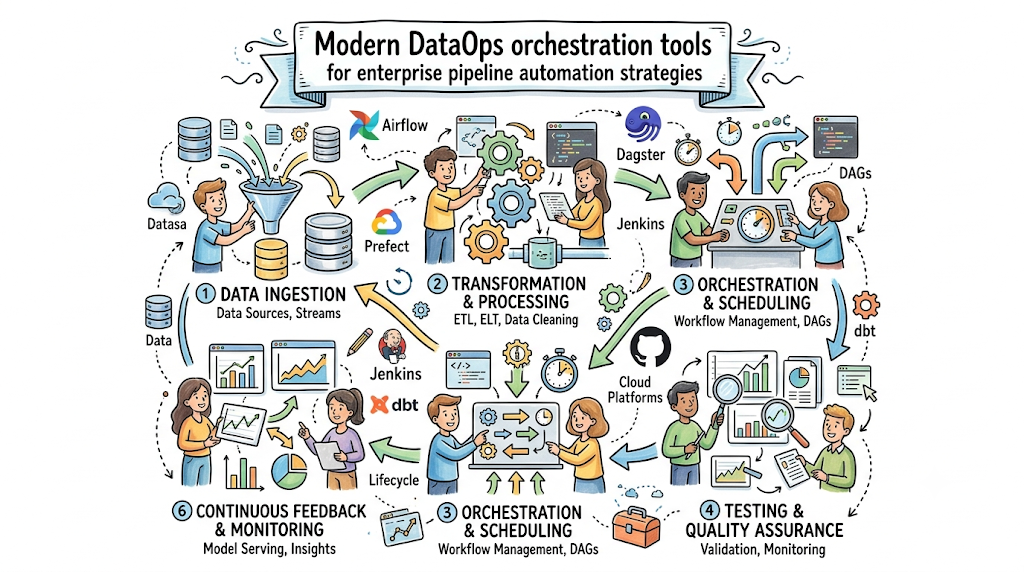
Introduction
The modern enterprise data ecosystem is undergoing an unprecedented expansion. Organizations no longer ingest data from a couple of centralized relational databases. Instead, a standard production pipeline ingests data from hundreds of disparate sources. The data team spends the next ten hours manually hunting down the failure point, cleaning up corrupted database tables, and restarting jobs in the correct sequence. This breakdown underscores why modern enterprise data operations require specialized platforms. To master these architectures, teams rely on comprehensive educational platforms like DataOpsSchool, which provides specialized programs in production data engineering.
Featured Snippet
What Are Orchestration Tools in DataOps?
DataOps orchestration tools are centralized platforms designed to programmatically author, schedule, automate, and monitor complex data pipelines. They manage task dependencies, handle operational failures, abstract underlying computational infrastructure, and ensure that data flows seamlessly through validation, transformation, and storage layers across distributed enterprise systems.
Understanding Data Orchestration Tools
What Is Data Orchestration?
In Simple Terms, data orchestration acts as the conductor of a massive digital orchestra. Imagine dozens of musicians playing different instruments. Without a conductor to signal exactly when each person should start and stop, the performance turns into chaotic noise. A data orchestration tool ensures that every distinct task in a data factory executes at precisely the right moment, using the correct input, and in the exact sequence required.
Real-World Example: In an enterprise banking environment, a data orchestration platform coordinates the end-to-end anti-money laundering pipeline. It ensures that customer transaction logs are completely extracted from cloud storage bucket platforms before triggering an Apache Spark job to scrub personal identifying information (PII). Only after the Spark job validates and finishes does the orchestrator signal a Snowflake warehouse to refresh its analytical views.
Why It Matters: Without structural orchestration, data workflows become highly fragile. Individual scripts run out of order, systems overload because too many intensive queries trigger simultaneously, and business leaders lose trust in the accuracy of operational reports.
- Centralization: It unifies fragmented operational scripts into a single, cohesive interface.
- State Management: The system tracks the exact success, failure, or running state of every operational task.
- Deterministic Execution: Tasks execute based on structural logical conditions rather than arbitrary time estimates.
Why Orchestration Is Needed in DataOps
The DataOps philosophy emphasizes continuous integration, rapid deployment, high data quality, and repeatable delivery of analytics. Achieving these outcomes requires eliminating brittle, manual steps within the data engineering lifecycle.
As pipelines expand to support machine learning models, operational dashboards, and real-time reporting, human oversight must scale programmatically. Orchestration bridges the gap between infrastructure management and software engineering principles.
+-----------------------------------------------------------------------+
|                           DATAOPS TRITYCH                             |
|                                                                       |
|   [ Continuous Integration ] ---> [ Reliable Orchestration ]          |
|                                              |                        |
|                                              v                        |
|                                 [ High Quality Analytics ]            |
+-----------------------------------------------------------------------+
In Simple Terms, orchestration serves as the structural scaffolding that keeps your data factory operating automatically without human workers constantly monitoring the machinery. It replaces constant human panic with automated, predictable processes.
Real-World Example: An e-commerce platform processes millions of user clickstream events daily. The DataOps team configures an orchestration system to automate continuous quality checks. If a data validation step discovers that an upstream schema change broke the incoming data format, the orchestrator halts the pipeline immediately, quarantines the bad files, and alerts the engineering team via Slack before any corrupted metrics hit production dashboards.
Why It Matters: Automating these operational checks reduces the time data engineers spend on firefighting operations. Instead of manually auditing data pipelines, engineers can focus on developing new features, optimizing queries, and accelerating business intelligence velocity.
- Operational Resilience: Pipelines automatically isolate and handle structural anomalies without crashing completely.
- Agility: Teams can deploy new code changes into production pipelines with confidence, knowing the orchestrator manages dependencies safely.
- Transparency: Provides a clear, audible record of every data mutation step for strict corporate compliance.
Difference Between Scheduling and Orchestration
Many engineering teams conflate basic scheduling with true data orchestration. This misunderstanding leads to brittle infrastructure implementations that fail under real-world production stress.
In Simple Terms, scheduling is a simple alarm clock that goes off at a specific time regardless of what is happening around it. Orchestration is an intelligent assistant that monitors your environment, waits until all required prerequisites are met, verifies security clearances, and then executes a complex series of tasks in sequence.
Real-World Example: A traditional logistics firm uses a cron scheduler to run a script at midnight that imports inventory files. If the files are delayed due to a vendor server outage, the script runs anyway, processes zero files, and closes out.
Conversely, a modern competitor uses a DataOps orchestration platform. The orchestrator waits until the file arrives in an Amazon S3 bucket, validates its structural integrity, provisions an ephemeral computing cluster, processes the records, and then shuts down the infrastructure to save costs.
Why It Matters: Relying solely on basic schedulers forces engineers to introduce artificial time delays between tasks to account for worst-case scenarios. This practice artificially slows down data delivery across the entire enterprise.
- Time vs. Logic: Schedulers rely exclusively on the clock; orchestrators operate based on event triggers and topological dependency logic.
- Context Awareness: Schedulers execute tasks in isolation without awareness of surrounding systems; orchestrators maintain global operational context.
- Error Containment: Schedulers cannot natively halt downstream workflows if an upstream job fails silently; orchestrators prevent cascading corruption through precise dependency graphs.
Core Functions of Orchestration Tools
Workflow Scheduling
Modern data systems must respond to both time-based constraints and external business events. Orchestration tools provide advanced scheduling engines capable of executing workflows based on complex cron expressions, intervals, or specific real-time webhooks and cloud event triggers.
+-------------------------------------------------------------------------+
|                        ORCHESTRATION ENGINE                             |
|                                                                         |
|   [ Event Triggers ] ----\                                              |
|                           +---> [ Evaluation Engine ] ---> [ Tasks ]    |
|   [ Cron Schedules ] ----/                                              |
+-------------------------------------------------------------------------+
Dependency Management
Tasks within a modern data stack rarely exist in isolation. A transformation query cannot execute until data extraction finishes. Orchestration platforms utilize Directed Acyclic Graphs (DAGs) to define precise operational paths. The system evaluates these graphs to determine exactly which tasks can run concurrently and which must wait for preceding steps to finalize.
Pipeline Automation
True DataOps requires zero human touch during normal operations. Automation features handle the programmatic provisioning of cloud infrastructure, execution of code repositories, configuration of environment variables, and systematic teardown of compute resources once operations finish.
Error Handling & Retry Logic
Network timeouts, database locks, and external API rate limits are standard occurrences in enterprise computing. Orchestration tools allow engineers to define granular retry policies. For instance, a task can be configured to retry three times with an exponential backoff delay of five minutes between attempts before officially declaring a failure state.
Monitoring & Logging
When a pipeline containing thousands of distinct tasks encounters an error, finding the root cause can be challenging. Orchestration engines centralize standard output and standard error streams from every executed task. They expose deep visual dashboards that highlight precisely where a failure occurred, saving critical debugging time.
Resource Management
Running massive data workloads simultaneously can easily overwhelm underlying hardware clusters or result in massive cloud infrastructure bills. Orchestration software includes concurrency limits, resource pools, and priority queues to ensure that critical financial reports get computational priority over non-urgent exploratory data science workloads.
How Orchestration Works in DataOps
To understand the practical mechanics of an orchestration engine, let us trace the step-by-step lifecycle of an enterprise data processing workflow as it passes through a modern orchestration platform.
+------------------+     +--------------------+     +------------------------+
|  Step 1: Ingest  | --> | Step 2: Execution  | --> | Step 3: Dependency Res |
|  (S3 / Webhook)  |     | (Orchestrator Core)|     | (DAG Path Evaluation)  |
+------------------+     +--------------------+     +------------------------+
                                                                |
                                                                v
+------------------+     +--------------------+     +------------------------+
|  Step 6: Delivery| <-- | Step 5: Validation | <-- | Step 4: Data Processing|
| (BI / Analytics) |     |  (Data Quality)    |     | (Spark / Snowflake)    |
+------------------+     +--------------------+     +------------------------+
Step 1: Data Ingestion Trigger
The pipeline lifecycle begins with an explicit trigger event. This can be a time-based schedule (e.g., every hour at the 15-minute mark) or an event-driven mechanism, such as a new object arriving in an enterprise cloud storage bucket or an upstream system firing a secure webhook payload.
Step 2: Workflow Execution
Upon receiving the trigger, the orchestration engine instantiates a specific run of the configured workflow. It allocates unique execution IDs, reads environmental parameters, initializes state tracking in its backend metadata database, and starts processing the initial layer of tasks defined in the architectural blueprint.
Step 3: Task Dependency Resolution
The orchestrator evaluates the system’s structural DAG to map out the execution pathway. It identifies tasks that possess no upstream dependencies and queues them for immediate parallel execution across available compute workers, while keeping downstream steps safely locked.
Step 4: Data Processing Jobs
As workers pick up individual tasks, the orchestrator issues programmatic commands to external processing engines. It does not typically process the massive datasets internally; instead, it sends API calls to heavy compute platforms like Databricks, Google BigQuery, or an internal Kubernetes cluster to perform the actual data transformations.
Step 5: Validation & Quality Checks
Once the core processing finishes, the orchestrator routes execution to data validation suites. It triggers programmatic tests to confirm that column schemas match expectations, null value percentages remain below target thresholds, and overall row counts fall within statistically normal distributions.
Step 6: Output Delivery
If all validation tests pass successfully, the orchestrator executes the final downstream nodes of the workflow. This includes loading the verified datasets into production business intelligence layers, updating machine learning feature stores, and sending success notifications to operational engineering teams.
Key Features of Modern Orchestration Tools
When evaluating enterprise-grade orchestration software for a modern data platform, architecture teams must focus on six fundamental structural features.
DAG-Based Workflow Management
A Directed Acyclic Graph (DAG) is a structural mathematical representation of a workflow. Directed means the workflow moves forward in a specific direction; Acyclic means tasks cannot loop back on themselves, which prevents infinite loops. Modern orchestrators define these DAGs programmatically using languages like Python, allowing for robust version control via Git.
                  +----------> [ Task B ] ----------+
                  |                                 |
 [ Task A (Start) ]                                 +---> [ Task D (End) ]
                  |                                 |
                  +----------> [ Task C ] ----------+
Real-Time Monitoring
Engineering teams must possess comprehensive structural visibility into execution pipelines. Modern platforms provide interactive user interfaces that render graph structures dynamically, color-code tasks based on real-time execution status (e.g., running, skipped, failed, retrying), and provide instant access to runtime system logs.
Scalability for Big Data
As operations grow, the orchestration tool itself must not become a performance bottleneck. Enterprise solutions utilize decoupled architectures where a central scheduler coordinates activities, while independent, distributed workers execute individual tasks across scalable infrastructure like Kubernetes clusters.
Cloud Integration
A modern data stack frequently spans multiple cloud providers and SaaS applications. Robust orchestrators feature extensive, pre-built operator ecosystems. These allow engineers to interact natively with AWS, Google Cloud, Azure, Snowflake, dbt, and Salesforce without writing complex custom authentication and API communication boilerplate.
Alerting & Observability
When critical processing fails, immediate notification is essential. Modern orchestrators integrate with enterprise observability stacks and communication tools. They automatically route detailed error traces directly to platforms like Slack, PagerDuty, Datadog, or OpenTelemetry endpoints the moment an anomaly is detected.
API-Based Automation
In advanced DataOps environments, workflows should not always be hardcoded. Modern orchestration tools expose fully functional REST or GraphQL APIs. This allows external software applications to programmatically generate DAGs, trigger custom pipeline executions, query system state, and alter configurations on the fly.
Popular DataOps Orchestration Tools
Choosing the correct tool within the modern data stack requires analyzing the strengths, target use cases, and limitations of the primary market options.
Apache Airflow
+-----------------------------------------------------------------------+
|                           APACHE AIRFLOW                              |
|                                                                       |
|  [ Core Webserver ] <---> [ Central Scheduler ] <---> [ Metadata DB ] |
|                                   |                                   |
|                                   v                                   |
|                        [ Distributed Workers ]                        |
+-----------------------------------------------------------------------+
- Overview: The industry-standard open-source platform for programmatically authoring, scheduling, and monitoring workflows as Python DAGs.
- Strengths: Massively adopted ecosystem with thousands of pre-built integrations; highly extensible architecture; robust community support.
- Use Cases: Complex, highly interdependent enterprise ETL/ELT pipelines requiring deep integrations across multi-cloud infrastructure environments.
- Limitations: Significant infrastructure configuration overhead; heavy metadata database dependency; high learning curve for novice infrastructure teams.
Prefect
- Overview: A modern, code-first orchestration engine built to turn standard Python functions into fully observable, dynamic workflows with minimal boilerplate.
- Strengths: Supports highly dynamic workflows that adapt at runtime; native asynchronous execution; lightweight hybrid cloud model that minimizes infrastructure management.
- Use Cases: Data science pipelines, machine learning engineering loops, and rapid development environments prioritizing rapid prototyping and agile deployment.
- Limitations: Smaller open-source community presence compared to legacy tools; rapid API evolution requires teams to carefully monitor version upgrades.
Dagster
- Overview: An asset-based orchestration system designed to focus entirely on the data assets produced by pipelines, rather than focusing purely on abstract operational tasks.
- Strengths: Exceptional native data testing and data quality tracking; local development and testing simulation capabilities; deep integration with dbt.
- Use Cases: Modern data stacks focused on analytical data modeling, strict data governance, and comprehensive data lineage tracking.
- Limitations: Requires a distinct shift in conceptual thinking from traditional task-oriented paradigms; specialized ecosystem requires explicit team training.
Luigi
- Overview: A pioneer open-source Python framework developed by Spotify to build complex pipelines, primarily focusing on long-running batch processing jobs.
- Strengths: Highly reliable tracking of static file-based dependencies; straightforward implementation structure for simple linear pipelines.
- Use Cases: Legacy Hadoop clusters or straightforward batch processing operations centered heavily around static file generation.
- Limitations: Lacks a powerful built-in execution scheduler; web user interface offers limited interactive features compared to modern alternatives.
Argo Workflows
- Overview: A container-native workflow engine implemented as a Kubernetes Custom Resource Definition (CRD) to orchestrate complex computing parallel tasks.
- Strengths: Native integration with Kubernetes infrastructure; blazing performance; excellent resource isolation using isolated Docker containers for every step.
- Use Cases: Cloud-native organizations running heavy containerized microservices, extensive machine learning training loops, or large-scale DevSecOps infrastructure automation.
- Limitations: Configured primarily through complex, highly verbose YAML manifests; lacks native optimization features designed specifically for business analytics operations.
Cloud-Based Orchestrators
- Overview: Managed cloud platform native workflow engines, including AWS Step Functions, Google Cloud Composer, and Azure Data Factory.
- Strengths: Zero server provisioning or patch management overhead; native security and identity access management integration; consumption-based utility pricing models.
- Use Cases: Teams fully committed to a single major cloud provider wishing to eliminate infrastructure maintenance responsibilities.
- Limitations: Vendor lock-in constraints; reduced flexibility when executing multi-cloud operations or incorporating emerging open-source tools.
Orchestration vs. Traditional Scheduling
To definitively clarify the structural shift from basic schedulers to modern enterprise orchestration engines, evaluate the following comprehensive architectural comparison.
| Feature / Capability | Traditional Scheduling Tools (e.g., Cron, Windows Task Scheduler) | Modern DataOps Orchestration Tools (e.g., Airflow, Prefect, Dagster) |
| Complexity Handling | Restricted to basic linear task execution; breaks down completely when handling branched or complex dependencies. | Purpose-built for highly complex, multi-branched, parallelized Directed Acyclic Graphs (DAGs). |
| Dependency Management | Time-delayed estimation only; completely unaware of actual upstream task success, failure, or performance states. | Stateful tracking; tasks trigger strictly based on programmatic logical execution conditions and data availability. |
| Scalability | Tied to a single compute instance; scales vertically by provisioning larger servers until physical limits are reached. | Distributed architecture; horizontal scaling via decoupled workers across elastic cloud infrastructure or Kubernetes. |
| Monitoring & Logs | Fragmented system log files scattered across various machines; requires manual log aggregation and debugging. | Fully centralized web dashboard featuring granular task-level visual log tracking and real-time execution status metrics. |
| Automation Level | Purely manual configuration; scripts must be modified by hand on individual machines to alter system operational behaviors. | Programmatic infrastructure automation; workflows are declared as version-controlled code allowing for dynamic scaling. |
| Data Quality Integration | Completely detached from data quality; unable to validate internal schemas or stop workflows based on content profiles. | Deeply integrated; native capacity to run data quality checks and automatically isolate anomalous datasets. |
Real-World Use Cases
ETL Pipeline Automation in Enterprises
- The Problem: A multinational financial services conglomerate possessed over five hundred disconnected legacy SQL transformation scripts. These scripts ran on various local cron timers across different database instances, resulting in frequent data discrepancies, missing records, and delayed reporting updates.
- The Solution: The architecture team unified the entire workflow under a centralized Apache Airflow platform running on AWS. They abstracted each processing step into isolated, modular task nodes organized in logical dependency graphs.
- The Outcome: Processing failures dropped by 85%, and the daily automated financial reconciliation reports closed by 5:00 AM consistently instead of stretching into the late afternoon.
Real-Time Analytics Workflows
- The Problem: A global media streaming company needed to serve real-time dashboard analytics tracking trending video content. However, late-arriving streaming events frequently arrived hours out of sequence, which corrupted the accuracy of historical trend graphs.
- The Solution: They implemented Dagster to orchestrate an event-driven workflow that cross-references incoming stream metadata with historical databases, utilizing dynamic asset tracking to constantly update calculations.
- The Outcome: The analytics team unlocked a reliable, sub-minute visualization dashboard that handles out-of-order event anomalies automatically without manual pipeline re-runs.
Financial Data Processing Systems
- The Problem: A credit card transaction processor needed to execute complex fraud-detection scoring models on hundreds of thousands of daily corporate accounts. The pipeline required strict compliance logging and immediate isolation of sensitive banking data if a processing error occurred.
- The Solution: They built a containerized workflow infrastructure using Argo Workflows on Kubernetes. This approach runs every account evaluation inside an isolated, highly secure container boundary.
- The Outcome: The organization secured an immutable, audited data pipeline. The system guarantees that failed data runs isolate in encrypted storage buckets instantly, eliminating any risk of cross-account data contamination.
E-Commerce Recommendation Pipelines
- The Problem: An online retail marketplace struggled to update its personalized product recommendation models. The machine learning pipeline frequently crashed because raw inventory data extraction workloads occasionally overran their allocated time slots, colliding with the model training phase.
- The Solution: The DataOps team deployed Prefect to orchestrate the machine learning infrastructure. They configured dynamic task mapping to scale up training nodes instantly when data extraction finishes, regardless of the time of day.
- The Outcome: Model training updates accelerated from a slow weekly batch cadence to an optimized, automated twice-daily cadence, lifting overall customer conversion rates by 12%.
Healthcare Data Processing Systems
- The Problem: A healthcare network needed to ingest patient electronic health records (EHR) from thousands of distributed clinical facilities. The raw data contained varying structures and frequently violated strict national patient privacy regulations (HIPAA).
- The Solution: They designed an orchestrated pipeline utilizing strict data quality gates. The orchestration framework routes incoming patient data through automated validation nodes that scan for unencrypted PII data.
- The Outcome: If validation detects unmasked sensitive data, the orchestrator immediately halts downstream database loading, isolates the source file, and triggers security alerts, ensuring total compliance with privacy laws.
Benefits of Data Orchestration Tools
Implementing an enterprise-grade orchestration framework delivers massive structural improvements across the entire organizational data lifecycle.
Improved Workflow Efficiency
By replacing arbitrary time-based delays with precise state-based dependency management, pipelines execute at maximum physical velocity. As soon as an upstream task completes, the downstream step triggers instantly. This eliminates dead idle time and optimizes computational resource consumption across cloud infrastructure.
Reduced Manual Intervention
Data engineers no longer need to wake up in the middle of the night to manually restart broken scripts or verify database tables. The built-in automated retry logic, fault isolation boundaries, and self-healing workflow paths handle standard operational hiccups smoothly, allowing human teams to focus on core development.
Better Data Reliability
When data flows through a stateful orchestration system, its historical lineage and structural transformations are carefully recorded. This comprehensive governance guarantees that any data landing in production business intelligence environments has passed rigorous structural validation checks, preventing silent data corruption from impacting business decisions.
Faster Pipeline Execution
Modern orchestrators support advanced execution parallelization features. If a workflow requires transforming fifty independent country-level sales files, the orchestrator can distribute those tasks simultaneously across fifty parallel cloud worker instances, shrinking overall processing times from hours to minutes.
Scalable Architecture
Because modern orchestration systems separate the central scheduling coordination plane from the physical data computation plane, the overall system scales smoothly. Your pipeline complexity can scale from managing five basic tasks to orchestrating fifty thousand highly interconnected operational tasks without degrading coordination performance.
Improved Data Quality
By incorporating automated testing suites directly into the structural pipeline flow, orchestrators serve as automated quality gates. Data that violates schema parameters, contains unexpected null values, or displays mathematical anomalies is caught and quarantined immediately, ensuring high metrics reliability.
Challenges in Data Orchestration
While the benefits are significant, deploying and managing an enterprise orchestration layer introduces distinct engineering challenges that teams must prepare to handle.
Complex Pipeline Dependencies
As an enterprise ecosystem expands, creating and maintaining architectural DAGs that span across thousands of tasks can become overwhelming. Without disciplined design patterns, workflows can evolve into highly tangled structures where a small change to an upstream model results in unexpected, cascading downstream pipeline failures.
Tool Configuration Complexity
Setting up a production-grade orchestration platform like Apache Airflow requires deep infrastructure expertise. Data engineering teams must configure distributed message brokers (such as Celery or Redis), manage persistent storage volumes for logging databases, implement secure networking protocols, and coordinate complex container orchestration rules.
Monitoring Overhead
While centralizing logs is highly advantageous, managing the sheer volume of telemetry data produced by thousands of continuous workflows creates substantial operational noise. Engineers can easily experience alert fatigue if alerting thresholds are poorly tuned, causing them to miss critical system alerts buried inside a sea of non-urgent notifications.
Debugging Failures
When an orchestrated task executes inside a remote Kubernetes pod fails while interacting with an external cloud data warehouse, locating the exact root cause requires traversing multiple infrastructure abstraction layers. Engineers must understand how to correlate orchestrator system state with external cloud infrastructure application logs.
Scalability Issues in Poorly Designed Pipelines
An orchestration tool cannot fix inherently flawed code. If an engineering team designs a DAG that passes massive, multi-gigabyte datasets directly through the central orchestrator memory core—rather than offloading that heavy compute payload to external cloud data warehouses—the orchestration scheduler will inevitably crash due to out-of-memory errors.
Best Practices for Using Orchestration Tools
To maximize the value of orchestration infrastructure while minimizing operational challenges, engineering teams must commit to strict architectural design standards.
+-----------------------------------------------------------------------+
|                         PIPELINE DESIGN MATRIC                        |
|                                                                       |
|   [ Modular Tasks ] ---> [ Idempotent Execution ] ---> [ Git/CI/CD ]  |
+-----------------------------------------------------------------------+
Design Modular Pipelines
Break every workflow down into the smallest logically practical tasks. A task should do exactly one thing—such as downloading a file, running a single SQL transformation, or updating an external API status. Modular tasks are dramatically easier to debug, test, maintain, and safely retry upon failure.
Use DAGs Effectively
Maintain clean structural patterns inside your Directed Acyclic Graphs. Avoid creating single, massive DAGs that contain thousands of disparate, unrelated tasks. Instead, break your organizational architecture down into specialized, smaller sub-DAGs linked together via clean cross-DAG dependency triggers.
Implement Retry Mechanisms
Always assume that infrastructure networks will occasionally drop connections and external APIs will experience brief performance dips. Configure sensible task-level retry thresholds combined with exponential backoff delays. This ensures transient infrastructure hiccups resolve themselves automatically without alerting the on-call engineer.
Monitor Every Workflow
Establish comprehensive, real-time observability across all production workflows. Define key performance indicators (KPIs) tracking overall pipeline duration, individual task execution speeds, and overall failure rates. Connect these metrics to centralized alerting platforms to catch performance anomalies before they impact end-users.
Standardize Data Pipelines
Enforce consistent naming conventions, directory layouts, environment configurations, and deployment processes across all data pipelines. Utilize standardized code templates and shared internal libraries to ensure that every team across the enterprise builds orchestration workflows using identical, approved patterns.
Automate Error Handling
Do not limit your error response strategy to basic notifications. Implement proactive, programmatic error-handling tasks directly within your pipeline graphs. For example, configure your DAG so that if a primary data ingestion task fails completely after its retries, the system automatically runs a cleanup script to clear out partial database loads and reset the target environment.
Common Mistakes in Orchestration Design
Recognizing and avoiding frequent anti-patterns is critical to maintaining a healthy, production-grade DataOps ecosystem.
- Overcomplicated DAGs: Building massive, interconnected monolithic graphs that are impossible for a human engineer to visually comprehend or safely modify without triggering unintended side effects.
- Ignoring Monitoring: Operating complex production data systems without setting up dedicated, automated alerting notifications, leaving the team completely blind to pipeline failures until business stakeholders complain.
- Poor Dependency Design: Relying on arbitrary time delays (e.g., waiting 30 minutes) to separate tasks instead of explicitly mapping the hard code dependencies, which introduces systemic fragility and artificial idle time.
- Lack of Logging: Failing to capture and structure standard output and application logs properly within tasks, turning subsequent post-mortem error debugging into an agonizing, time-consuming process.
- Not Testing Pipelines Locally: Writing complex workflow code and deploying it directly into a live production environment without running comprehensive local integration testing using simulated environments or container replicas.
- Treating the Orchestrator as Compute: Writing heavy, memory-intensive data processing computations directly inside the orchestrator application layer, which rapidly starves the core scheduling engine of memory and crashes the entire system.
Future of Data Orchestration in DataOps
As data engineering architectures mature over the coming years, the orchestration paradigm is shifting toward highly automated, self-optimizing frameworks.
+-----------------------------------------------------------------------+
|                        FUTURE DATAOPS LANDSCAPE                       |
|                                                                       |
|  [ Event-Driven Inputs ] --> [ AI Self-Healing Core ] --> [ Serverless]|
+-----------------------------------------------------------------------+
AI-Powered Workflow Optimization
Future orchestration tools will continuously monitor system telemetry using advanced machine learning models. These intelligent schedulers will automatically identify performance bottlenecks, adjust task concurrency parameters dynamically, re-route processing workloads away from congested cloud regions, and optimize resource allocations to minimize operational costs.
Self-Healing Pipelines
When an upstream data source changes its structural schema unexpectedly, next-generation orchestration engines will not simply crash. Instead, they will leverage advanced automated parsing layers to detect the modification, dynamically adapt downstream SQL queries to accommodate the new layout safely, quarantine anomalous attributes, and continue executing without human downtime.
Event-Driven Orchestration
The industry is rapidly shifting away from rigid batch-oriented time schedules. Future enterprise orchestration will operate entirely on real-time, event-driven reactive architectures. Pipelines will exist in a continuous state of listening, immediately spawning sub-second micro-workflows the instant a business event occurs anywhere across the global corporate grid.
Serverless Data Pipelines
The operational burden of managing persistent server nodes, configuring container networks, and provisioning worker pools for orchestration tools will disappear. Orchestration engines are transitioning to fully serverless architectures, where the core coordination plane scale up and down dynamically from absolute zero on a pure consumption basis.
Fully Automated DataOps Ecosystems
Ultimately, data orchestration will converge into a fully unified, closed-loop DataOps ecosystem. Code versioning, infrastructure configuration, security governance compliance, automated data quality testing, lineage tracking, and performance optimizations will merge into a single autonomous software layer that manages the enterprise data lifecycle from source ingestion to boardroom visualization.
FAQ Section
- What are DataOps orchestration tools?
DataOps orchestration tools are centralized software platforms designed to programmatically author, schedule, automate, and monitor complex enterprise data pipelines. They manage task dependencies, handle errors, abstract underlying infrastructure, and ensure smooth data flow across distributed networks.
- Why is orchestration important in DataOps?
Orchestration is critical because it eliminates the brittle manual processes and blind time-based scheduling that lead to data corruption. It injects automated state management, dependency resolution, error isolation, and continuous data quality validation into the modern data delivery pipeline.
- What is the difference between scheduling and orchestration?
A basic scheduler triggers an isolated task strictly based on a fixed time clock, oblivious to surrounding system failures. An orchestration engine evaluates complex event triggers, manages intricate topological dependency graphs, monitors data quality, and adapts execution based on real-time states.
- Is Apache Airflow a DataOps tool?
Yes, Apache Airflow is a fundamental foundational tool within the DataOps framework. It allows engineering teams to implement software engineering best practices—such as code-based configuration, Git version control, continuous integration, and modular testing—across complex data pipelines.
- What are DAGs in orchestration?
DAG stands for Directed Acyclic Graph. It is a mathematical model used by orchestration tools to map out a data workflow. “Directed” means it moves forward in a specific sequence; “Acyclic” guarantees that tasks never loop back into themselves, preventing infinite system processing loops.
- Which orchestration tool is best?
There is no single absolute best tool; the optimal choice depends entirely on your specific architecture. Apache Airflow is ideal for highly complex multi-cloud ecosystems; Prefect and Dagster excel in modern, asset-centric Python stacks; while Argo Workflows is optimized for native Kubernetes environments.
- Can orchestration tools handle real-time data?
Yes, modern orchestration tools integrate natively with real-time architectures. While they typically offload continuous stream processing to dedicated engines like Apache Kafka or Flink, the orchestrator triggers and monitors the broader pipeline ecosystem based on real-time event webhooks.
- Are orchestration tools hard to learn?
Tools like Apache Airflow carry a steeper initial learning curve due to their heavy distributed infrastructure management prerequisites. However, modern code-first frameworks like Prefect are designed to be highly accessible, allowing engineers to orchestrate Python functions quickly.
- How do orchestration tools improve data quality?
Orchestrators improve data quality by serving as programmatic automated quality gates. They execute rigorous testing tasks immediately after data processing steps, allowing the system to catch, isolate, and quarantine corrupt datasets before they reach production business dashboards.
- What is the future of data orchestration?
The future centers around intelligent, self-healing, serverless frameworks. Orchestration software will increasingly incorporate machine learning to optimize infrastructure costs, automatically adapt to unexpected schema migrations, and operate on entirely event-driven timelines.
Final Summary
Modern data orchestration tools have evolved from an engineering luxury into a critical structural prerequisite for any enterprise seeking to run a reliable data platform. By centralizing workflow scheduling, enforcing logical dependency management, automating cloud infrastructure execution, and providing comprehensive real-time system visibility, these tools transform highly fragile data pipelines into resilient data factories.
While implementing these distributed platforms introduces distinct infrastructure configurations and architectural challenges, adhering to rigorous design principles—such as designing modular tasks, maintaining clean DAGs, and embedding proactive data validation tests—safely mitigates these operational risks. As the industry advances toward self-healing pipelines and serverless event-driven environments, mastering orchestration concepts becomes essential for every modern engineer.
