Introduction
Stepping into the financial world can feel overwhelming, but securing high-quality stock market education is the ultimate way to build long-term wealth. For individuals starting their wealth creation journey, understanding the share market for beginners is more than just memorizing definitions; it is about establishing strong, logical financial planning habits. The Indian stock market offers immense opportunities for retail investors, working professionals, and students alike. By learning how the National Stock Exchange (NSE) and Bombay Stock Exchange (BSE) operate, you transition from a passive saver into an active market participant. This comprehensive guide simplifies stock market investing for beginners, breaking down complex terminology into actionable concepts so you can approach your investment journey with absolute clarity and analytical confidence.
What Is Stock Market Investing?
At its core, stock market investing means buying fractional ownership shares of a publicly listed company. When you purchase equity, you become a shareholder, meaning you own a tiny piece of that business. If the company expands its operations, generates higher profits, and manages its capital efficiently, its overall business value rises. This structural growth reflects in the rising price of its shares on public stock exchanges like the NSE and BSE.
For retail investors, the secondary market serves as an accessible platform to pool capital into high-growth industries. Unlike keeping your money in a traditional savings account where inflation slowly erodes purchasing power, equity investing allows your wealth to compound alongside the broader economic landscape. It is a systematic process of allocating your surplus capital into productive corporate assets.
Key Concepts Every Beginner Must Know
To navigate the financial markets smoothly, you need to master a few fundamental pillars that govern daily market operations:
- Stock Exchanges (NSE & BSE): These are regulated, highly secure marketplaces where buyers and sellers trade shares. The BSE is Asia’s oldest stock exchange, while the NSE is known for pioneering electronic trading in India.
- Market Capitalization: This represents the total market value of a company’s outstanding shares. It is calculated by multiplying a company’s total shares by the current share price. Businesses are broadly classified as Large-cap (stable market giants), Mid-cap (developing companies), and Small-cap (high-growth, higher-risk enterprises).
- Indices (Nifty 50 & Sensex): An index is a curated basket of stocks that represents the overall health of the market. The Nifty 50 tracks the top 50 liquid stocks on the NSE, while the Sensex tracks 30 prominent stocks on the BSE.
Comprehensive Comparison Tables
Table 1: Investing vs. Trading
| Feature | Investing | Trading |
| Core Approach | Buying and holding assets for years. | Buying and selling within days or hours. |
| Advantages | Benefits from compounding and dividends. | Quick profits from short-term price moves. |
| Limitations | Requires patience; slow capital growth. | High transaction costs and stress. |
| Best For | Long-term wealth creators, professionals. | Active market participants, swing traders. |
| Risk Level | Moderate to Low (over a long horizon). | Extremely High. |
Table 2: Fundamental Analysis vs. Technical Analysis
| Feature | Fundamental Analysis | Technical Analysis |
| Core Approach | Evaluating financial statements and business health. | Studying historical price movements and charts. |
| Advantages | Helps find undervalued, high-quality companies. | Precise entry and exit points for timing trades. |
| Limitations | Time-consuming; doesn’t pinpoint perfect entry. | Can produce false signals in volatile markets. |
| Best For | Value investors and long-term asset builders. | Short-term swing traders and day traders. |
| Risk Level | Conservative to Moderate. | High. |
Table 3: Growth Stocks vs. Value Stocks
| Feature | Growth Stocks | Value Stocks |
| Core Approach | Investing in fast-growing, premium industries. | Finding unappreciated stocks trading below worth. |
| Advantages | Massive capital appreciation potential. | Margin of safety with reliable dividend payouts. |
| Limitations | High valuations; volatile during market dips. | Can remain undervalued for long periods. |
| Best For | Risk-tolerant investors seeking expansion. | Patient, conservative dividend investors. |
| Risk Level | High. | Low to Moderate. |
How to Analyze Stocks: Two Core Approaches
To make informed decisions, investors rely on two distinct schools of stock market analysis: Fundamental Analysis and Technical Analysis.
Fundamental Analysis of Stocks
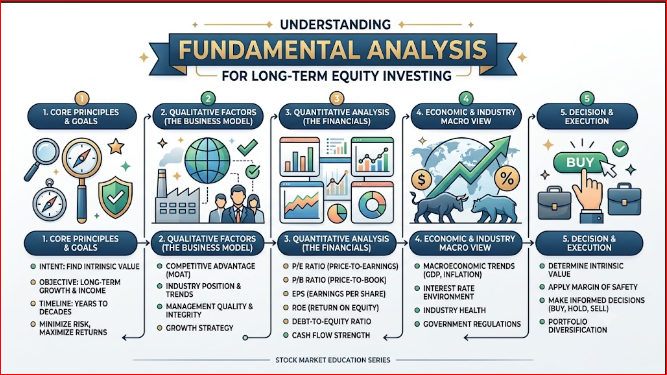
Fundamental analysis involves diving deep into a company’s financial health to determine its intrinsic value. You look closely at key financial statements, starting with the Balance Sheet to inspect assets and long-term liabilities. Next, you review the Income Statement to check revenue growth and net profit margins, followed by the Cash Flow Statement to verify if the company is generating actual cash rather than just accounting profits.
Beginners can start by calculating the Price-to-Earnings (PE) Ratio, which compares the stock price to its earnings per share, indicating whether a stock is overvalued or bargain-priced.
Technical Analysis for Beginners
Technical analysis focuses entirely on price action and market sentiment rather than corporate balances. Beginners utilize candlestick charts to track how prices move across daily or weekly intervals.
By identifying clear zones of support (where buying pressure stops a stock from falling) and resistance (where selling pressure prevents a stock from rising), you can make logical decisions about when to buy or sell an asset without letting emotions take over.
Real-World Investment Scenarios
Let’s look at two practical examples to see how these analytical frameworks operate in real-world scenarios:
- Scenario A (The Long-Term Investor): Imagine a working professional who researches an enterprise using fundamental analysis. They notice steady 15% revenue growth year-over-year, zero debt on the balance sheet, and a low PE ratio compared to its industry peers. They buy the stock and hold it for five years, shrugging off short-term market noise, and watch their wealth compound alongside the company’s real business expansion.
- Scenario B (The Swing Trader): Consider a finance student tracking a stock on a candlestick chart. They observe that whenever the stock drops to ₹500, a wave of buying enters the market (strong support zone). They buy near ₹502 with a strict defensive stop-loss order at ₹490, aiming to sell when the price moves up toward its historical resistance level of ₹550.
What Is IPO Analysis?
An Initial Public Offering (IPO) occurs when a privately owned business decides to list its shares on public stock exchanges for the very first time. This transition allows companies to raise vast amounts of capital from retail investors to fuel their future business expansion.
Conducting an IPO analysis requires a slightly different approach because the stock doesn’t have a historical public price chart. Instead, investors must review the company’s Draft Red Herring Prospectus (DRHP). You need to assess why the company is raising money, evaluate the promoters’ background, check recent revenue trends, and determine if the issue price is reasonable or overly expensive relative to listed competitors.
Common Beginner Mistakes to Avoid
- Chasing Hype and Tips: Entering trades based entirely on unchecked social media channels or casual friendly advice without performing independent stock market research.
- Ignoring Risk Management: Investing your emergency funds or borrowing money to buy highly volatile speculative stocks, exposing yourself to unexpected financial distress.
- Overtrading: Buying and selling shares continuously due to short-term panic, which racks up heavy brokerage fees and erodes your net returns.
- Failing to Diversify: Putting your entire capital into a single stock or sector, leaving your investment portfolio heavily exposed if that specific industry hits a sudden downturn.
Best Practices for New Investors
- Practice Portfolio Diversification: Spread your capital intelligently across different sectors like technology, banking, healthcare, and consumer goods to minimize industry-specific risks.
- Automate Your Investments: Use systematic investments to consistently allocate money into the market each month, helping you average out purchase costs across market cycles.
- Maintain an Emergency Fund: Keep at least six months of living expenses safely in liquid accounts before committing any long-term capital to equity markets.
- Commit to Continuous Education: Dedicate time each week to tracking economic indicators, reading financial news, and improving your overall market literacy.
Expert Tips for Market Success
- Focus on the Process, Not Just Outcomes: Develop a rule-based checklist for every investment. A well-researched thesis that results in a minor loss is far better for your growth than an impulsive gamble that happens to turn a lucky profit.
- Keep an Active Learning Journal: Document every investment decision you make. Write down exactly why you purchased a stock, your expected holding period, and the core fundamental attributes you observed. Reviewing this log after six months provides priceless personal insights.
- Start Small and Scale Slowly: Never feel pressured to deploy large amounts of capital right away. Begin with small allocations to understand how market volatility impacts your emotions, then scale up your investments as your knowledge deepens.
Strategic Market Research Tips
- Leverage Authoritative Platforms: Use official resources like the NSE and BSE websites to download authentic, unaltered financial statements, corporate announcements, and shareholding patterns.
- Track Global Economic Indicators: Monitor central bank interest rate decisions, inflation data, and gross domestic product (GDP) growth rates, as these macroeconomic trends heavily influence systemic market directions.
- Analyze Industry Competitors: Never study a company in complete isolation. Always compare its operating profit margins, debt structures, and growth rates against its top three direct industry rivals to see if it holds a genuine competitive edge.
Why Learn with Stocks Mantra?
Navigating the stock market requires a structured, distraction-free educational pathway. Stocks Mantra serves as a comprehensive, independent educational guide tailored specifically for aspiring retail investors. By prioritizing clarity, objective metrics, and practical step-by-step methodologies over speculative hype, the platform helps beginners transition into highly capable, independent analysts.
Whether you want to unpack complex corporate balance sheets, master price action chart setups, or analyze upcoming IPO opportunities, Stocks Mantra provides high-quality learning resources designed to build long-term confidence and discipline in your personal financial planning journey.
Frequently Asked Questions
What is the minimum amount needed to start stock market investing?
There is no statutory minimum capital requirement to begin investing. You can easily start your journey by purchasing a single share of a company, which could cost less than one hundred rupees. The focus should be on building a regular, disciplined investing habit rather than waiting to accumulate a large lump sum.
How can beginners pick their very first stock safely?
Beginners should focus on large-cap, market-leading companies that produce products or services used in everyday life. Look for businesses with zero debt, steady multi-year profit growth, and simple corporate structures. Conducting basic fundamental analysis using these metrics provides a protective margin of safety.
What is the difference between the NSE and BSE?
The Bombay Stock Exchange is Asia’s oldest exchange, established in 1875, and features its benchmark index called the Sensex. The National Stock Exchange was founded in 1992, introduced fully automated electronic trading to India, and features its primary benchmark index known as the Nifty 50.
Is stock trading different from stock market investing?
Yes, they are completely different paths. Stock market investing focuses on buying high-quality businesses and holding them for several years to participate in long-term corporate growth. Trading involves buying and selling assets rapidly over days or hours to profit from short-term price fluctuations.
What is a Price-to-Earnings ratio in simple terms?
The Price-to-Earnings ratio measures a company’s current share price relative to its earnings per share. It tells you exactly how much money investors are willing to pay for every single rupee of corporate profit, helping you quickly identify if a stock is overvalued or undervalued.
How does portfolio diversification protect my hard-earned capital?
Portfolio diversification involves spreading your total investment capital across multiple companies, asset classes, and distinct economic sectors. If one industry faces an unexpected economic downturn, the stable performances of your other allocations help cushion your portfolio from severe capital drawdowns.
What documents are required to open a demat account?
To open a Demat and trading account in India, you need standard identity and address proofs. This includes your PAN card, Aadhaar card, a current bank account statement with cancelled cheques, and recent passport-sized photographs to complete the mandatory electronic Know Your Customer process.
Can I lose all my money in the stock market?
While equities carry inherent market risks, losing your entire capital generally only happens if you invest in fraudulent, highly leveraged, or fundamentally bankrupt companies. By focusing on diversified investments in established large-cap companies, you significantly mitigate catastrophic capital destruction risks.
What is an IPO and how do I analyze it?
An Initial Public Offering is when a private business lists its shares publicly to raise growth capital. You analyze an IPO by reviewing its Draft Red Herring Prospectus to inspect its financial history, competitive strengths, promoter background, and intentional use of the raised funds.
How long should I hold a stock for long term wealth?
For equity compounding to truly work, a long-term investment horizon should ideally span between five to ten years. This extended timeframe allows companies to execute their business strategies, expand market share, and ride out short-term macroeconomic market cycles comfortably.
What are support and resistance zones in technical analysis?
Support is a price level where buying interest is strong enough to overcome selling pressure, stopping a stock from falling further. Resistance is a price ceiling where selling pressure overpowers buying momentum, preventing the stock price from climbing higher in the short term.
Why are quarterly corporate earnings reports so important?
Publicly listed companies must publish detailed financial results every three months. Tracking these quarterly reports allows investors to monitor real-time changes in revenues, margins, and debt levels, ensuring the company’s long-term business thesis remains completely intact.
What is dividend investing for retail users?
Dividend investing involves purchasing shares in mature, highly profitable companies that regularly distribute a portion of their earnings directly back to shareholders. This provides investors with a predictable stream of passive income alongside standard long-term capital appreciation.
How do inflation and interest rates affect stocks?
High inflation increases raw material costs for businesses, which can squeeze profit margins. When central banks raise interest rates to curb inflation, borrowing costs rise for corporations, often slowing down economic expansion and causing short-term compression in stock market valuations.
Can students and working professionals invest effectively?
Absolutely. Both groups can utilize systematic investment plans to automate their monthly contributions into selected companies or index funds. This hands-off approach removes the need to constantly monitor daily price charts, making it ideal for busy individuals.
Conclusion
Mastering the stock market requires moving away from speculative shortcuts and committing fully to structured stock market education. By understanding the core mechanics of fundamental and technical analysis, identifying common beginner mistakes, and implementing disciplined risk management practices, you lay down a rock-solid foundation for sustainable wealth creation.
Successful stock market investing for beginners is ultimately a journey of patience, consistent research, and continuous learning. Approach the market with an analytical mindset, focus on the real business metrics behind the tickers, and allow your financial knowledge to compound right along with your investment portfolio over time.
