Introduction
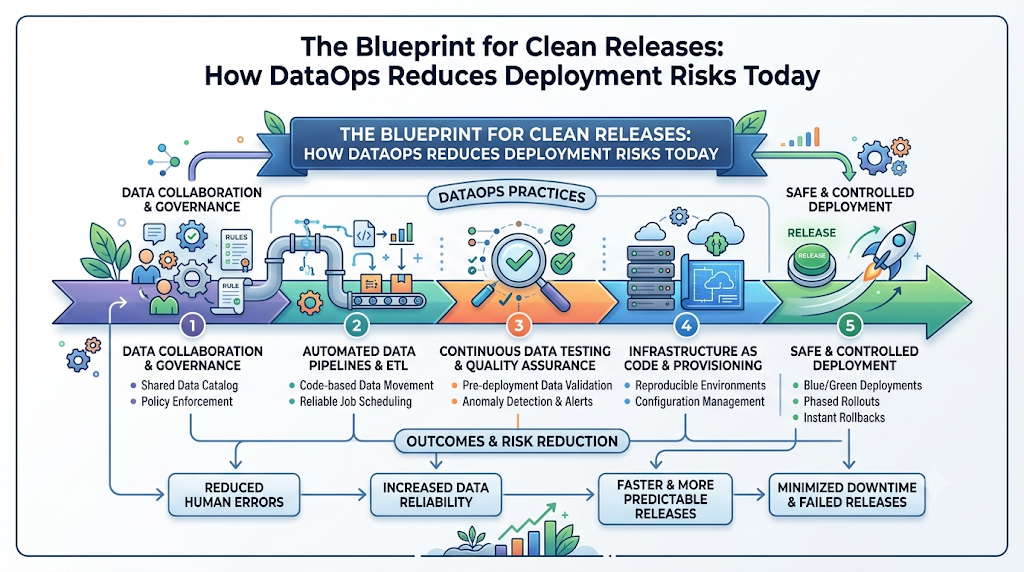
In the world of modern business intelligence and analytics, deploying software updates to data platforms can feel like walking through a minefield. When a data pipeline breaks, the consequences are immediate. Dashboards go blank, automated financial algorithms ingest corrupted data, and executive decision-making grinds to a sudden halt. Traditional software applications can occasionally tolerate minor bugs, but minor flaws in a data pipeline often result in silent data corruption that pollutes downstream warehouses for weeks before anyone notices. A single missed configuration variable can trigger catastrophic pipeline failures across production databases. Understanding How DataOps Reduces Deployment Risks is essential for any technical professional aiming to build resilient architectures. Through this educational guide provided by DataOpsSchool.com, you will learn how to transition from brittle, manual releases to automated, continuous data delivery. We will explore practical strategies for implementing automated testing, continuous integration (CI/CD for DataOps), and rollback plans that ensure production systems remain consistently stable.
What Are Deployment Risks in DataOps?
Featured Snippet Definition:
DataOps deployment risks refer to the potential failures, data corruptions, performance drops, or system outages that occur when new or updated code, schemas, and orchestrations are released into a production data environment.
These risks usually stem from unexpected differences between development and production environments, incomplete testing, and uncoordinated changes made to live databases. When a data pipeline deployment fails, the business impact can be severe. Financial institutions might generate inaccurate compliance reports, e-commerce platforms can lose track of real-time inventory levels, and customer-facing analytics apps can display completely broken metrics.
[Development Changes] ──> [Manual Release Windows] ──> [Production Environment]
                                                            │
                                                            └──> HIGH RISK: Broken Schemas,
                                                                 Stale Data, Outages
Maintaining tightly controlled deployments is vital for preserving data integrity. Without an organized framework, code changes become unpredictable experiments. Data Ops emphasizes that every code change must be treated as a potential hazard until it passes through a standardized, automated validation pipeline.
Common Deployment Risks
Data Quality Issues
When new pipeline code is deployed without adequate validation, it can inadvertently alter data types, miscalculate metrics, or drop rows. This results in corrupted tables, duplicate entries, and invalid data sets that pollute downstream business applications.
Pipeline Failures
A minor syntax error in an orchestration tool like Apache Airflow or a missing environmental variable in a dbt project can cause an entire data pipeline to crash, halting the ingestion of critical business data.
Configuration Errors
Data pipelines rely on secure connections to cloud data warehouses, API keys, and database credentials. Manually copying these configuration files across staging and production areas frequently introduces typos that cause authentication failures.
Version Conflicts
When multiple analytics engineers modify the same shared SQL models simultaneously without proper branching strategies, they risk overwriting each other’s changes, causing version conflicts that disrupt production stability.
Infrastructure Changes
Migrating an underlying compute cluster or updating a cloud data platform’s version without automated environment provisioning often introduces software incompatibilities, causing previously functional pipelines to break.
Performance Degradation
A new SQL query that runs efficiently on a small development dataset may fail completely when exposed to terabytes of production data, leading to severe resource bottlenecks and expensive cloud computing bills.
How DataOps Reduces Deployment Risks
Automated Testing
DataOps minimizes deployment anxiety by running automated testing suites before any code reaches production. Instead of relying on manual spot-checks, every pull request triggers unit tests on underlying SQL logic and data transformations.
For example, if an engineer updates a customer segmentation script, an automated CI/CD pipeline runs that script against an isolated, representative test dataset to confirm the output structure matches exact business specifications.
Continuous Integration
Continuous integration ensures that changes are continually integrated into a shared, version-controlled repository. Every code update triggers automated builds that run linting tools and validate code syntax.
[Developer Push] ──> [Automated Lint & Syntax Check] ──> [Unit Tests on Test Data] ──> [Safe Merge]
In an enterprise environment, this means a DataOps deployment pipeline automatically catches broken SQL statements or invalid YAML configurations the moment a developer attempts to merge their branch, preventing faulty code from progressing further.
Continuous Delivery
Continuous delivery automatically moves validated code through staging and production environments. By utilizing CI/CD for DataOps, teams can eliminate irregular, high-stress monthly release windows in favor of small, incremental daily updates.
[Validated Master Branch] ──> [Auto-Deploy to Staging] ──> [Integration Tests] ──> [Automated Prod Release]
A retail enterprise can safely roll out small adjustments to daily sales aggregation pipelines without taking down their entire business intelligence infrastructure.
Data Validation
Modern DataOps relies heavily on continuous data quality validation directly inside the pipeline. Tools like Great Expectations or dbt tests run checks at every stage of ingestion, transformation, and storage.
[Raw Ingestion] ──> [Data Quality Check] ──> [Transformation] ──> [Null/Type Check] ──> [Production Table]
If a streaming pipeline pulls transaction records from an external API, the data validation layer confirms that the transaction_id column contains no null values before writing to the primary analytics database.
Version Control
By tracking every pipeline configuration, transformation script, and orchestration workflow in Git, organizations establish a definitive source of truth. Version control ensures that all changes are fully auditable and peer-reviewed. If two data engineers modify the same financial transformation pipeline, Git conflict resolution workflows prevent accidental data overwrites.
Monitoring and Alerting
Once code goes live, modern DataOps infrastructures use continuous monitoring tools to track data freshness, volume anomalies, and execution durations.
If a newly deployed pipeline suddenly ingests zero rows or takes three times longer to execute than historical averages, real-time alerting systems instantly ping the on-call data operations team via Slack or PagerDuty.
Rollback Strategies
When an unforeseen issue bypasses testing safeguards, DataOps architectures enable swift, automated rollbacks. Because infrastructure is managed as code and code is tracked in Git, reverting to a stable state is simple.
[Production Outage Detected] ──> [Revert Git Commit] ──> [Automated Redeploy] ──> [System Restored]
If a schema change disrupts downstream Looker dashboards, an engineer can redeploy the previous stable version within minutes, minimizing total business downtime.
DataOpsSchool.com Guide to Safe Data Pipeline Deployments
Building a dependable data platform requires structured educational foundations. This dedicated framework from DataOpsSchool.com details how enterprise teams can achieve highly reliable, low-risk production environments.
Standardizing Deployment Processes
Uncoordinated deployment methods across different teams create operational silos. To lower risk, organizations must establish a single, unified method for all data releases. Every data artifact—whether an Airflow DAG, a Snowflake schema modification, or a Spark job—must use identical staging-to-production workflows. Standardizing this path ensures that every team member follows identical validation processes.
Improving Collaboration
Deployment risks drop significantly when data engineers, data scientists, and business stakeholders collaborate within a shared framework. DataOpsSchool.com emphasizes using clear documentation, automated notifications, and open pull requests to break down traditional operational walls. When downstream analytics users can review upcoming schema changes ahead of time, unexpected dashboard breakages decrease sharply.
Automating Validation
Manual testing cannot scale alongside modern, high-velocity data platforms. Teams must integrate data quality checks into their ingestion routines. By checking for row counts, schema drifts, and null variations automatically, you catch corrupt data before it hits production tables, shielding business teams from faulty metrics.
Increasing Deployment Reliability
Reliability is built through consistency. By replacing manual command-line updates with automated deployment software, you eliminate human error from the release process. A pipeline deployment should run exactly the same way whether it is initiated at noon on Tuesday or midnight on Sunday. This predictability gives technical teams peace of mind.
Building Scalable Data Platforms
A highly scalable data platform must scale both its compute infrastructure and its operational workflows. Adopting infrastructure as code (IaC) tools like Terraform allows organizations to provision identical, isolated sandboxes for testing. This setup guarantees that the performance metrics validated in your staging area align closely with production behavior.
Benefits of DataOps Deployment Practices
Reduced Deployment Failures
Automating validations and testing workflows catches major pipeline errors early in the delivery process, dramatically cutting down on production pipeline failures.
Faster Release Cycles
Replacing slow, manual validation procedures with automated CI/CD tools allows engineering teams to ship bug fixes and new analytics models within hours rather than weeks.
Improved Data Quality
Continuous validation barriers block corrupted, malformed, or incomplete information from reaching production warehouses, keeping downstream executive reporting highly reliable.
Better Operational Visibility
Centralized logging, real-time system alerts, and comprehensive pipeline tracing provide deep insight into the health and processing status of your entire data footprint.
Lower Business Risk
By minimizing data downtime and preventing silent data corruption, companies safeguard their daily operations, protect customer revenue, and maintain strict regulatory compliance.
Increased Team Productivity
Automating repetitive data pipeline deployment tasks frees engineers from manual firefighting, allowing them to focus on building new data products and optimizations.
Real-World Applications
Financial Services
Large banking institutions handle massive amounts of transactional data under strict regulatory oversight. Implementing enterprise DataOps ensures that any updates to risk-assessment pipelines undergo thorough syntax checking and schema validation before deployment. This automated verification shields the business from reporting compliance errors to regulatory bodies.
Healthcare
In hospital data systems, pipeline reliability directly impacts patient care metrics. DataOps architectures ensure that changes made to patient data pipelines do not interrupt real-time monitoring tools. Automated verification processes confirm that modified schemas map correctly to electronic health records without introducing null fields or data loss.
Retail
E-commerce and retail brands rely on fast data processing to handle dynamic pricing and track inventory levels. By employing data pipeline deployment best practices, retail engineers can roll out new sales analytics features during high-volume shopping events without crashing regional sales dashboards.
Manufacturing
Smart factories utilize IoT sensor feeds to monitor assembly line health. DataOps methodologies allow engineering teams to update processing algorithms smoothly without stopping the underlying ingestion streams, maintaining a steady, uninterrupted flow of factory metrics.
Telecommunications
Telecom networks process billions of structural call and data logs daily. Utilizing DataOps principles allows network engineers to deploy updated network optimization pipelines across distributed cloud platforms while maintaining consistent throughput and operational visibility.
Cloud Data Platforms
Enterprises operating across multi-cloud environments utilize DataOps to deploy portable pipelines across platforms like Snowflake, Databricks, and Google BigQuery. Centralized CI/CD code bases configure cross-platform resources automatically, eliminating manual database setup errors.
Traditional Deployments vs. DataOps Deployments
To understand how DataOps transforms operational safety, it helps to contrast traditional data management with modern DataOps practices.
| Feature | Traditional Deployment | DataOps Deployment |
| Testing | Limited, manual spot-checks after release | Automated unit and integration testing before merge |
| Validation | Manual data checking by analysts | Continuous data quality validation throughout the pipeline |
| Rollback | Difficult, manual code rewrites and migrations | Planned, repeatable, and fast Git-driven rollbacks |
| Monitoring | Basic, reactive based on user complaints | Continuous, proactive monitoring and automated alerts |
| Deployment Risk | Higher risk of downtime and silent corruption | Lower risk due to automated, isolated validations |
Common Challenges and Solutions
Legacy Systems
- Challenge: Old, on-premise data warehouses frequently lack native APIs and support for modern version control or automated provisioning tools.
- Recommendation: Wrap legacy workflows in modern containers or use orchestration tools like Apache Airflow to interact with legacy systems via secure database drivers, introducing automated testing at the interface boundary.
Data Consistency
- Challenge: Maintaining consistent state and schema configurations across development, staging, and production databases can be difficult.
- Recommendation: Utilize database migration tools to manage schema changes as versioned code files, applying identical alterations across all environments via automated steps.
Complex Dependencies
- Challenge: A single change in an upstream data source can trigger unexpected failures across numerous downstream models, tables, and dashboards.
- Recommendation: Build comprehensive data lineage maps using tools like OpenLineage or dbt, allowing engineers to visualize dependencies and run impact reviews before approving deployments.
Team Collaboration
- Challenge: Separated data engineering, data science, and business analyst teams often use conflicting tools and isolated workflows.
- Recommendation: Centralize your core development around a shared repository and adopt standardized cross-team communication channels, ensuring all groups use the same version-control framework.
Tool Integration
- Challenge: Stitching together distinct tools for orchestration, ingestion, storage, and monitoring into a single unified pipeline can be complex.
- Recommendation: Prioritize open-source standards and extensible tools that offer native integrations, keeping your CI/CD architecture clean and manageable.
Best Practices for Low-Risk Deployments
- Automate deployment workflows: Eliminate manual command-line execution by routing every production code change through an automated CI/CD pipeline.
- Validate data before release: Deploy data validation rules to verify that new code treats incoming production metrics correctly without generating corrupt tables.
- Use version control consistently: Keep all database transformations, infrastructure definitions, and scheduling configurations secured inside a shared Git repository.
- Monitor deployments continuously: Implement real-time monitoring and alerting frameworks to track performance metrics and pipeline health directly after every release.
- Maintain rollback plans: Ensure that every schema change or code adjustment can be reverted swiftly via automated rollbacks if production errors surface.
Key Performance Metrics
Tracking specific operational metrics allows teams to evaluate the health, efficiency, and stability of their data platform deployments.
- Deployment Success Rate: The percentage of code releases that move into production smoothly without causing system downtime or data anomalies.
- Change Failure Rate: The proportion of production deployments that require immediate hotfixes, patches, or rollbacks after going live.
- Mean Time to Recovery (MTTR): The average time it takes for your data operations team to restore a broken pipeline to full functionality after an outage occurs.
- Pipeline Reliability: The percentage of time that data ingestions and transformations run successfully within their scheduled windows.
- Data Quality Score: A metric derived from automated testing that evaluates accuracy, completeness, and formatting consistency across tables.
- Deployment Frequency: How often your engineering team safely pushes code updates, new analytics models, or pipeline enhancements to production.
Career Opportunities
As organizations prioritize data reliability, professionals skilled in deployment automation are seeing significant demand across the industry.
- DataOps Engineer: Focuses on building, maintaining, and optimizing CI/CD systems, automated data testing configurations, and deployment infrastructure.
- Data Engineer: Builds data pipelines and transforms raw elements into structured data sets, utilizing version control and automated validation strategies daily.
- Analytics Engineer: Sits between engineering and business teams, writing clean, well-tested SQL code to power corporate dashboards while following DataOps practices.
- DevOps Engineer: Specializes in cloud infrastructure provisioning, container management, and continuous delivery pipelines, frequently supporting data platform teams.
- Cloud Data Engineer: Designs and manages highly scalable data architectures directly inside cloud ecosystems, utilizing automation to deploy infrastructure safely.
- Data Platform Architect: Designs the overarching blueprint for enterprise data platforms, selecting tools that ensure long-term scalability, data governance, and secure deployments.
Future of DataOps Deployments
AI-Assisted Deployments
Machine learning models will increasingly assist engineers by scanning incoming code changes for hidden syntax errors, security vulnerabilities, or inefficient patterns before release.
Autonomous Data Pipelines
Future data environments will automatically adapt to upstream schema changes, dynamically reconfiguring pipeline components to prevent unexpected data ingestion failures.
Intelligent Deployment Validation
Testing suites will use historical metadata to dynamically generate tailored test cases, targeting parts of the data model most vulnerable to code changes.
Self-Healing Data Workflows
When a production data pipeline encounters a failure, self-healing mechanisms will isolate the problematic rows, spin up backup clusters, and retry jobs without requiring manual human intervention.
Predictive Deployment Analytics
Deployment software will analyze historical code release patterns to calculate a risk probability score for upcoming changes, warning teams before risky updates go live.
Common Misconceptions
Misconception: Automation Eliminates All Deployment Risks
Reality: Automation dramatically lowers human error, but if you write flawed tests or input broken code, your automated framework will simply deploy those mistakes faster.
Misconception: DataOps Is Only About Automation
Reality: While automation is crucial, DataOps is equally focused on culture, communication, and standardizing workflows across data engineers, analysts, and business consumers.
Misconception: Small Teams Do Not Need DataOps
Reality: Small teams often benefit the most from DataOps practices. Automating validation steps saves limited engineering time, allowing small teams to focus on core product development instead of manual troubleshooting.
Misconception: Deployment Ends After Release
Reality: Pushing code live is only the first step. True DataOps requires continuous, post-release monitoring to ensure pipelines handle live production traffic reliably over time.
FAQ Section
- What is the main goal of DataOps?The core purpose of DataOps is to improve data quality, accelerate release cycles, and reduce deployment risks by combining automated testing, continuous integration, and collaborative workflows across data teams.
- How does automated testing protect production pipelines?Automated testing screens your code updates for syntax mistakes and schema errors before they are merged, catching bugs early so you don’t break downstream tables.
- Can DataOps prevent all pipeline failures?No methodology can eliminate every single unexpected error, but DataOps minimizes their impact by identifying issues quickly through continuous monitoring and enabling rapid rollbacks to stable states.
- Why is version control important for data pipelines?Version control establishes a reliable history for your entire code base, allowing teams to track changes, review updates collectively, and revert to earlier configurations if a bug slips through.
- What is data lineage and why should I care?Data lineage maps the flow of information from raw sources down to finished dashboards, helping engineers see exactly how an upstream schema change might impact downstream tables before deploying code.
- How often should teams deploy pipeline updates with DataOps?DataOps encourages small, incremental updates pushed daily or even multiple times a day, which reduces the complexity and risk associated with large, infrequent monthly releases.
- Do we need specialized tools to start implementing DataOps?You can begin implementing DataOps principles using your existing data stack by integrating standard version control tools like Git and setting up basic, automated testing routines around your transformations.
- What is the difference between DevOps and DataOps?DevOps focuses on optimizing software application development and infrastructure stability, while DataOps adapts those principles to manage data quality, schema evolution, and continuous pipeline orchestration.
- How do rollback strategies work in a data environment?When a production bug is discovered, a rollback allows you to quickly redeploy the previous stable version of your code from Git, minimizing overall system downtime while you troubleshoot.
- Where can I learn more about enterprise DataOps best practices?You can find comprehensive training modules, detailed tutorials, and structured learning tracks on modern data engineering workflows by visiting DataOpsSchool.com.
Final Summary
Managing data platforms without structured operational guardrails introduces significant risks to data quality and system uptime. Manual deployment methods frequently lead to unexpected pipeline failures, schema conflicts, and unreliable metrics that can distort critical business insights. Implementing a solid DataOps framework provides the automation, continuous validation, and robust monitoring needed to make data delivery safe and predictable. Standardizing release workflows and embedding automated data quality validation directly into your deployment pipelines helps shield production data systems from unexpected errors. This discipline allows data teams to scale effortlessly, roll out updates with confidence, and maintain highly dependable data environments. Aspiring professionals and enterprise teams looking to master these methodologies can access comprehensive learning resources at DataOpsSchool.com to build the practical skills required for modern data engineering.
