Introduction
Modern data operations move at an incredible pace. Organizations ingest billions of data points every day from disparate sources, processing them in real time to fuel business dashboards, machine learning models, and executive decisions. However, speed without control leads to chaos. When a data pipeline breaks silently or ingested data contains corrupted schemas, downstream business decisions suffer immediately. This is why continuous feedback is no longer optional for modern data teams; it is a fundamental survival mechanism. To help data professionals master these automated workflows, learning platforms like DataOpsSchool.com provide structured training designed to bridge the gap between traditional data engineering and modern, automated operations. Building a culture of reliable data delivery requires an understanding of how automated signals loop back into your development and operational processes.
What Are Feedback Loops in DataOps?
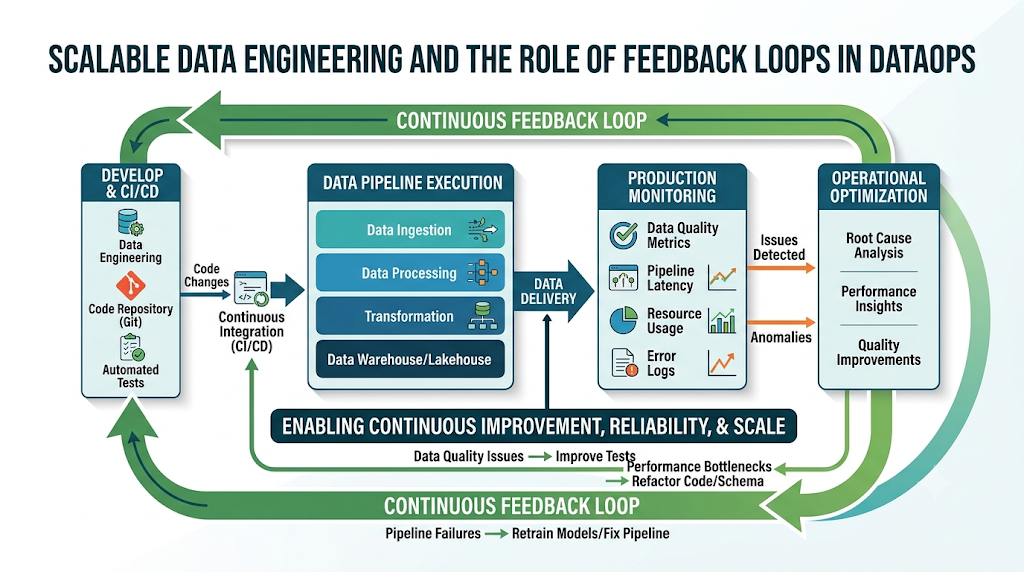
In DataOps, a feedback loop is an automated or structural mechanism that captures output data from a pipeline, analyzes it against pre-defined expectations, and routes those insights back to developers, operators, or upstream systems to trigger corrective actions or optimizations.
[ Data Sources ] ---> [ Pipeline Processing ] ---> [ Data Output ]
                             |                           |
                             v                           v
                     [ Data Validation ]       [ Performance Metrics ]
                             |                           |
                             +------------> <------------+
                                          |
                                          v
                                 [ Feedback Loop ]
                                          |
                                          v
                        [ Automated Alerts / CI/CD Action ]
                                          |
                                          v
                             ( Continuous Improvement )
The fundamental purpose of a feedback loop is to eliminate guesswork. Instead of assuming a data pipeline is running perfectly, feedback systems provide objective, real-time telemetry regarding data health, infrastructure performance, and delivery velocity.
This concept is tightly woven into the fabric of continuous improvement. Just as software development relies on continuous integration and continuous deployment (CI/CD) to test and deploy code safely, DataOps uses feedback loops to monitor both the code (SQL, Python, dbt models) and the data flowing through that code. When a feedback loop detects a drop in data quality or a spike in pipeline latency, it instantly notifies the responsible team or triggers an automated rollback, ensuring the system evolves and improves over time.
Core Components of DataOps Feedback Loops
An effective feedback system relies on six core components working in harmony:
Monitoring
Monitoring provides the eyes and ears of your infrastructure. It continuously tracks the state of cloud data warehouses, orchestration engines (like Apache Airflow or Prefect), and ingestion tools. Monitoring answers whether the systems are online, processing data, and running within expected time frames.
Data Validation
Data validation focuses on the integrity of the information itself. This component uses automated testing frameworks (such as Great Expectations, dbt tests, or Soda) to verify data against strict business rules. It checks for null values, schema drift, incorrect data types, and out-of-bounds metrics at every stage of the pipeline.
Performance Metrics
Performance metrics collect operational metadata over time. This includes tracking execution durations, compute resource consumption, storage growth, and cost metrics. Analyzing these metrics helps data architects spot gradual performance degradation before it results in a total system outage.
Automated Alerts
When validation or monitoring systems detect an anomaly, automated alerts act as the routing mechanism. Instead of broad email blasts, intelligent alerting sends specific, actionable notifications to communication channels like Slack, Microsoft Teams, or incident response platforms like PagerDuty, ensuring the right engineer receives the correct context immediately.
Team Collaboration
Feedback loops are useless if teams operate in isolation. This component ensures that data engineers, analytics engineers, data scientists, and business stakeholders share visibility into pipeline health. Shared dashboards and integrated issue tracking (like Jira or GitHub Issues) turn technical alerts into collaborative resolution workflows.
Continuous Optimization
The final phase of the loop uses historical feedback to drive structural changes. If a specific data source repeatedly triggers validation failures due to schema updates, the continuous optimization component prompts the engineering team to refactor the ingestion layout or implement programmatic schema evolution.
The Role of Feedback Loops in DataOps
To understand how these components manifest in an enterprise environment, let us look at the specific operational roles feedback loops perform across your data estate.
Improving Data Quality
Feedback loops serve as the primary defense mechanism against bad data. Consider an enterprise e-commerce platform ingesting transactional records. A feedback loop configured with schema validation rules checks incoming JSON objects from the web application. If a software update changes a price field from a float (99.99) to a string ("$99.99"), the feedback loop catches this discrepancy at the ingestion gate, isolates the bad records into a dead-letter queue, and alerts the engineering team before the erroneous rows corrupt the main data warehouse.
Detecting Pipeline Issues Early
By placing automated validation checkpoints throughout analytics workflows, you achieve shift-left observability. For example, in a daily financial reconciliation pipeline, a validation step can count input rows versus output rows after an extract-transform-load (ETL) run. If a transformation step drops 30% of the rows due to an unhandled join condition, the loop flags the variance immediately, preventing incomplete financial metrics from surfacing on executive dashboards.
Optimizing Workflow Performance
Enterprise data pipelines often process terabytes of data across cloud warehouses like Snowflake, BigQuery, or Databricks. A performance feedback loop tracks query runtime and slot/credit consumption. If a dbt model that normally takes 10 minutes to execute suddenly takes 2 hours due to an inefficient cross-join, the feedback system captures this spike and flags the model for optimization, saving the organization thousands of dollars in compute costs.
Supporting Continuous Delivery
When data engineers modify pipeline code, they must be confident that their changes will not break production. In a mature DataOps ecosystem, CI/CD for DataOps heavily leverages feedback loops. When an engineer opens a pull request, an automated workflow spins up an isolated, temporary environment, runs the new code against a production-like data sample, executes tests, and feeds the results directly back into the pull request chat. The code can only be merged if all feedback metrics pass cleanly.
Enhancing Team Collaboration
Feedback loops align data producers and data consumers. When a downstream dashboard breaks because an upstream data provider changed a database column, a collaborative feedback loop automatically tags both the data source owner and the BI analyst in an incident ticket. This transparent routing eliminates finger-pointing and speeds up the root-cause analysis.
Driving Continuous Improvement
Over time, the metadata generated by feedback loops uncovers systemic bottlenecks. For instance, if data quality logs show that a third-party marketing API delivers incomplete attribution data every Monday morning, the data team can use this recurring feedback to redesign the pipeline, building an automated retry mechanism specifically tuned for Monday ingestions.
Increasing Deployment Reliability
By ensuring that every change goes through rigorous automated validation checkpoints, teams can deploy code multiple times a day. If a deployed pipeline exhibits unexpected behaviors post-merge, automated canary testing feeds this performance failure back to the orchestration engine, executing an instant rollback to the last known stable code version.
DataOpsSchool.com Guide to Feedback Loops in DataOps
Building an enterprise-ready feedback system requires a strategic approach. This guide provides a foundational blueprint for implementing these concepts in production.
Building Reliable Data Pipelines
To establish structural reliability, you must treat data pipelines as manufacturing lines. Implement a “write-test-deliver” paradigm rather than “write-deliver-pray.”
- Use automated tools to test your data at rest and data in motion.
- Isolate development, staging, and production environments entirely.
- Program pipelines to fail fast and fail safely, halting execution before corrupted data can overwrite historical master records.
Strengthening Monitoring Practices
Monitoring must extend beyond simple “up or down” infrastructure pings. Effective DataOps pipeline monitoring focuses on data observability. You need to capture:
- Freshness: Is the data arriving on time?
- Volume: Did you receive the expected number of rows?
- Schema: Have columns been added, removed, or changed?
- Distribution: Are the averages, minimums, and maximums of your metrics within normal variance bands?
Improving Collaboration
Break down walls between analytics engineers and DevOps specialists by standardizing your toolchain. Store pipeline definitions, transformation logic, and data quality tests in a centralized git repository. When a data validation rule fails, generate an automated ticket containing the exact failing query, the affected tables, and the owner of the source code, allowing any engineer on call to troubleshoot the problem without hunting through log files.
Reducing Operational Risks
Mitigate risk by implementing circuit breakers within your orchestration workflows. If a critical upstream table fails its data quality check, the circuit breaker prevents downstream tables from running. This minimizes the blast radius of data anomalies, ensuring that while some dashboards might show delayed data, they will never show incorrect data.
Scaling Enterprise Data Platforms
As your data volume scales from gigabytes to petabytes, human-driven code reviews and manual schema checks become impossible bottlenecks. Scaling enterprise DataOps demands completely automated feedback loops. Leverage infrastructure-as-code (IaC) to provision testing sandboxes programmatically and deploy metadata-driven pipelines that read incoming data schemas and adapt dynamically, passing validation metrics up to centralized corporate governance dashboards.
Real-World Applications
Financial Analytics
In algorithmic trading and retail banking, transactional data must be perfect. A major bank uses feedback loops to monitor credit card transaction streams. If a streaming pipeline detects an unmapped merchant category code, the feedback loop isolates those specific records, alerts the core banking team, and routes the remaining valid transactions to fraud-detection models without pausing the entire financial stream.
Healthcare Data Platforms
Patient care systems aggregate data from electronic health records (EHR), wearables, and lab systems. Healthcare data platforms implement feedback loops to ensure compliance and patient safety. If an ingestion pipeline receives a patient record missing a required cryptographic identifier or containing an impossible vital statistic (e.g., negative heart rate), the validation loop intercepts the payload, flags it for compliance review, and logs the incident for auditing purposes.
Retail Analytics
An international omni-channel retailer tracks inventory levels across thousands of physical stores and online warehouses. Their analytics workflows incorporate feedback loops that cross-reference point-of-sale data with logistics logs. If inventory drops rapidly without a matching sales event, the performance loop highlights the data disparity, prompting automated stock verifications to prevent supply chain disruption.
Manufacturing Data Systems
Industrial IoT setups capture thousands of sensor readings per second from factory floors. Feedback loops in these manufacturing platforms evaluate the frequency and completeness of incoming MQTT messages. If a critical assembly line machine stops emitting telemetry, the monitoring feedback loop instantly informs site reliability engineers, allowing them to fix the sensor before the machine overheats or undergoes unplanned downtime.
Telecommunications
Telecom operators process call detail records (CDRs) for billing and network optimization. Using DataOps feedback loops, they track data pipeline latency in real time. If network congestion delays the ingestion of CDR files by more than five minutes, the automated feedback system reallocates cloud compute nodes dynamically, speeding up processing times to ensure accurate real-time customer data balances.
Cloud-Based Analytics
Modern SaaS platforms run heavy analytical transformations in the cloud to provide customer-facing usage metrics. By deploying continuous feedback loops within their cloud data warehouses, these platforms track the exact dollar cost of every query run by their analytics workflows. If a new dashboard variant begins executing unindexed queries that double daily hosting expenditures, the loop flags the query pattern to the engineering team for fast optimization.
Benefits of Feedback Loops
Implementing structured data loops offers several direct advantages to data-driven organizations:
- Better Data Quality: Automated checks ensure only clean, accurate, and structured data enters production environments.
- Faster Issue Detection: Teams discover bugs, schema drift, and ingestion failures seconds after they occur, rather than weeks later.
- Reduced Downtime: Quick alerting and automated rollbacks prevent prolonged pipeline outages and data gaps.
- Improved Operational Efficiency: Engineers spend less time manually auditing tables and chasing bugs, freeing them up to build new features.
- Higher Deployment Success: CI/CD frameworks validated by feedback ensure production code changes are safe and predictable.
- Better Decision-Making: Business leaders can confidently rely on executive dashboards, knowing that the underlying data is fresh and verified.
Traditional Data Workflows vs. DataOps Feedback Loops
The shift from traditional data processing architectures to a modern DataOps framework changes how operational telemetry is handled.
| Feature | Traditional Workflow | DataOps Feedback Loops |
| Monitoring | Limited to basic infrastructure infrastructure checks (e.g., system up/down). | Continuous data observability, metadata tracking, and lineage visibility. |
| Issue Detection | Reactive; relies on business end-users finding broken metrics on dashboards. | Proactive; automated alerting detects anomalies before data delivery. |
| Data Validation | Manual, occasional spot-checks or handled via brittle database constraints. | Automated testing integrated directly into every pipeline step. |
| Collaboration | Periodic, siloed communication via manual emails and ad-hoc meetings. | Continuous, integrated toolchains linking engineers, operators, and analysts. |
| Improvement | Occasional, reactive fixes applied after major system failures or yearly audits. | Continuous optimization driven by ongoing metadata analysis and CI/CD. |
Common Challenges and Solutions
While the benefits are clear, building these automated networks comes with certain practical challenges.
Tool Integration
- The Challenge: Enterprise data stacks are often fragmented, combining legacy on-premise databases, modern cloud warehouses, various orchestrators, and diverse BI layers. Making these tools talk to one another to form a single feedback loop can be difficult.
- The Recommendation: Adopt open metadata standards and tools that expose clear API endpoints. Use unified orchestration layers (like Airflow or Prefect) alongside data observability tools that integrate natively into your entire modern data stack.
Alert Fatigue
- The Challenge: If validation checks are tuned too loosely or too strictly, they can flood engineering teams with hundreds of Slack alerts a day. Eventually, engineers start ignoring notifications, leading to critical failures slipping through unnoticed.
- The Recommendation: Classify alerts by severity. Minor variations should log warnings to a central dashboard, while critical pipeline failures that halt downstream delivery should trigger high-priority paging alerts. Regularly audit and tune your validation rules.
Legacy Systems
- The Challenge: Older databases and mainframes often lack the capability to output performance logs or handle automated schema tests efficiently.
- The Recommendation: Wrap legacy systems in an extraction layer. Use modern data ingestion tools to stream legacy data into a cloud landing zone where automated feedback validation can be safely applied before processing.
Large Data Volumes
- The Challenge: Running comprehensive data quality tests over multi-billion row tables can significantly slow down pipeline execution and increase compute expenses.
- The Recommendation: Avoid scanning entire historical tables. Configure your validation loops to run tests primarily on incremental data deltas (newly arrived data) and use statistical sampling methods for larger datasets.
Team Coordination
- The Challenge: Creating feedback loops requires collaboration between software developers, data engineers, and business users. Cultural silos can prevent these groups from aligning on data rules.
- The Recommendation: Establish shared data contracts. Clearly define ownership of data assets and document metrics definitions in a centralized data catalog accessible to both technical and business stakeholders.
Best Practices for Implementation
To maximize your returns when implementing feedback networks, keep these core best practices in mind:
- Automate monitoring wherever possible: Manual checks will eventually fail due to human oversight. Ensure every new data pipeline deployment automatically registers its monitoring rules with your observability platform.
- Track meaningful performance metrics: Focus on indicators that drive business value and team efficiency, such as pipeline latency, cost per query, data freshness, and test pass rates.
- Encourage cross-functional collaboration: Bring data engineers, analysts, and business stakeholders together to define what “high-quality data” means for your specific organizational requirements.
- Continuously validate data quality: Run validation checks at every major boundary of your data journey: at ingestion, after heavy transformations, and right before delivering data to downstream applications.
- Review and improve feedback processes regularly: Treat your feedback loops as software. Schedule regular reviews to retire outdated alerts, optimize test logic, and adjust thresholds as data volumes grow.
Key Performance Metrics
To judge whether your feedback mechanisms are successful, you should measure and optimize these six vital industry metrics:
Pipeline Success Rate
The percentage of total pipeline runs that complete successfully without errors or manual interventions. Aim for a consistently high percentage as your automation matures.
Data Quality Score
A metric calculating the ratio of records that pass all validation checks against the total volume of processed records. Tracking this helps teams spot systemic shifts in source data integrity.
Mean Time to Detect (MTTD)
The average time it takes from the moment a data anomaly or pipeline failure occurs until the team or system is alerted. Automated feedback loops should drive this metric from days or hours down to minutes.
Mean Time to Recovery (MTTR)
The average time required for your engineering team to fix an outage, resolve a data quality failure, and resume normal pipeline operations after an alert is issued.
Pipeline Latency
The total duration it takes for raw data to travel from its initial source endpoint through your ingestion and transformation systems until it is ready for consumption.
Deployment Frequency
How often your data engineering team safely deploys code changes, bug fixes, or new data models to your production environment. High deployment frequency indicates a highly reliable testing loop.
Career Opportunities
The growth of enterprise DataOps has created substantial demand for professionals who understand how to design, maintain, and optimize these automated feedback networks.
- DataOps Engineer: Specializes in building the CI/CD pipelines, automated testing suites, and observability frameworks that keep data infrastructures running reliably.
- Data Engineer: Constructs the core data delivery pipelines, implementing automated validation checkpoints and performance tuning parameters directly within data flows.
- Analytics Engineer: Sits between engineering and business, writing clean, well-tested data transformation models and integrating quality checks into semantic layers.
- Cloud Data Engineer: Focuses on provisioning cloud infrastructure, optimizing compute utilization, and ensuring that storage patterns scale alongside feedback requirements.
- Platform Engineer: Builds internal tools and infrastructure platforms that allow decentralized data teams to self-serve pipelines with built-in monitoring templates.
- Data Platform Architect: Designs the high-level technical blueprint for the organization’s entire data ecosystem, selecting standard tools and establishing enterprise governance protocols.
Future of Feedback Loops in DataOps
As modern data ecosystems continue to evolve, the feedback architectures powering them are becoming increasingly intelligent.
AI-Assisted Monitoring
Instead of relying on human engineers to write static data validation rules, machine learning models will automatically analyze historical metadata profiles to learn what constitutes normal data behavior, flag anomalies without manual configuration, and reduce setup friction.
Predictive Analytics
Future platforms will use performance trends to anticipate failures before they occur. For example, a predictive feedback system could analyze steady growth in storage metrics and warn a data team that a storage partition will run out of space in three days, allowing for proactive adjustments.
Autonomous Data Pipelines
We are moving toward self-contained workflows that can dynamically adapt to incoming changes. If an upstream system adjusts its data format, an autonomous pipeline will dynamically adjust its transformation schema without failing execution or requiring engineering intervention.
Intelligent Alerting
By applying natural language processing and advanced grouping algorithms, alerting engines will combine dozens of separate pipeline warnings into a single, cohesive incident summary, pinpointing the specific root cause and drastically reducing noise.
Self-Healing Data Platforms
When a minor validation check fails—such as a missing column or an out-of-bounds value—self-healing architectures will automatically execute predefined remediation paths, such as querying an alternative backup endpoint or applying intelligent defaults, ensuring uninterrupted delivery.
Common Misconceptions
Feedback Loops Are Only About Monitoring
Monitoring is just one piece of the puzzle. While monitoring tells you if a system is broken, a comprehensive feedback loop goes further by validating the data itself, routing metrics back to development pipelines, and driving long-term structural codebase upgrades.
Automation Eliminates Human Input
Automation handles the repetitive, fast-paced tasks of detecting and isolating errors. However, human engineers are still absolutely vital for defining initial business criteria, interpreting complex systemic trends, and designing architectural fixes.
Feedback Is Only Needed After Deployment
Feedback is equally critical during the early development and pre-deployment phases. Running automated feedback tests on local branches and staging environments stops bugs from ever reaching production code in the first place.
Small Teams Do Not Need Feedback Loops
Small teams actually benefit immensely from automated loops. When engineering resources are limited, you cannot afford to waste valuable hours manually hunting down silent data errors or auditing tables. Automation acts as a force multiplier for small teams.
FAQ Section
1. What is the main difference between monitoring and a feedback loop in DataOps?
Monitoring is a one-way system that observes and logs the current status of an application or data pipeline. A feedback loop takes that monitored information, analyzes it against rules or history, and routes that actionable data back into the system or to the development team to trigger a change or an optimization.
2. How do feedback loops help improve data quality?
They improve quality by introducing automated validation checks at every phase of the pipeline. If data fails a check (such as containing null values or wrong formats), the loop isolates that data and alerts engineers immediately, keeping bad data out of production systems.
3. Can I build DataOps feedback loops using my existing data engineering tools?
Yes, you can build effective feedback setups using popular modern tools. Orchestrators like Apache Airflow manage execution paths, transformation tools like dbt run data quality checks, and communication tools like Slack route the resulting alerts directly to your on-call teams.
4. What is alert fatigue, and how do I prevent it?
Alert fatigue happens when data systems send too many low-priority or false alarms, causing engineers to ignore notifications. You can prevent this by clearly defining alert severities, routing non-critical warnings to dashboards, and keeping critical alerts reserved for absolute pipeline failures.
5. How do feedback loops support continuous integration and continuous deployment (CI/CD)?
In CI/CD, feedback loops automatically run a suite of data tests whenever an engineer proposes a code change. The loop provides instant feedback on whether the new code breaks data quality standards, ensuring only safe changes get merged into your master branch.
6. What is a data contract, and how does it fit into feedback loops?
A data contract is an agreement between data producers and data consumers defining the expected schema, quality rules, and SLA of a dataset. Feedback loops automatically enforce these contracts by checking incoming data against the agreed rules and flagging violations.
7. How do I measure the success of my feedback loop system?
You can measure success by tracking specific metrics like Mean Time to Detect (MTTD), which should go down, and your overall Data Quality Score and Pipeline Success Rate, both of which should steadily go up as automation handles errors.
8. Do feedback loops increase the computing costs of running cloud warehouses?
Running data tests does consume compute power, which can increase costs if unoptimized. You can minimize this by testing incremental data updates instead of entire tables, and by choosing high-priority checkpoints rather than testing every single column.
9. What is shift-left testing in DataOps?
Shift-left testing means moving validation checks as close to the beginning of the data journey as possible. By testing code during development and testing data at the ingestion stage, you catch and fix errors before they cause downstream issues.
10. How can a beginner start learning about implementing these DataOps concepts?
Beginners can start by learning foundational tools like Git, SQL, and Docker, and then exploring specialized training resources. Platforms like DataOpsSchool.com offer structured learning paths that teach you how to design automated, reliable enterprise data pipelines.
Final Summary
The modern enterprise runs on data, and the speed at which that data is processed continues to grow exponentially. However, high-speed delivery means very little if the underlying data lacks accuracy, consistency, and structural reliability. The role of feedback loops in DataOps is to provide the automated guardrails that make rapid data development and operations safe at scale. By combining proactive monitoring, automated data validation, and real-time alerting, feedback loops transform data pipelines from fragile black boxes into transparent, self-optimizing engines of continuous improvement.
